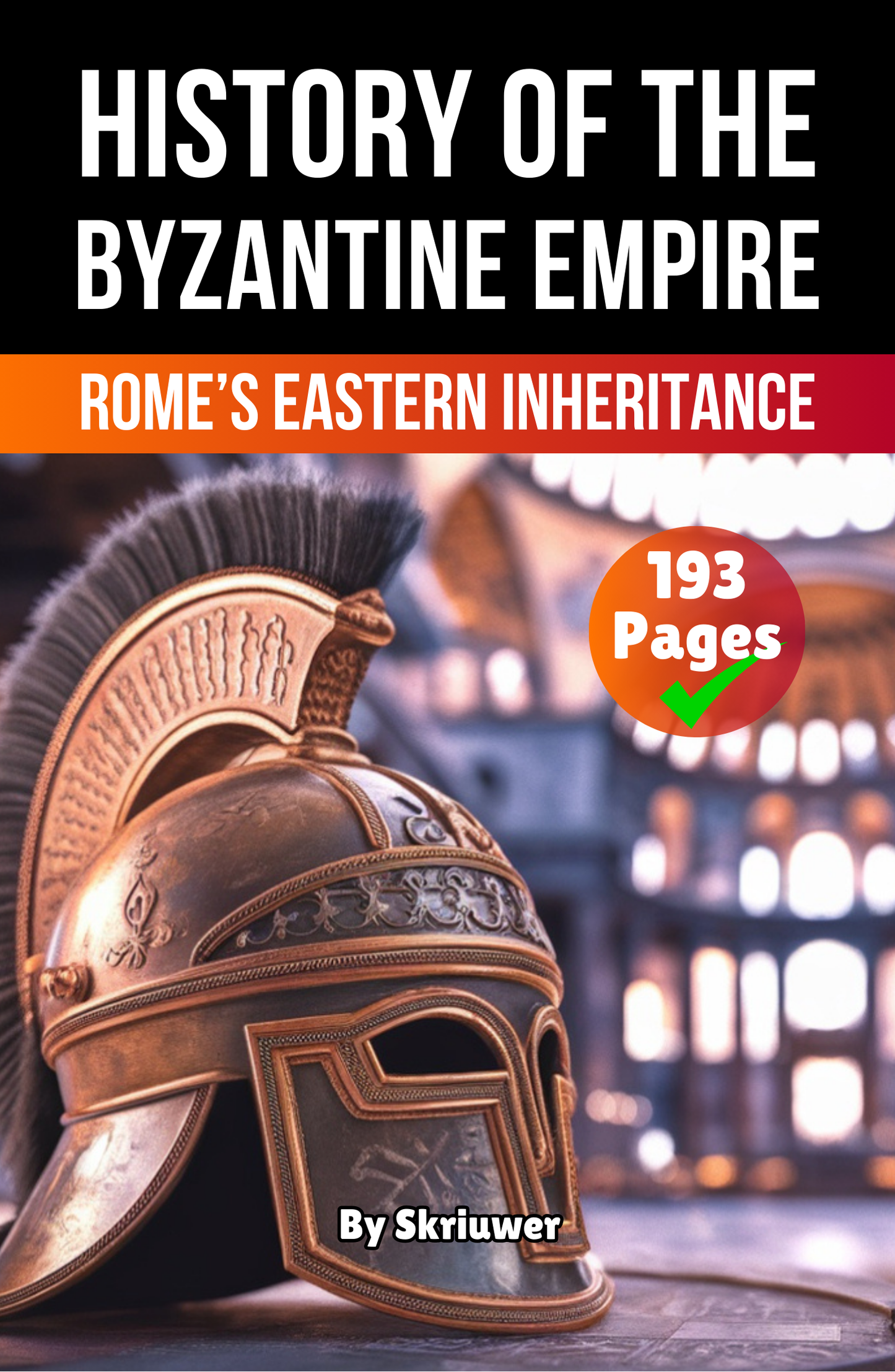
The History of Byzantine Empire: Rome’s Eastern Inheritance | Paperback Book
Couldn't load pickup availability
This book provides an overview of the Byzantine Empire's history, spanning approximately 1,000 years from its founding to 1453. It discusses political, military, religious, and cultural developments in the Eastern Roman Empire.
Key Topics Covered:
- Founding and Early Period: Constantine's establishment of Constantinople and early challenges.
- Military Innovations: Use of Greek fire in defense.
- Religious Conflicts: Iconoclasm debates and their impacts.
- Key Figures: Rulers like Justinian, Basil II, and interactions with eunuchs in court.
- Later Events: The Fourth Crusade and its consequences.
Reader Feedback Example: "This book covers emperors, military events, and court dynamics." — Marcus P. (Verified Purchase)
Book Features:
- Comprehensive Coverage: Explores major periods and events.
- Intended Audience: Suitable for those interested in medieval and Eastern Roman history.
TABLE OF CONTENTS
CHAPTER 1: INTRODUCTION TO BYZANTIUM
- Foundations of the Eastern Roman Empire
- Geographical and Cultural Roots
- Importance of Constantinople’s Strategic Location
CHAPTER 2: CONSTANTINE THE GREAT AND THE FOUNDING OF CONSTANTINOPLE
- Rise of Constantine and His Embrace of Christianity
- Establishment of Constantinople as “New Rome”
- The Edict of Milan and Its Impact
CHAPTER 3: THE REIGN OF THEODOSIUS I
- Christianity Becomes the Empire’s Official Religion
- Dealing with Goths and Internal Challenges
- The Final Division Between East and West
CHAPTER 4: THE BEGINNINGS OF CHRISTIAN BYZANTIUM
- Early Church Organization and Hierarchy
- Monasticism’s Roots and Growth
- Merging Roman Traditions with Christian Faith
CHAPTER 5: THE AGE OF JUSTINIAN I
- Ambitious Conquests and Expansion of Imperial Borders
- Legal Reforms: The Corpus Juris Civilis
- Hagia Sophia and the Grandeur of Byzantine Architecture
CHAPTER 6: THE AFTERMATH OF JUSTINIAN’S REIGN
- Economic Strains and Military Overextension
- Recovering from Plagues and Continuous Warfare
- Transition Toward Defensive Strategies
CHAPTER 7: THE RISE OF HERACLIUS AND THE EARLY ISLAMIC CONQUESTS
- Overthrowing Phocas and Restoring Imperial Control
- Battles Against the Persians and Triumph of Heraclius
- Emergence of Islam and Rapid Territorial Losses
CHAPTER 8: ICONOCLASM AND THE TRIUMPH OF ORTHODOXY
- Debate over Religious Images and Their Legitimacy
- Imperial Policies Destroying Icons, Then Restoring Them
- Lasting Impact on Doctrine and Church Unity
CHAPTER 9: THE MACEDONIAN DYNASTY AND THE REVIVAL OF POWER
- Reforms of Basil I and Strengthening of the Legal System
- Cultural Renaissance in Art and Literature
- Military Campaigns Securing Imperial Borders
CHAPTER 10: THE TIME OF BASIL II
- Conquest of Bulgaria and the “Bulgar Slayer” Title
- Fiscal Discipline and Centralized Authority
- Influential Alliances with Kievan Rus’
CHAPTER 11: THE KOMNENIAN DYNASTY AND THE CRUSADES
- Alexios I’s Diplomatic Ties to the First Crusade
- John II and Manuel I’s Efforts to Stabilize the Empire
- Complex Relations with Western Knights and Muslim Powers
CHAPTER 12: THE FOURTH CRUSADE AND THE LATIN EMPIRE
- Detour of Crusaders to Constantinople and Its Sack
- Establishment of the Latin Empire in 1204
- Greek Successor States (Nicaea, Epirus, Trebizond)
CHAPTER 13: THE PALAIOLOGOS DYNASTY AND THE RESTORATION OF THE EMPIRE
- Michael VIII Recaptures Constantinople in 1261
- Struggles Against Internal Conflicts and Foreign Enemies
- Final Phase of Byzantine Sovereignty
CHAPTER 14: THREATS FROM THE OTTOMANS
- Ottoman Rise from a Small Beylik to a Major Power
- Sieges of Constantinople and Territorial Encirclement
- Sultans’ Diplomacy and Military Innovation
CHAPTER 15: THE FALL OF CONSTANTINOPLE
- Final Siege by Mehmed II in 1453
- Heroic Defense by Constantine XI Palaiologos
- End of the Byzantine Empire and Aftermath
CHAPTER 16: LIFE, CULTURE, AND SOCIETY IN BYZANTIUM
- Social Classes, Family Structures, and Gender Roles
- Economy, Education, and Daily Routines
- Orthodox Worship and Community Life
CHAPTER 17: BYZANTINE ART AND ARCHITECTURE
- Evolution of Mosaics, Frescoes, and Icons
- Architectural Innovations like the Pendentive Dome
- Influence on Eastern Europe and Later Styles
CHAPTER 18: BYZANTINE MILITARY AND STRATEGY
- Theme System and Localized Defense
- Diplomacy, Greek Fire, and Naval Supremacy
- Blending Roman Traditions with Medieval Adaptations
CHAPTER 19: THE CHURCH AND MONASTIC TRADITIONS
- Patriarch of Constantinople and Church Hierarchy
- Monastic Life from Desert Fathers to Mount Athos
- Hesychasm, Church Councils, and Charity
CHAPTER 20: LESSONS AND LEGACY OF THE BYZANTINE EMPIRE
- Preservation of Roman Law and Classical Knowledge
- Impact on Eastern Orthodox Christianity
- Artistic, Cultural, and Diplomatic Contributions to World History
Product Details
Dimensions: 5.8 × 8.3 inches / 15.24 x 22.86 cm
Cover: Paperback

Why Skriuwer.com?
-
Supporting Frisian Language
When you buy from Skriuwer, you're not just getting a book—you’re helping create more Frisian books and educational resources like LearnFrisian.com. Your support directly helps us preserve and grow the Frisian language for future generations.
-
Making Languages Accessible
We believe in making languages easy to learn and accessible. While Frisian is our passion, we also want to help people learn other key languages like Dutch and English by providing helpful resources and learning tools.
-
Investing in Future Projects
Your purchase fuels more than just current projects. It helps us dream big and plan for the future, whether that’s developing new books, launching language-learning platforms, or supporting other educational initiatives. You're helping us build something lasting!
Preserving the Frisian Language
At Skriuwer.com, we believe that the Frisian language is more than just words—it's a living, breathing part of our heritage. But like many minority languages, it faces challenges of survival in an ever-changing world. That’s why our mission is simple yet vital: to keep the Frisian language alive and thriving for generations to come.
Every book we create, every story we tell, and every word we publish is part of a larger effort to preserve and celebrate Frisian culture. But we can’t do it alone. With your help, we can make a real difference.
How You Can Help:
- When you purchase one of our books, you’re not just adding a beautiful piece of literature to your collection—you’re directly supporting the preservation of the Frisian language. Each book helps to spread the richness of our language to more people.
- You can also contribute to this cause by learning the Frisian language through our partner site, www.learnfrisian.com.
- Donate: If you believe in our mission, you can also make a contribution to help us continue our work. Whether it’s funding new publications, supporting educational programs, or helping us reach more Frisian speakers, your donation can make a lasting impact. Just click the button below to contribute!
Together, we can ensure that the Frisian language remains a vibrant part of our world. Join us in this journey—your support today means a brighter future for our language tomorrow.