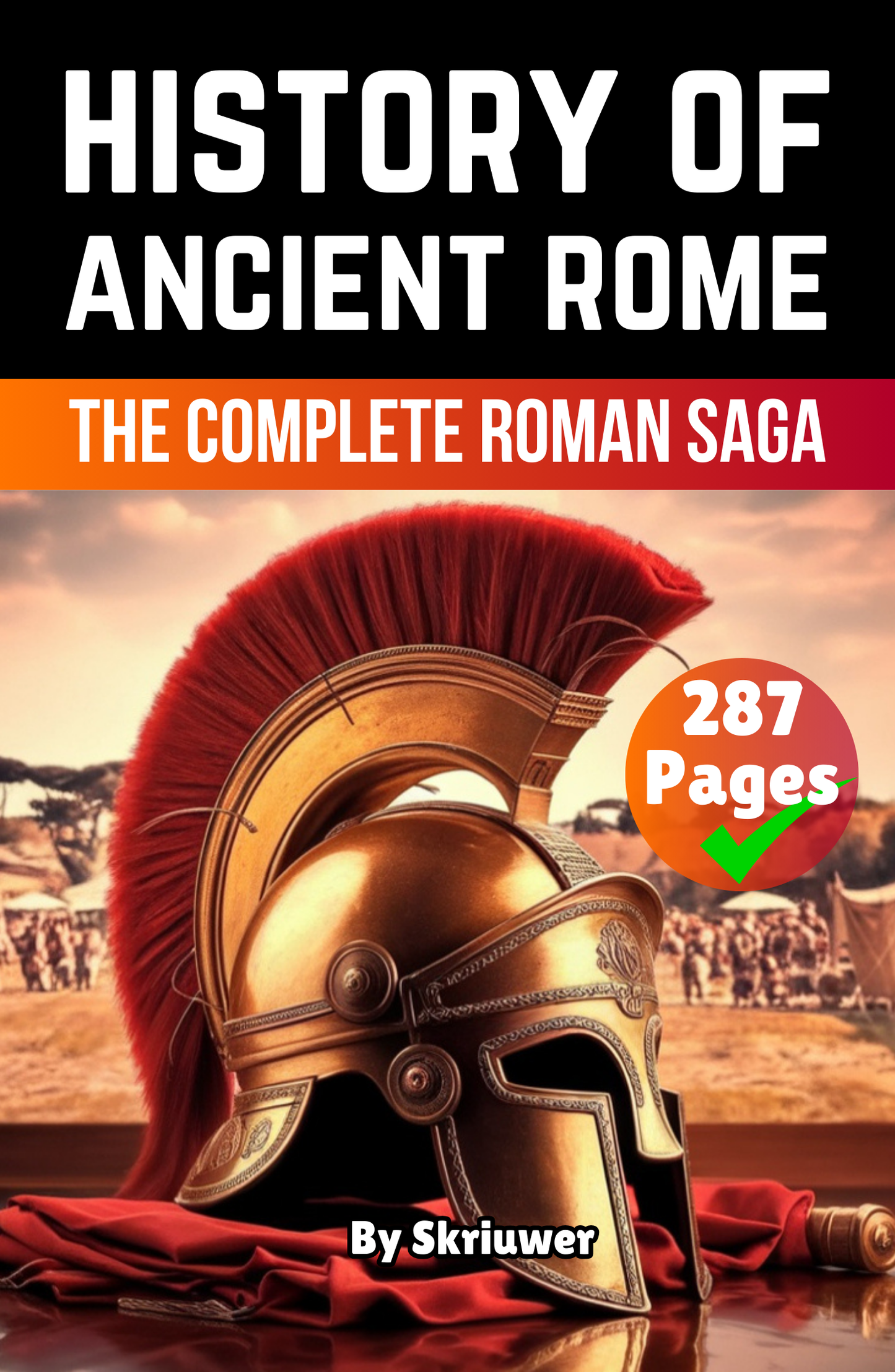
The History of Ancient Rome: The Complete Roman Saga | Paperback Book
Couldn't load pickup availability
This book examines the history of Rome from its early beginnings to the Byzantine period, covering political, social, and cultural developments over approximately 1,200 years.
Key Topics Covered:
- Early Foundations: Influences from Etruscan and Bronze Age societies.
- Republican Era: Events like slave revolts and figures such as Julius Caesar.
- Imperial Period: Rulers including Caligula and transitions to empire.
- Infrastructure and Society: Engineering achievements like roads and aqueducts, as well as cultural practices.
- Decline and Legacy: Factors contributing to changes in the Western Empire and continuation in the East.
Reader Feedback Example: "This book discusses connections between ancient events and later periods." — Dr. Marcus Thorne (Classical Historian)
Book Features:
- Structured Chapters: 20 chapters with references to historical sources.
- Intended Audience: Suitable for those interested in classical history and its influences.
TABLE OF CONTENTS
CHAPTER 1: INTRODUCTION & EARLY BRONZE AGE HERITAGE
- Earliest settlements in the Italian peninsula
- Key Bronze Age cultures and their impact on later Roman society
- Initial trade networks and technological advancements
CHAPTER 2: THE FOUNDING MYTHS & THE REGAL PERIOD
- Legends of Romulus and Remus
- Seven legendary kings and their contributions
- Etruscan influence on early Roman governance
CHAPTER 3: THE EARLY REPUBLIC – STRUGGLES AND REFORMS
- Overthrow of the monarchy and the birth of the republic
- Class conflicts between patricians and plebeians
- Foundation of republican institutions and offices
CHAPTER 4: THE MIDDLE REPUBLIC – WARS & EXPANSIONS
- Samnite Wars and early territorial growth
- Initial Punic Wars and the confrontation with Carthage
- Effects of foreign conquests on Roman society
CHAPTER 5: THE LATE REPUBLIC – POLITICAL TURMOIL
- Rise of powerful generals and civil unrest
- Social War and challenges to the republican system
- Growth of personal ambition and weakening of the Senate
CHAPTER 6: JULIUS CAESAR – RISE AND FALL
- Gaul campaigns and military achievements
- Crossing the Rubicon and civil war
- Dictatorship, reforms, and assassination
CHAPTER 7: THE SECOND TRIUMVIRATE AND THE RISE OF AUGUSTUS
- Alliance of Octavian, Mark Antony, and Lepidus
- Proscription and power struggles
- End of the Republic and Augustus as first emperor
CHAPTER 8: THE JULIO-CLAUDIAN EMPERORS
- Tiberius and early imperial administration
- Caligula’s rule and controversies
- Claudius’s conquests and Nero’s turbulent reign
CHAPTER 9: THE FLAVIAN DYNASTY AND THE YEAR OF THE FOUR EMPERORS
- Turmoil after Nero’s death
- Vespasian’s rise and restoration of stability
- Construction of the Colosseum and Flavian policies
CHAPTER 10: THE “FIVE GOOD EMPERORS” AND ROME AT ITS PEAK
- Nerva’s succession and Trajan’s expansion
- Hadrian’s consolidations and building projects
- Antoninus Pius and Marcus Aurelius’s philosophical leadership
CHAPTER 11: THE SEVERAN DYNASTY AND MILITARY ANARCHY
- Septimius Severus’s reforms and campaigns
- Economic strains and frequent power shifts
- Growing role of the military in imperial politics
CHAPTER 12: THE DIOCLETIAN REFORMS AND TETRARCHY
- Efforts to reorganize administration and military
- Division of the empire among four rulers
- Tax reforms and attempts to stabilize the economy
CHAPTER 13: CONSTANTINE THE GREAT AND THE CHRISTIAN EMPIRE
- Rise to power and the Battle of the Milvian Bridge
- Edict of Milan and the growth of Christianity
- Foundation of Constantinople and long-term impact
CHAPTER 14: THE DECLINE OF THE WESTERN EMPIRE
- Economic downturn and Germanic pressures
- Political fragmentation and short-lived emperors
- Increasing vulnerability of the Western territories
CHAPTER 15: SOCIAL AND CULTURAL LIFE IN THE REPUBLIC AND EMPIRE
- Family structures, gender roles, and slavery
- Urban and rural living conditions
- Education, leisure, and public entertainments
CHAPTER 16: ROMAN RELIGION, MYTHOLOGY, AND PHILOSOPHY
- Pantheon of gods and religious festivals
- Influence of Greek philosophy on Roman thought
- Emergence of mystery cults and varied beliefs
CHAPTER 17: ROMAN ART, ARCHITECTURE, AND ENGINEERING
- Sculptures, paintings, and monumental buildings
- Roads, aqueducts, and bridges
- Continuing Etruscan and Greek influences
CHAPTER 18: ECONOMY, TRADE, AND DAILY LIFE
- Agricultural foundations and currency
- Trade networks across the Mediterranean
- Crafts, guilds, and rural-urban dynamics
CHAPTER 19: THE END OF THE WESTERN EMPIRE
- Barbarian invasions and sack of Rome
- Last emperors and the fall in 476 AD
- Survival of Eastern Roman Empire (Byzantium)
CHAPTER 20: CONCLUSION – LEGACY OF ANCIENT ROME
- Influence on modern legal systems and languages
- Cultural and architectural heritage
- Enduring fascination with Roman history
Product Details
Dimensions: 5.8 × 8.3 inches / 15.24 x 22.86 cm
Cover: Paperback

Why Skriuwer.com?
-
Supporting Frisian Language
When you buy from Skriuwer, you're not just getting a book—you’re helping create more Frisian books and educational resources like LearnFrisian.com. Your support directly helps us preserve and grow the Frisian language for future generations.
-
Making Languages Accessible
We believe in making languages easy to learn and accessible. While Frisian is our passion, we also want to help people learn other key languages like Dutch and English by providing helpful resources and learning tools.
-
Investing in Future Projects
Your purchase fuels more than just current projects. It helps us dream big and plan for the future, whether that’s developing new books, launching language-learning platforms, or supporting other educational initiatives. You're helping us build something lasting!
Preserving the Frisian Language
At Skriuwer.com, we believe that the Frisian language is more than just words—it's a living, breathing part of our heritage. But like many minority languages, it faces challenges of survival in an ever-changing world. That’s why our mission is simple yet vital: to keep the Frisian language alive and thriving for generations to come.
Every book we create, every story we tell, and every word we publish is part of a larger effort to preserve and celebrate Frisian culture. But we can’t do it alone. With your help, we can make a real difference.
How You Can Help:
- When you purchase one of our books, you’re not just adding a beautiful piece of literature to your collection—you’re directly supporting the preservation of the Frisian language. Each book helps to spread the richness of our language to more people.
- You can also contribute to this cause by learning the Frisian language through our partner site, www.learnfrisian.com.
- Donate: If you believe in our mission, you can also make a contribution to help us continue our work. Whether it’s funding new publications, supporting educational programs, or helping us reach more Frisian speakers, your donation can make a lasting impact. Just click the button below to contribute!
Together, we can ensure that the Frisian language remains a vibrant part of our world. Join us in this journey—your support today means a brighter future for our language tomorrow.