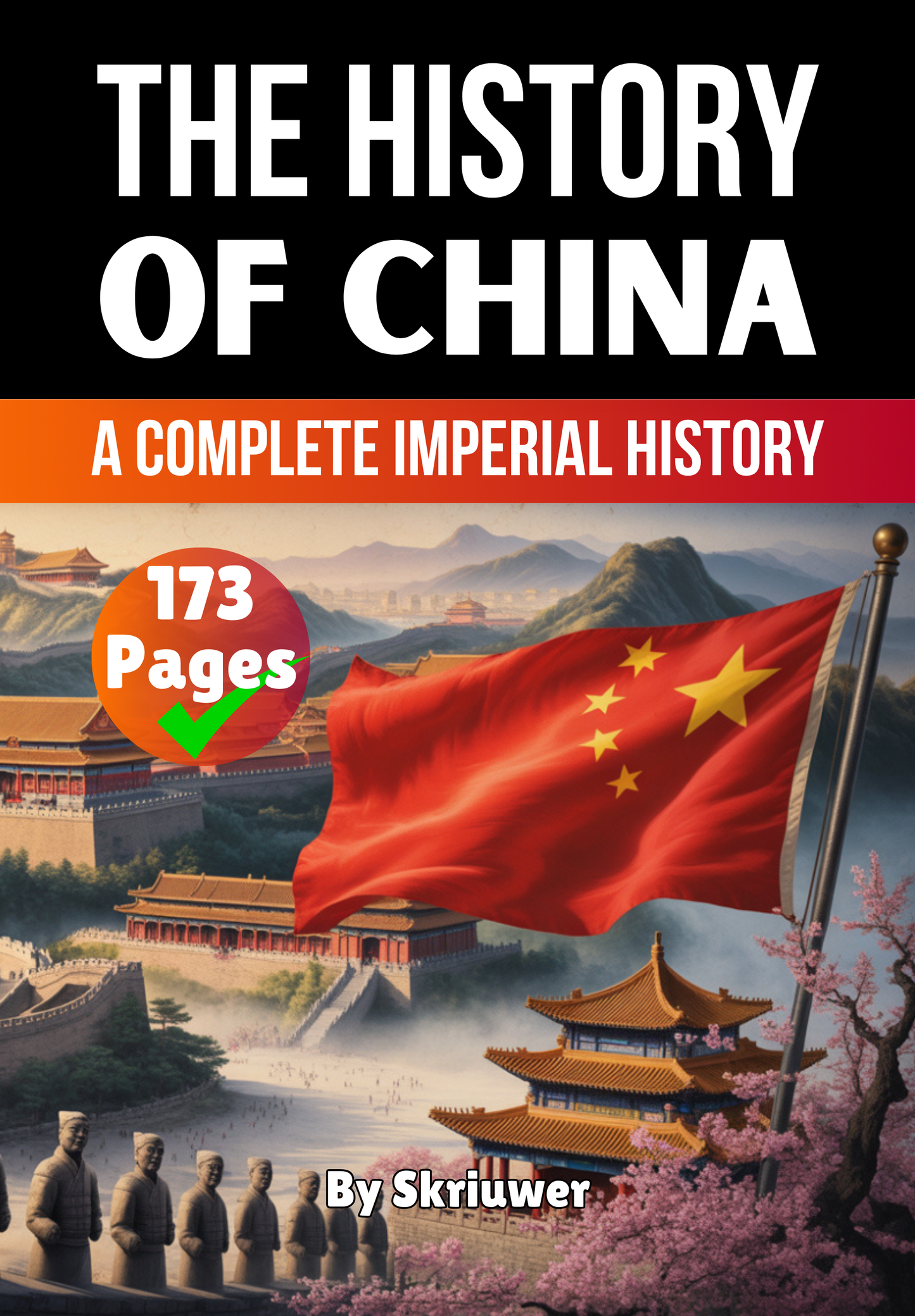

The History of China: A Complete Imperial History | Paperback Book
Couldn't load pickup availability
This sweeping book tells the complete story of China across 4,000 years, from the earliest dynasties to the end of imperial rule. Written with passion and clarity, it brings emperors, philosophers, explorers, and revolutionaries to life in a way that makes every era feel immediate and exciting.
Key Chapters and Highlights:
- Shang oracle bones and the birth of Chinese writing
- Qin Shi Huang’s unification and the creation of the Terracotta Army
- Han dynasty’s Silk Road diplomacy and cultural golden age
- Tang poetry, Song innovation, and Zheng He’s treasure fleets
- Ming grandeur and the dramatic final decades of the Qing
- The revolutionary ideas that ended two millennia of imperial rule
Reader Feedback Example: "This is the China book I’ve been waiting for! It connects ancient philosophy to modern power moves in a way that finally makes sense. I couldn’t stop reading." – DynastySeeker (Verified Purchase)
Why Readers Love This Book:
- Engaging storytelling that flows like your favorite historical epic
- Perfect for fans of Three Kingdoms games, wuxia novels, or anyone planning a trip to the Great Wall or Forbidden City
- Ideal for students, travelers, or anyone curious about how one civilization shaped the world for millennia
- Clear, insightful writing that links past and present without overwhelming detail
Discover why China continues to fascinate the world: a story of brilliance, ambition, and reinvention that still echoes today. Whether you’re new to Chinese history or deepening your knowledge, this book delivers the full, unforgettable journey.
Add to cart today and experience one of history’s greatest stories in one powerful volume.
TABLE OF CONTENTS
CHAPTER 1: PREHISTORIC ORIGINS OF THE CHINESE CIVILIZATION
-
Earliest human presence and the role of Homo erectus
-
Transition from nomadic life to the Neolithic Revolution
-
Key archaeological cultures (Peiligang, Pengtoushan, Yangshao, Hongshan, and Longshan)
-
Formation of social structures and early spiritual beliefs
CHAPTER 2: THE XIA DYNASTY: MYTH AND LEGEND
-
Legends of Yu the Great and the control of floods
-
Evolution from tribal confederations to hereditary rule
-
Debates around archaeological evidence (Erlitou and Taosi sites)
-
Cultural and technological transitions leading to the Shang
CHAPTER 3: THE SHANG DYNASTY: BRONZE AGE AND EARLY WRITING
-
Establishment of the Shang and the significance of oracle bones
-
Advances in bronze technology and ritual vessels
-
Social hierarchy and religious practices
-
Interactions with neighboring tribes and regions
CHAPTER 4: THE ZHOU DYNASTY: MANDATE OF HEAVEN AND FEUDAL STATES
-
Overthrow of the Shang and the concept of the Mandate of Heaven
-
Western Zhou vs. Eastern Zhou: shifts in political power
-
Rise of a feudal system and regional lords
-
Cultural developments and early literary works
CHAPTER 5: THE SPRING AND AUTUMN PERIOD: PHILOSOPHICAL BEGINNINGS
-
Decline of central Zhou power and fragmented states
-
Emergence of Confucianism, Daoism, and other philosophical thoughts
-
Conflicts among regional lords and alliances
-
Societal changes and the role of scholars
CHAPTER 6: THE WARRING STATES PERIOD: TURMOIL AND INNOVATION
-
Intense warfare and quest for dominance among major states
-
Strategic innovations and the influence of military thinkers like Sun Tzu
-
Growth of trade, commerce, and new administrative systems
-
Continued development of philosophical schools
CHAPTER 7: THE QIN DYNASTY: UNIFICATION AND LEGALISM
-
Rise of Qin Shi Huang and the first unified Chinese empire
-
Legalist policies and centralized governance
-
Great construction projects (precursor to the Great Wall)
-
Efforts to standardize currency, writing, and measurements
CHAPTER 8: THE HAN DYNASTY: EXPANSION AND CONFUCIANISM
-
Founding by Liu Bang and the establishment of a lasting imperial structure
-
Adoption of Confucian ideas as state orthodoxy
-
Territorial expansion and the opening of the Silk Road
-
Achievements in science, technology, and culture
CHAPTER 9: THE THREE KINGDOMS PERIOD: CONFLICT AND HEROES
-
Collapse of the Han and fragmentation into Wei, Shu, and Wu
-
Famous figures like Cao Cao, Liu Bei, and Zhuge Liang
-
Impact of continuous warfare on society and economy
-
Cultural legacy in literature and popular tales
CHAPTER 10: THE JIN DYNASTY AND THE SIXTEEN KINGDOMS
-
Brief unification under the Western Jin
-
Invasions by nomadic groups and the rise of multiple states
-
Shifting capitals and social turmoil
-
Blend of diverse cultures and religious influences
CHAPTER 11: THE SOUTHERN AND NORTHERN DYNASTIES: CULTURAL GROWTH
-
Division between northern non-Han regimes and southern Han courts
-
Spread of Buddhism and developments in art and architecture
-
Economic transformations and the growth of city life
-
Steps toward eventual reunification
CHAPTER 12: THE SUI DYNASTY: SHORT BUT INFLUENTIAL
-
Reunification of China under Emperor Wen of Sui
-
Ambitious projects like the Grand Canal
-
Foundation for the Tang Dynasty’s rise
-
Excessive centralization and the dynasty’s downfall
CHAPTER 13: THE TANG DYNASTY: GOLDEN AGE OF CULTURE
-
Military expansion and strong central government
-
Flourishing of poetry, painting, and cosmopolitan life
-
Religious diversity and the influence of Silk Road trade
-
Contributions in law, governance, and society
CHAPTER 14: THE FIVE DYNASTIES AND TEN KINGDOMS
-
Fragmentation following the Tang collapse
-
Brief successions of regimes in the north and multiple kingdoms in the south
-
Regional conflicts and cultural cross-pollination
-
Preparation for the rise of the Song Dynasty
CHAPTER 15: THE SONG DYNASTY: ECONOMIC BOOM AND INNOVATIONS
-
Reunification under the Northern and then Southern Song
-
Advancements in agriculture, commerce, and maritime trade
-
Innovations in printing, gunpowder, and navigation
-
Cultural renaissance in painting and literature
CHAPTER 16: THE YUAN DYNASTY: MONGOL RULE AND CULTURAL EXCHANGE
-
Conquest by the Mongols under Kublai Khan
-
Challenges of governing a large, diverse empire
-
Increased trade along the Silk Road and contact with the West
-
Integration of Mongol, Persian, and Chinese influences
CHAPTER 17: THE MING DYNASTY: MARITIME VENTURES AND THE GREAT WALL
-
Return to Han Chinese rule under Emperor Hongwu
-
Zheng He’s voyages and global maritime connections
-
Renewed construction of the Great Wall and other defenses
-
Cultural flourishings and developments in printing
CHAPTER 18: THE QING DYNASTY: LAST IMPERIAL RULE
-
Manchu conquest and expansion of the empire’s borders
-
Management of diverse peoples under a centralized system
-
Achievements in literature, art, and architecture
-
Seeds of decline through internal and external pressures
CHAPTER 19: THE RISE OF WESTERN INFLUENCE AND INTERNAL STRUGGLES
-
Growing foreign presence and trade imbalances
-
Socioeconomic unrest and uprisings
-
Attempts at reform and modernization
-
Increasing strain on Qing authority
CHAPTER 20: THE END OF IMPERIAL CHINA AND SEEDS OF REFORM
-
Fall of the Qing Dynasty and the abolition of the imperial system
-
Emergence of new political ideas and movements
-
Lingering impact of centuries of dynastic rule
-
Transition period setting the stage for modern history
Product Details
Dimensions: 6 × 9 inches / 15.24 x 22.86 cm
Cover: Paperback

Why Skriuwer.com?
-
Supporting Frisian Language
When you buy from Skriuwer, you're not just getting a book—you’re helping create more Frisian books and educational resources like LearnFrisian.com. Your support directly helps us preserve and grow the Frisian language for future generations.
-
Making Languages Accessible
We believe in making languages easy to learn and accessible. While Frisian is our passion, we also want to help people learn other key languages like Dutch and English by providing helpful resources and learning tools.
-
Investing in Future Projects
Your purchase fuels more than just current projects. It helps us dream big and plan for the future, whether that’s developing new books, launching language-learning platforms, or supporting other educational initiatives. You're helping us build something lasting!
It behâld fan de Fryske taal
By Skriuwer.com leauwe wy dat it Frysk mear is as allinnich wurden – it is in libbend part fan ús erfgoed. Mar lykas in protte minderheidstalen stiet it Frysk foar de útdaging om te oerlibjen yn in wrâld dy't konstant feroaret. Dêrom is ús misje ienfâldich mar essinsjeel: it Frysk libben hâlde foar takomstige generaasjes.
Elts boek dat wy meitsje, elts ferhaal dat wy fertelle, en elts wurd dat wy publisearje, is diel fan in gruttere ynspanning om de Fryske kultuer te behâlden. Mar wy kinne it net allinnich dwaan. Mei jo help kinne wy in echt ferskil meitsje.

Hoe kinne jo helpe:
Keapje in boek: As jo ien fan ús boeken keapje, foegje jo net allinich in moai stik literatuer ta oan jo samling – jo stypje ek direkt it bewarjen fan de Fryske taal. Elts boek helpt de rykdom fan ús taal nei mear minsken te fersprieden. Jo kinne ek bydrage oan dizze saak troch it Frysk te learen fia ús partnerside, www.learnfrisian.com.
Donearje: As jo leauwe yn ús misje, kinne jo ek in bydrage dwaan om ús wurk troch te setten. Of it no giet om it finansieren fan nije publikaasjes, it stypjen fan ûnderwiisprogramma's, of it helpen om mear Frysk sprekkers te berikken, jo donaasje kin in bliuwend ferskil meitsje. Klikje gewoan op de knop hjirûnder om by te dragen!
Tegearre kinne wy derfoar soargje dat it Frysk in libben diel fan ús wrâld bliuwt. Doch mei ús op dizze reis – jo stipe hjoed betsjut in ljochtere takomst foar ús taal moarn.