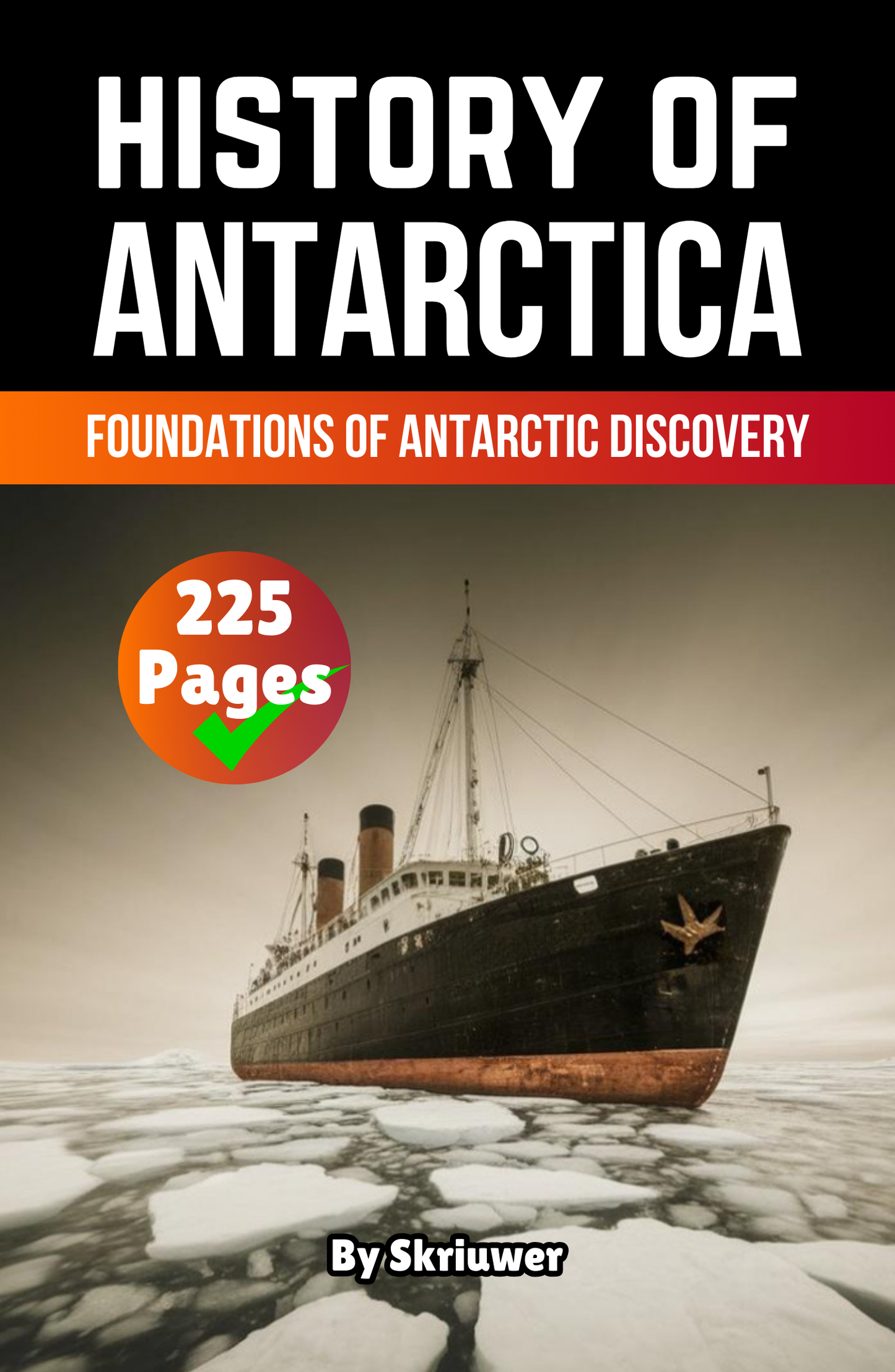
The History of Antarctica: Foundations of Antarctic Discovery | Paperback Book
Couldn't load pickup availability
This book explores the history of Antarctic exploration, from early voyages to 20th-century expeditions. It discusses motivations, challenges, and key figures in the continent's discovery and study.
Key Topics Covered:
- Geological Past: Antarctica's connection to Gondwana and climatic changes over millions of years.
- Early Voyages: James Cook's 1770s circumnavigation and observations.
- Sealing Era: 19th-century activities and their environmental impacts.
- Heroic Age Expeditions: Efforts by explorers like Ernest Shackleton and the Endurance voyage.
- International Races: Contributions from figures like Nobu Shirase and Roald Amundsen.
- 20th Century Activities: Expeditions during the 1930s and World War II era.
Reader Feedback Example: "This book discusses exploration challenges and historical events." — Eleanor V. (Polar Historian)
Book Features:
- Comprehensive Coverage: Includes scientific, personal, and geopolitical aspects.
- Intended Audience: Suitable for those interested in polar history, survival stories, or works like Endurance.
TABLE OF CONTENTS
CHAPTER 1: THE ANCIENT PAST OF ANTARCTICA
- Part of the supercontinent Gondwana
- Shift from warmer climates to an icy landscape
- Formation of colossal ice sheets
CHAPTER 2: MYTHS & EARLY IDEAS ABOUT A SOUTHERN CONTINENT
- Ancient Greek and medieval concepts of Terra Australis
- Influence of philosophers and map-makers
- Persistent legends and balancing the Earth’s landmass
CHAPTER 3: FIRST HINTS OF A FROZEN LAND – 16TH-CENTURY EXPLORATIONS
- Accidental southern voyages
- Early encounters with icebergs
- Growing curiosity but limited geographic proof
CHAPTER 4: 17TH-CENTURY VOYAGES & GROWING CURIOSITY
- Dutch expeditions and refined cartography
- Shift toward seeing Antarctica as an icy region
- Commercial and strategic motives for sailing south
CHAPTER 5: CAPTAIN JAMES COOK & THE LATE 18TH CENTURY
- Crossing the Antarctic Circle
- Disproving myths of a lush southern continent
- Laying groundwork for future explorers
CHAPTER 6: EARLY 19TH-CENTURY EXPLORERS AND THEIR FINDINGS
- Claims of first sightings of the Antarctic mainland (1820)
- Sealers and whalers driving exploration
- Foundations of scientific observation
CHAPTER 7: THE WHALING AND SEALING RUSH OF THE 19TH CENTURY
- Intense exploitation of marine life for oil and fur
- Commercial drivers pushing into higher latitudes
- Accidental mapping and early scientific gains
CHAPTER 8: SCIENTIFIC EXPEDITIONS OF THE MID-19TH CENTURY
- National-sponsored voyages with research goals
- Magnetic studies, biological collection, and geology
- Heroic Age precursors: bridging exploration and science
CHAPTER 9: THE ROAD TO THE HEROIC AGE – LATE 19TH-CENTURY EFFORTS
- Reduced interest after initial fervor
- Shift toward preparation for deeper inland ventures
- Seeds of polar technology (steam power, better navigation)
CHAPTER 10: EARLY HEROES OF THE ICE – THE 1890S TO 1905
- Borchgrevink’s Cape Adare overwintering
- Belgian expedition under de Gerlache
- Firm steps toward sustained Antarctic residence
CHAPTER 11: BOLD JOURNEYS AND HARSH LESSONS – 1905 TO 1910
- Shackleton’s Nimrod expedition and near-pole success
- Risks of man-hauling and limited technology
- Continued rivalry and planning for pole attempts
CHAPTER 12: THE RACE TO THE POLE – 1910 TO 1912
- Amundsen’s triumph and Scott’s tragic end
- Nobu Shirase’s lesser-known Japanese expedition
- Defining moment of the Heroic Age
CHAPTER 13: STRUGGLES AND SURVIVAL STORIES – THE EARLY 1910S
- Aftermath of the pole race
- Filchner’s Weddell Sea attempts
- Stages for Shackleton’s next grand plan
CHAPTER 14: SHACKLETON’S TRIALS AND TRIUMPHS – THE ENDURANCE EXPEDITION
- Imperial Trans-Antarctic Expedition’s crossing goal
- Ship trapped and lost in the pack ice
- Miraculous survival boat journey to South Georgia
CHAPTER 15: QUIET YEARS AND CONTINUED CURIOSITY – LATE 1910S
- World War I diverting resources
- Sealing, whaling, and small-scale scientific work
- Preparing for post-war exploration
CHAPTER 16: TERRITORY CLAIMS AND SLOW EXPLORATION – EARLY 1920S
- Nations reaffirming claims, small research camps
- Commercial whaling and modest scientific gains
- Shackleton’s final expedition and death
CHAPTER 17: EARLY RESEARCH STATIONS AND CAMPS – 1920S TO 1930S (BRIEF OVERVIEW)
- Shift from single-season huts to longer stays
- Richard Byrd’s Little America base and aerial surveys
- Incremental science amid economic challenges
CHAPTER 18: CHALLENGES AND PREPARATIONS – LATE 1930S (BRIEF OVERVIEW)
- Rise of aviation for mapping
- Germany’s Neuschwabenland claim
- Looming World War II halting expeditions
CHAPTER 19: BUILDING ON PAST KNOWLEDGE – EARLY 1940S (BRIEF OVERVIEW)
- Wartime constraints on polar activities
- Abandoned stations and reduced whaling
- Suspended plans awaiting post-war revival
CHAPTER 20: REFLECTIONS ON THE EARLY ERA AND LAST NOTES ON PRE-MODERN ANTARCTICA
- Key lessons from myths to the dawn of modern exploration
- Heritage of the Heroic Age and transitional stations
- Foundations for collaborative research in the post-war era
Product Details
Dimensions: 5.8 × 8.3 inches / 15.24 x 22.86 cm
Cover: Paperback

Why Skriuwer.com?
-
Supporting Frisian Language
When you buy from Skriuwer, you're not just getting a book—you’re helping create more Frisian books and educational resources like LearnFrisian.com. Your support directly helps us preserve and grow the Frisian language for future generations.
-
Making Languages Accessible
We believe in making languages easy to learn and accessible. While Frisian is our passion, we also want to help people learn other key languages like Dutch and English by providing helpful resources and learning tools.
-
Investing in Future Projects
Your purchase fuels more than just current projects. It helps us dream big and plan for the future, whether that’s developing new books, launching language-learning platforms, or supporting other educational initiatives. You're helping us build something lasting!
Preserving the Frisian Language
At Skriuwer.com, we believe that the Frisian language is more than just words—it's a living, breathing part of our heritage. But like many minority languages, it faces challenges of survival in an ever-changing world. That’s why our mission is simple yet vital: to keep the Frisian language alive and thriving for generations to come.
Every book we create, every story we tell, and every word we publish is part of a larger effort to preserve and celebrate Frisian culture. But we can’t do it alone. With your help, we can make a real difference.

How You Can Help:
- When you purchase one of our books, you’re not just adding a beautiful piece of literature to your collection—you’re directly supporting the preservation of the Frisian language. Each book helps to spread the richness of our language to more people.
- You can also contribute to this cause by learning the Frisian language through our partner site, www.learnfrisian.com.
- Donate: If you believe in our mission, you can also make a contribution to help us continue our work. Whether it’s funding new publications, supporting educational programs, or helping us reach more Frisian speakers, your donation can make a lasting impact. Just click the button below to contribute!
Together, we can ensure that the Frisian language remains a vibrant part of our world. Join us in this journey—your support today means a brighter future for our language tomorrow.