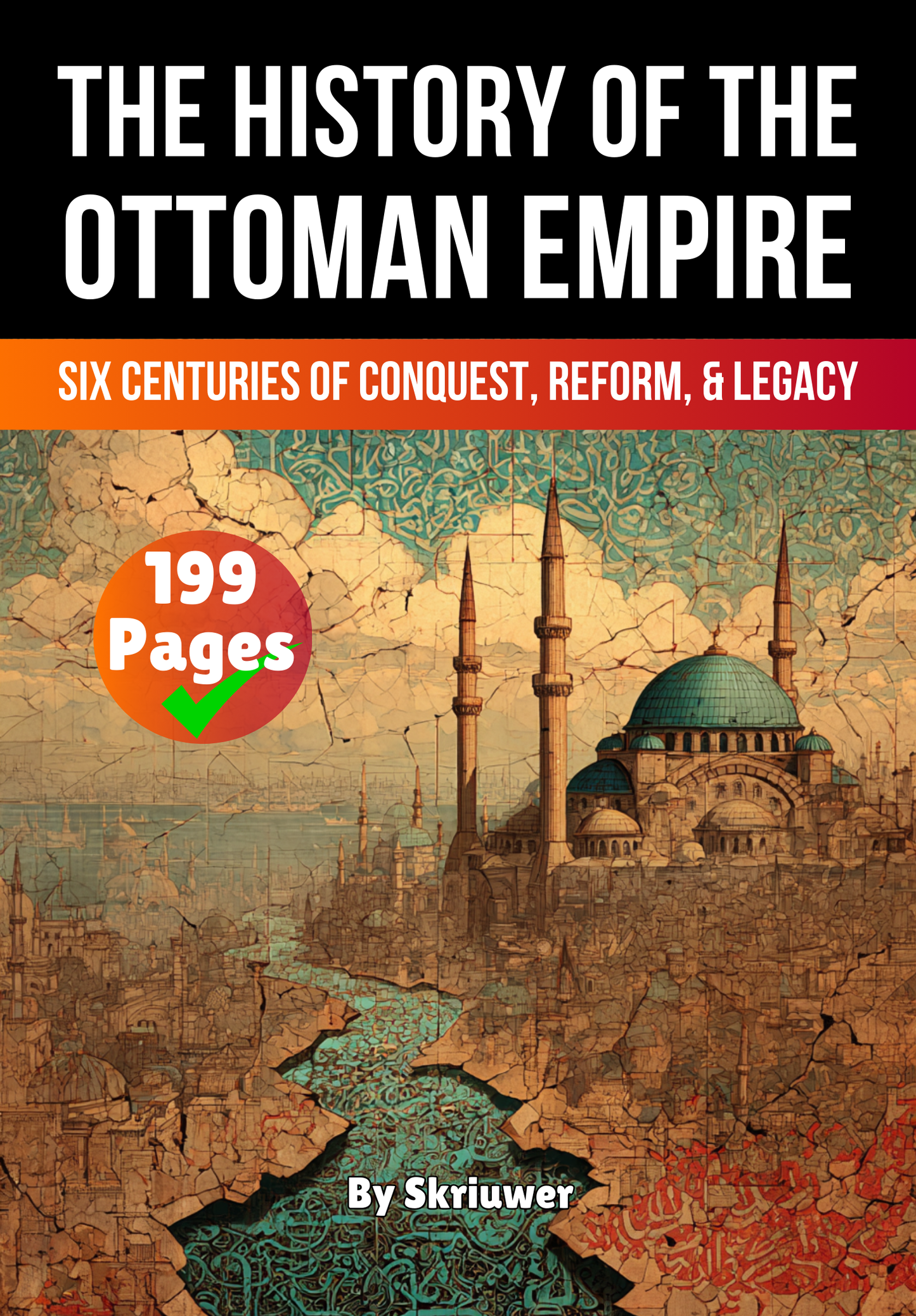

The History of The Ottoman Empire: Six Centuries of Conquest, Reform, and Legacy | Paperback Book
Kan beschikbaarheid voor afhalen niet laden
This book provides an overview of the Ottoman Empire's history over six centuries, examining its conquests, administrative systems, and internal dynamics. It discusses key figures such as Mehmed II and Suleiman, along with aspects of governance, military organization, and societal structures.
Key Topics Covered:
- Recruitment System: The devşirme practice of conscripting Christian boys for military and administrative roles.
- Palace Intrigues: Political rivalries within the harem and their impact on succession.
- Janissary Dissolution: The 1826 event where the elite corps was disbanded, resulting in significant casualties.
- Reforms: The Tanzimat period's efforts toward modernization and equality.
- Armenian Events: Massacres in the 1890s under Abdulhamid II.
Additional Historical Points:
- Succession Practices: Instances of fratricide to secure the throne.
- Slavery: The role of enslaved individuals in the empire's economy and households.
- Infrastructure: Development of railroads and other projects.
- Decline Factors: Economic challenges contributing to the empire's weakening.
Book Features:
- Comprehensive Coverage: Explores conquests, reforms, and legacies.
- Intended Audience: Suitable for readers interested in Ottoman history, geopolitics, or related works like Osman's Dream or The Ottomans: Khans, Caesars, and Caliphs.
TABLE OF CONTENTS
CHAPTER 1: THE EARLY TURKMEN BEGINNINGS (13TH CENTURY ORIGINS)
- The decline of the Seljuk Sultanate of Rum and emergence of Turkish beyliks
- The Mongol invasions and their impact on Anatolia
- Ertuğrul and the establishment of the Ottoman foothold around Söğüt
- Frontier society, tribal dynamics, and early administrative practices
CHAPTER 2: THE RISE OF OSMAN I AND ESTABLISHMENT OF THE OTTOMAN BEYLIK
- Osman’s early leadership and the Battle of Bapheus
- Key conquests against the Byzantine Empire
- Administrative seeds, alliances, and the role of Sufi orders
- The siege of Bursa and Osman’s lasting legacy
CHAPTER 3: EXPANSION UNDER ORHAN AND MURAD I
- Consolidation of Bursa as the first Ottoman capital
- Introduction of the first Ottoman coins and further administrative steps
- Strategic marriages and diplomatic relations
- Murad I’s push into the Balkans (notably in Thrace and beyond)
CHAPTER 4: BAYEZID I AND THE TIMURID INVASION
- The ambitious expansion campaigns of Bayezid I (Yıldırım)
- Internal consolidation: centralizing power over other beyliks
- Threats from European coalitions and battles in the Balkans
- The Battle of Ankara (1402) and the devastating Timur invasion
CHAPTER 5: THE INTERREGNUM & THE RISE OF MEHMED I
- Power vacuum following Bayezid I’s capture
- Fierce rivalry among Bayezid’s sons and the civil war
- Mehmed I’s eventual triumph and reunification of Ottoman territories
- Reestablishing stability and trust among local populations
CHAPTER 6: THE AGE OF MURAD II
- Challenges to Ottoman authority from both East and West
- Murad II’s battles in the Balkans and encounters with Crusader forces
- Diplomatic maneuvers and pacts with rival states
- Periods of abdication and return to power
CHAPTER 7: THE CONQUEST OF CONSTANTINOPLE BY MEHMED II
- Succession and vision of a young Mehmed II
- Siege warfare innovations and the fall of Constantinople (1453)
- Consequences for Eastern Christendom and global trade routes
- Transformation of the city into the Ottoman capital
CHAPTER 8: MEHMED II’S REFORMS AND CONQUESTS AFTER 1453
- Administrative and legal restructuring: Kanun and central bureaucracy
- Cultural patronage and architectural developments
- Further expansions in Eastern Europe, the Black Sea region, and Anatolia
- Integration of diverse populations under Ottoman rule
CHAPTER 9: THE REIGN OF BAYEZID II & SHIFTS IN POWER
- Bayezid II’s approach to governance and consolidation
- Diplomacy with emerging European powers
- Internal opposition and conflicts with Prince Cem
- Prelude to the empire’s next major expansions
CHAPTER 10: SELIM I (SELIM THE GRIM) AND EASTERN EXPANSION
- Rise of Selim I and clashes with Safavid Persia
- Victories against the Mamluks and control of holy cities (Mecca, Medina)
- Reorganization of power in the Middle East
- Establishment of the Ottoman sultan as a leading figure in the Islamic world
CHAPTER 11: THE GOLDEN AGE UNDER SULEIMAN THE MAGNIFICENT
- Suleiman’s legislative reforms and the epithet “the Lawgiver”
- Military campaigns in Hungary, Rhodes, and beyond
- Patronage of arts, architecture, and the imperial court
- Diplomatic relationships with European states
CHAPTER 12: LATER REIGNS OF THE 16TH CENTURY AND INTERNAL DEVELOPMENTS
- Succession struggles and court intrigues
- Shifts in the balance of power with Venice and Habsburg realms
- Economic challenges and changes in the global trade environment
- Continued architectural and cultural patronage
CHAPTER 13: DECLINE? REASSESSING THE 17TH CENTURY
- Debates on the concept of “decline” versus transformation
- Military reforms and challenges on multiple fronts
- Rising tensions in the provinces and court factionalism
- Significant battles and treaties shaping Ottoman-European relations
CHAPTER 14: KÖPRÜLÜ ERA AND ATTEMPTS AT REVIVAL
- The Köprülü family of grand viziers and their strong leadership
- Efforts to restore military discipline and administrative efficiency
- Successes and failures in pushing back European advances
- Long-term implications of the Köprülü reforms
CHAPTER 15: THE LONG 18TH CENTURY AND SHIFTING GLOBAL POWERS
- Key treaties with European powers (e.g., Karlowitz, Passarowitz)
- Internal social dynamics, tax revolts, and local autonomy
- Rise of Russia as a major threat in the Black Sea region
- Cultural changes and Western influences at the Ottoman court
CHAPTER 16: THE ERA OF REFORMS (TANZIMAT AND EARLY 19TH CENTURY)
- Efforts to modernize the military, bureaucracy, and legal codes
- Edicts such as the Hatt-ı Şerif of Gülhane
- Growing tension between reformists and conservative factions
- European involvement in Ottoman internal affairs
CHAPTER 17: MAHMUD II, ABDÜLMECID I, AND THE CHANGING FACE OF THE EMPIRE
- Mahmud II’s destruction of the Janissary Corps (the Auspicious Incident)
- Centralization efforts and administrative overhauls
- New educational institutions and Western-style governance
- Abdülmecid I’s continuation of Tanzimat principles
CHAPTER 18: CONTINUED REFORM EFFORTS AND INTERNAL STRUGGLES IN THE LATE 19TH CENTURY
- Further constitutional attempts under Abdülhamid II
- Nationalist movements and the weakening of imperial cohesion
- Financial crises and European control over Ottoman debts
- Social and intellectual movements shaping the future of the empire
CHAPTER 19: THE EARLY 20TH CENTURY, INTERNAL CHALLENGES, AND EXTERNAL PRESSURES
- Discontent leading to the Young Turk Revolution
- Reforms, new constitutions, and the struggle for parliamentary governance
- Unrest in the Balkans and the ripple effects of nationalist uprisings
- Geopolitical rivalries with European powers
CHAPTER 20: THE EMPIRE’S FINAL DECADES AND LEGACY
- The empire’s last efforts to maintain sovereignty
- Impact of wars and shifting alliances on Ottoman stability
- The cultural, social, and political heritage left behind
- Reflections on six centuries of Ottoman influence in the region and beyond
Product Details
Dimensions: 5.8 × 8.3 inches / 15.24 x 22.86 cm
Cover: Paperback

Why Skriuwer.com?
-
Supporting Frisian Language
When you buy from Skriuwer, you're not just getting a book—you’re helping create more Frisian books and educational resources like LearnFrisian.com. Your support directly helps us preserve and grow the Frisian language for future generations.
-
Making Languages Accessible
We believe in making languages easy to learn and accessible. While Frisian is our passion, we also want to help people learn other key languages like Dutch and English by providing helpful resources and learning tools.
-
Investing in Future Projects
Your purchase fuels more than just current projects. It helps us dream big and plan for the future, whether that’s developing new books, launching language-learning platforms, or supporting other educational initiatives. You're helping us build something lasting!
Behoud van de Friese taal
Bij Skriuwer.com geloven we dat de Friese taal meer is dan alleen woorden – het is een levend onderdeel van ons erfgoed. Maar net als veel minderheidstalen staat het Fries voor uitdagingen om te overleven in een steeds veranderende wereld. Daarom is onze missie eenvoudig maar van levensbelang: de Friese taal levend houden en laten bloeien voor de generaties die komen.
Elk boek dat we maken, elk verhaal dat we vertellen en elk woord dat we publiceren, is onderdeel van een grotere inspanning om de Friese cultuur te behouden en te vieren. Maar we kunnen dit niet alleen. Met jouw hulp kunnen we een echt verschil maken.

Hoe je kunt helpen:
Koop een boek: Als je een van onze boeken koopt, voeg je niet alleen een prachtig literair werk toe aan je collectie, maar ondersteun je ook direct het behoud van de Friese taal. Elk boek helpt om de rijkdom van onze taal naar meer mensen te brengen. Je kunt ook bijdragen aan deze missie door Fries te leren via onze partnersite, www.learnfrisian.com.
Doneer: Als je in onze missie gelooft, kun je ook een bijdrage leveren om ons werk voort te zetten. Of het nu gaat om het financieren van nieuwe publicaties, het ondersteunen van educatieve programma's of het bereiken van meer Friese sprekers, jouw donatie kan een blijvend verschil maken. Klik gewoon op de knop hieronder om bij te dragen!
Samen kunnen we ervoor zorgen dat de Friese taal een levendig deel van onze wereld blijft. Doe met ons mee op deze reis – jouw steun vandaag betekent een betere toekomst voor onze taal morgen.