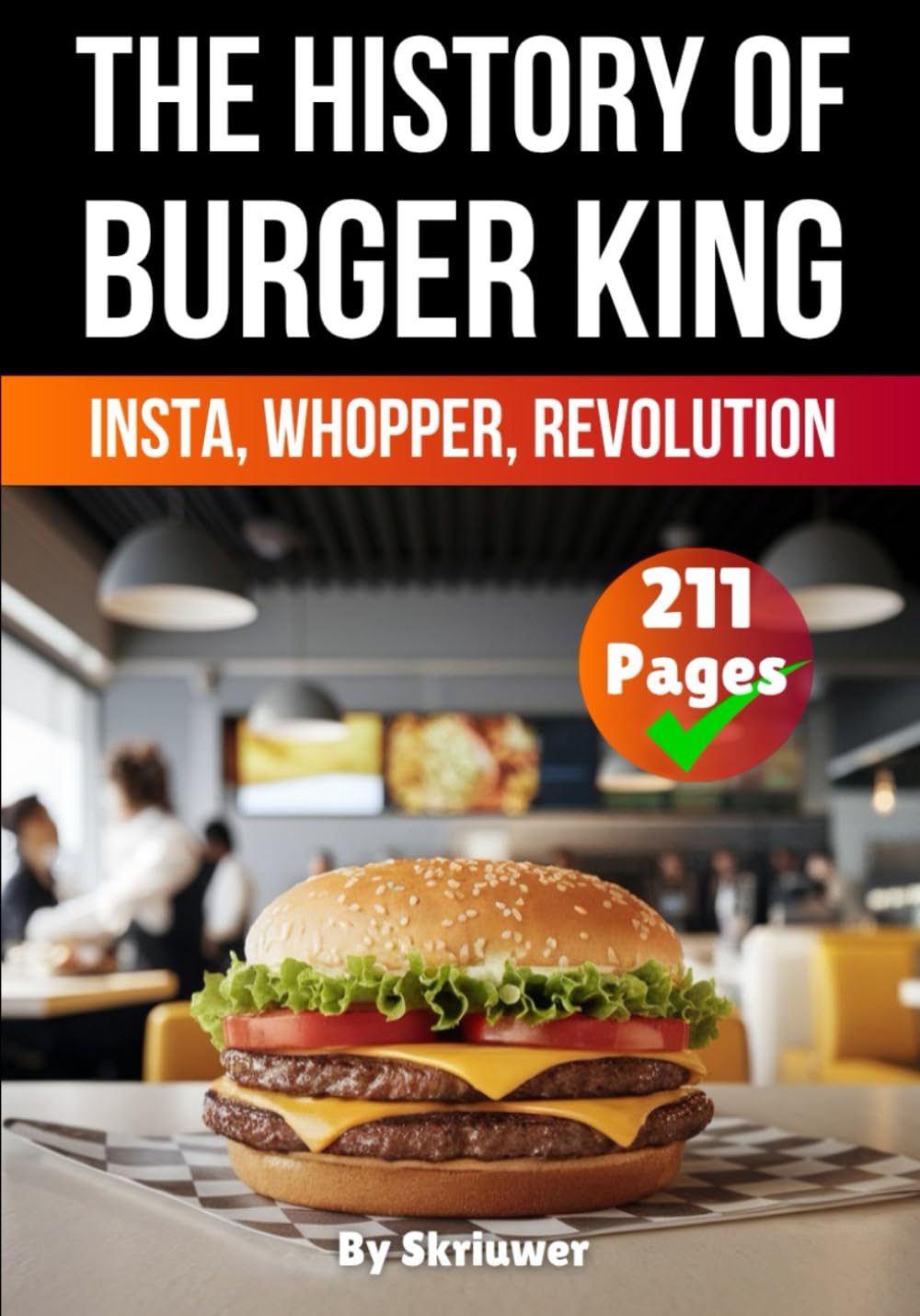
The History of Burger King: Insta, Whopper, Revolution
Kan beschikbaarheid voor afhalen niet laden
This exciting book tells the complete inside story of how Burger King grew from a single failing restaurant in 1954 to one of the world’s biggest fast-food brands. Written like a business thriller, it reveals the bold decisions, clever marketing, and dramatic turning points that built an empire worth billions.
Key Chapters and Highlights:
- The $37 Insta-Broiler that launched the flame-grilled revolution
- How “Have It Your Way” changed fast food forever
- The wild 1980s ad campaigns that became legend (including the famous “Where’s Herb?” story)
- Franchise growth battles and corporate takeovers that shaped the brand
- Global expansion adventures and lessons learned along the way
Reader Feedback Example: “I’ve owned Burger King restaurants for 18 years and this book still blew me away. Every detail is spot-on, from the early broiler struggles to the marketing wins and mistakes. Essential reading for anyone in the business.” – Mike R. (Verified Purchase)
Why Readers Love This Book:
- Fast-paced storytelling that reads like your favorite startup saga
- Perfect for fast-food fans, business students, or anyone who loves real-life underdog stories
- Ideal gift for entrepreneurs, marketing pros, or anyone curious about how iconic brands are really built
- Packed with surprising facts and behind-the-scenes moments you won’t find anywhere else
Discover how two determined founders turned a broken grill into a global phenomenon. Whether you grew up with the Whopper or just love a great success story, this book delivers the full flavor of Burger King’s incredible journey.
Add to cart today and get the real story straight from the grill.
TABLE OF CONTENTS
CHAPTER 1: ORIGINS OF THE INSTA-BROILED DREAM
1950s fast-food culture and growth
Insta-Broiler invention and early equipment
Keith Kramer, Matthew Burns, and the first Jacksonville store
CHAPTER 2: THE TRANSITION FROM INSTA-BURGER KING TO BURGER KING
James McLamore and David Edgerton take over
Dropping “Insta” for a simpler brand name
Refining the broiler system for consistency
CHAPTER 3: THE EARLY FRANCHISE MODEL AND EXPANSION STRATEGIES
Why franchising accelerated growth
Establishing operational manuals and training
Challenges in scaling beyond Florida
CHAPTER 4: NAVIGATING COMPETITIVE WATERS IN THE 1960S
Rising fast-food rivals (McDonald’s, Wendy’s, others)
Comparative advertising and the “Burger Wars”
Refining the Whopper to stand out
CHAPTER 5: THE INTRODUCTION OF THE WHOPPER AND MENU INNOVATIONS
Birth of the Whopper and its significance
Expanding beyond basic burgers with chicken, fish, and sides
Managing complexity in a growing menu
CHAPTER 6: CHANGING OWNERSHIP AND CORPORATE CULTURE IN THE LATE 1960S
Pillsbury’s acquisition and its immediate effects
Leadership turnovers and brand-direction conflicts
Shifts in how franchisees interacted with corporate
CHAPTER 7: GROWTH SPURTS
Prototype stores and standardized design
Operational improvements for consistency
Challenges of fast expansion and franchise relations
CHAPTER 8: MARKETING TALES AND ADVERTISING STRATEGIES OF THE 1970S
Early “Have It Your Way” momentum
Local vs. national advertising efforts
Shaping the Burger King brand voice
CHAPTER 9: CHALLENGES WITH FRANCHISEES, OPERATIONS, AND CONSISTENCY
Franchise conflicts over remodels and rules
Maintaining consistent quality across scattered locations
Dealing with labor shortages and high turnover
CHAPTER 10: INTERNATIONAL FORAYS
Entering Canada, Puerto Rico, and select overseas markets
Master franchise agreements and cultural adaptations
Logistical lessons from global expansion
CHAPTER 11: BURGER WARS INTENSIFY
Direct competition with McDonald’s and Wendy’s
Pricing battles and menu comparisons
Push to maintain flame-broiled differentiation
CHAPTER 12: SHIFTS IN LEADERSHIP AND THE CORPORATE VISION IN THE 1980S
Frequent CEO changes and strategic reboots
Pillsbury’s oversight, data-driven approach
Balancing aggressive expansion with brand identity
CHAPTER 13: MENU EXPERIMENTATIONS AND LIMITED-TIME OFFERS
Introduction of new chicken, fish, and specialty burgers
Pros and cons of frequent LTOs
Navigating consumer demand for variety
CHAPTER 14: OPERATIONAL OVERHAULS AND TECHNOLOGICAL CHANGES
Modernizing kitchen layouts and store prototypes
Computerized POS adoption and data analytics
Improving consistency via training and inspections
CHAPTER 15: BRAND IMAGE CAMPAIGNS AND SPONSORSHIPS
Celebrity endorsements and sports tie-ins
Relaunching “Have It Your Way” in different ad styles
Dealing with misfires like “Where’s Herb?”
CHAPTER 16: INTERNAL STRUGGLES AND OWNERSHIP CHANGES IN THE 1980S
Corporate tension under Pillsbury and Grand Met
Franchisee legal conflicts and store remodel pressures
Reactions to brand-wide controversies
CHAPTER 17: CONTROVERSIES AND PUBLIC PERCEPTION ISSUES
Health critiques, nutritional labeling, and environment debates
Criticisms over labor practices in fast-food
Burger King’s crisis management approach
CHAPTER 18: SLOWING MOMENTUM AND EFFORTS TO REINVIGORATE THE BRAND
Late 1980s slowdown in sales and store traffic
Refocusing on the Whopper, store design, and “Have It Your Way”
Finding balance between value items and premium positioning
CHAPTER 19: LATE 1980S TO EARLY 1990S INITIATIVES
Consolidating brand identity under Grand Met
Project “BK Now!” for operational efficiency
Selective LTOs and modernized marketing campaigns
CHAPTER 20: POSITIONING FOR THE FUTURE: REFLECTIONS ON A GROWING CHAIN
Review of Burger King’s evolution and major lessons
Continued focus on flame-broiling and customization
Entering the mid-1990s with new momentum despite ongoing challenges
Product Details
Dimensions: 6 × 9 inches / 15.24 x 22.86 cm
Cover: Paperback

Why Skriuwer.com?
-
Supporting Frisian Language
When you buy from Skriuwer, you're not just getting a book—you’re helping create more Frisian books and educational resources like LearnFrisian.com. Your support directly helps us preserve and grow the Frisian language for future generations.
-
Making Languages Accessible
We believe in making languages easy to learn and accessible. While Frisian is our passion, we also want to help people learn other key languages like Dutch and English by providing helpful resources and learning tools.
-
Investing in Future Projects
Your purchase fuels more than just current projects. It helps us dream big and plan for the future, whether that’s developing new books, launching language-learning platforms, or supporting other educational initiatives. You're helping us build something lasting!
Behoud van de Friese taal
Bij Skriuwer.com geloven we dat de Friese taal meer is dan alleen woorden – het is een levend onderdeel van ons erfgoed. Maar net als veel minderheidstalen staat het Fries voor uitdagingen om te overleven in een steeds veranderende wereld. Daarom is onze missie eenvoudig maar van levensbelang: de Friese taal levend houden en laten bloeien voor de generaties die komen.
Elk boek dat we maken, elk verhaal dat we vertellen en elk woord dat we publiceren, is onderdeel van een grotere inspanning om de Friese cultuur te behouden en te vieren. Maar we kunnen dit niet alleen. Met jouw hulp kunnen we een echt verschil maken.

Hoe je kunt helpen:
Koop een boek: Als je een van onze boeken koopt, voeg je niet alleen een prachtig literair werk toe aan je collectie, maar ondersteun je ook direct het behoud van de Friese taal. Elk boek helpt om de rijkdom van onze taal naar meer mensen te brengen. Je kunt ook bijdragen aan deze missie door Fries te leren via onze partnersite, www.learnfrisian.com.
Doneer: Als je in onze missie gelooft, kun je ook een bijdrage leveren om ons werk voort te zetten. Of het nu gaat om het financieren van nieuwe publicaties, het ondersteunen van educatieve programma's of het bereiken van meer Friese sprekers, jouw donatie kan een blijvend verschil maken. Klik gewoon op de knop hieronder om bij te dragen!
Samen kunnen we ervoor zorgen dat de Friese taal een levendig deel van onze wereld blijft. Doe met ons mee op deze reis – jouw steun vandaag betekent een betere toekomst voor onze taal morgen.