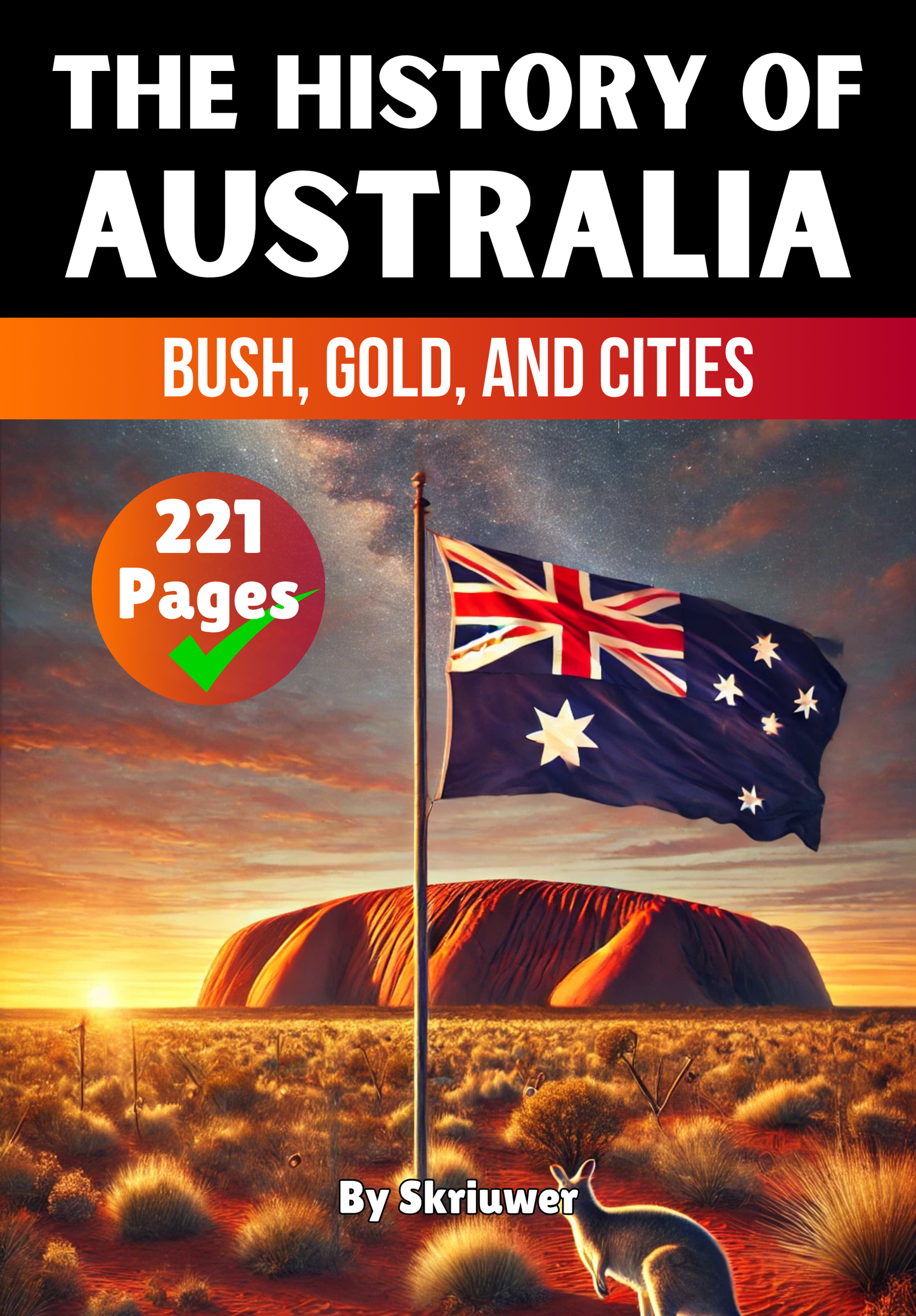
The History of Australia: Bush, Gold, and Cities | Paperback Book
Kan beschikbaarheid voor afhalen niet laden
This sweeping book tells the full story of Australia from its earliest human inhabitants to the birth of modern Australia. Written with passion and clarity, it brings 65,000 years of Indigenous heritage, colonial settlement, gold rushes, wars, and nation-building to life in one unforgettable journey.
Key Chapters and Highlights:
- Ancient Australia: The world’s oldest continuous culture, Songlines, fire-stick farming, and monumental sites like Brewarrina fish traps
- First Encounters: Arrival of the First Fleet, early Sydney, and the complex meeting of two worlds
- Frontier Era: Exploration, convict life, and the growth of colonial society
- Gold Rush and Rebellion: Eureka Stockade and the birth of the Southern Cross legend
- Nation Building: Federation, Gallipoli, and the ANZAC spirit
- 20th Century: World Wars, Stolen Generations, and the long road to reconciliation
Reader Feedback Example: "This is the Australian history book I’ve been waiting for my whole life. Every chapter feels alive, from ancient Dreamtime to modern reconciliation. The storytelling is brilliant." – Prof. Marcia Langton (University of Melbourne)
Why Readers Love This Book:
- Engaging narrative that reads like your favourite historical drama
- Perfect for anyone planning a trip to Uluru, Sydney, or the Goldfields
- Ideal for Outlander-style history fans who want the real stories behind the legends
- Clear, vivid writing that connects Indigenous heritage with colonial and modern Australia
Discover why Australia’s spirit of survival, mateship, and reconciliation continues to inspire the world. Whether you have Australian roots or simply love a nation forged-in-fire story, this book delivers the complete, unforgettable journey.
Add to cart today and experience Australia’s remarkable history in one powerful volume.
TABLE OF CONTENTS
Chapter 1: The Ancient Land of Australia
-
Traces Australia’s geological origins from Gondwana
-
Highlights unique flora and fauna (marsupials, monotremes)
-
Discusses early megafauna and their extinction
-
Previews the environment encountered by the First Peoples
Chapter 2: Arrival of the First Peoples
-
Explores theories on human migration to Australia
-
Introduces early archaeological sites (e.g., Lake Mungo)
-
Describes Aboriginal adaptation to diverse landscapes
-
Outlines kinship systems and the Dreaming concept
Chapter 3: Early Aboriginal Societies and Beliefs
-
Examines social organization (clans, totems, moieties)
-
Details ceremonial life and spiritual practices
-
Highlights kinship responsibilities and law
-
Addresses gender roles and sacred sites significance
Chapter 4: Regional Connections and Trade
-
Illustrates trade networks among Aboriginal groups
-
Shows ochre routes, stone tool exchanges, and ceremonial gatherings
-
Describes fire-stick farming for land management
-
Notes Aboriginal engineering (fish traps, etc.) before European contact
Chapter 5: The Age of European Exploration
-
Chronicles early European theories of “Terra Australis”
-
Focuses on Dutch, Portuguese, and later British voyages
-
Mentions shipwrecks (e.g., Batavia) and early Aboriginal encounters
-
Discusses James Cook’s 1770 claim over the east coast
Chapter 6: The First Fleet and British Settlement
-
Recounts the First Fleet’s voyage and arrival in 1788
-
Describes Sydney Cove foundation under Governor Arthur Phillip
-
Explores convict life, rations, and relations with Aboriginal peoples
-
Highlights Botany Bay vs. Port Jackson settlement choice
Chapter 7: Convict Life and the Expanding Colonies
-
Details assignment systems, punishments, and ticket-of-leave ideas
-
Explains social hierarchy: squatters, free settlers, ex-convicts
-
Notes the Rum Corps influence and early economic structures
-
Reviews the rise of pastoralism and agricultural sectors
Chapter 8: Frontier Conflicts and Aboriginal Resistance
-
Examines violent dispossession on the frontiers
-
Discusses Pemulwuy, Windradyne, and other resistance figures
-
Highlights Black War in Van Diemen’s Land (Tasmania)
-
Addresses government policies of “protection” and mission systems
Chapter 9: The Spread of Pastoralism and Economic Growth
-
Shows squatters’ dominance and legislative control of Crown lands
-
Describes the wool export boom, tariff policies, and port improvements
-
Notes urbanization driven by wool wealth
-
Traces conflicts with smaller farmers, bushrangers, and land acts
Chapter 10: The Gold Rush and Social Transformation
-
Chronicles discovery of gold at Ophir, Ballarat, Bendigo
-
Explains mass immigration and population surge
-
Highlights Eureka Stockade and miners’ rights movements
-
Details growth of Melbourne, new wealth, and social mobility
Chapter 11: Colonial Governance and Social Changes
-
Explores responsible government in each colony
-
Covers land acts, pastoral vs. selector tensions, and settlement
-
Notes urban industrial development and early labor unions
-
Introduces women’s roles, education expansion, and religious diversity
Chapter 12: Towards Federation
-
Maps intercolonial rivalries, tariff debates, and defense concerns
-
Follows constitutional conventions (1890s) drafting the Commonwealth
-
Explains referendums and final approval from the British Parliament
-
Previews 1901 inauguration of the Commonwealth of Australia
Chapter 13: Federation and the Early Commonwealth Years
-
Reviews First Federal Parliament, Immigration Restriction Act
-
Chronicles White Australia policy frameworks, labor arbitration, and social reforms
-
Describes early prime ministers (Barton, Deakin) and institutional foundations
-
Addresses Aboriginal exclusion from the Constitution
Chapter 14: Life in the Early 1900s
-
Describes urban and rural living conditions, household technology
-
Highlights convict presence diminishing, replaced by new social norms
-
Examines work and wages, children’s schooling, and Sunday observances
-
Touches on immigration (still mainly British) and Aboriginal marginalization
Chapter 15: Australia in World War I
-
Recounts 1914 outbreak of war, Anzac landings at Gallipoli
-
Notes Western Front battles, conscription debates, and home front changes
-
Details tragedy of high casualties, rise of Anzac legend
-
Covers armistice, repatriation struggles, and impact on national psyche
Chapter 16: Between the Wars: Economic and Social Shifts
-
Tracks post-WWI adjustments, the Roaring Twenties, and rural vs. urban divides
-
Explains Great Depression effect on labor, housing, politics (Premiers’ Plan)
-
Spotlights evolving women’s roles and Aboriginal continued dispossession
-
Observes slow industrial recovery, leading to WWII readiness
Chapter 17: Australia in World War II
-
Summarizes early commitments in North Africa, Greece, and Crete
-
Explains Japanese threat in 1942, bombing of Darwin, shift to US alliance
-
Details Kokoda Track heroics, New Guinea campaigns, and final push in Borneo
-
Highlights home front mobilization, rationing, women’s expanded roles, and post-war reconstruction planning
Chapter 18: Post-War Reconstruction and Change
-
Shows Ben Chifley’s government implementing full employment, social welfare
-
Describes massive immigration programs, “populate or perish,” and new cultural diversity
-
Explores Snowy Mountains Scheme as a flagship infrastructure project
-
Notes rising suburban living standards, Aboriginal neglect, and the 1949 political shift to Menzies’ era
Chapter 19: Cultural and Social Movements of the Mid-1900s
-
Examines suburban boom, consumer culture, and youth influences
-
Reviews art, literature, modern architecture, and Aboriginal activism seeds
-
Highlights the continuing White Australia Policy, tension with new European migrants
-
Notes early stirrings of women’s and civil rights movements
Chapter 20: A Reflection on Australia’s Historical Journey
-
Provides an overview of themes from ancient Aboriginal presence to mid-1900s developments
-
Recaps colonization, Federation, world wars, and post-war transformations
-
Notes enduring tensions: land rights, cultural identity, economic cycles, government intervention
-
Concludes with Australia’s mid-century outlook—prosperous yet facing deeper social reforms ahead
Product Details
Dimensions: 6 × 9 inches / 15.24 x 22.86 cm
Cover: Paperback

Why Skriuwer.com?
-
Supporting Frisian Language
When you buy from Skriuwer, you're not just getting a book—you’re helping create more Frisian books and educational resources like LearnFrisian.com. Your support directly helps us preserve and grow the Frisian language for future generations.
-
Making Languages Accessible
We believe in making languages easy to learn and accessible. While Frisian is our passion, we also want to help people learn other key languages like Dutch and English by providing helpful resources and learning tools.
-
Investing in Future Projects
Your purchase fuels more than just current projects. It helps us dream big and plan for the future, whether that’s developing new books, launching language-learning platforms, or supporting other educational initiatives. You're helping us build something lasting!
Behoud van de Friese taal
Bij Skriuwer.com geloven we dat de Friese taal meer is dan alleen woorden – het is een levend onderdeel van ons erfgoed. Maar net als veel minderheidstalen staat het Fries voor uitdagingen om te overleven in een steeds veranderende wereld. Daarom is onze missie eenvoudig maar van levensbelang: de Friese taal levend houden en laten bloeien voor de generaties die komen.
Elk boek dat we maken, elk verhaal dat we vertellen en elk woord dat we publiceren, is onderdeel van een grotere inspanning om de Friese cultuur te behouden en te vieren. Maar we kunnen dit niet alleen. Met jouw hulp kunnen we een echt verschil maken.
Hoe je kunt helpen:
Koop een boek: Als je een van onze boeken koopt, voeg je niet alleen een prachtig literair werk toe aan je collectie, maar ondersteun je ook direct het behoud van de Friese taal. Elk boek helpt om de rijkdom van onze taal naar meer mensen te brengen. Je kunt ook bijdragen aan deze missie door Fries te leren via onze partnersite, www.learnfrisian.com.
Doneer: Als je in onze missie gelooft, kun je ook een bijdrage leveren om ons werk voort te zetten. Of het nu gaat om het financieren van nieuwe publicaties, het ondersteunen van educatieve programma's of het bereiken van meer Friese sprekers, jouw donatie kan een blijvend verschil maken. Klik gewoon op de knop hieronder om bij te dragen!
Samen kunnen we ervoor zorgen dat de Friese taal een levendig deel van onze wereld blijft. Doe met ons mee op deze reis – jouw steun vandaag betekent een betere toekomst voor onze taal morgen.