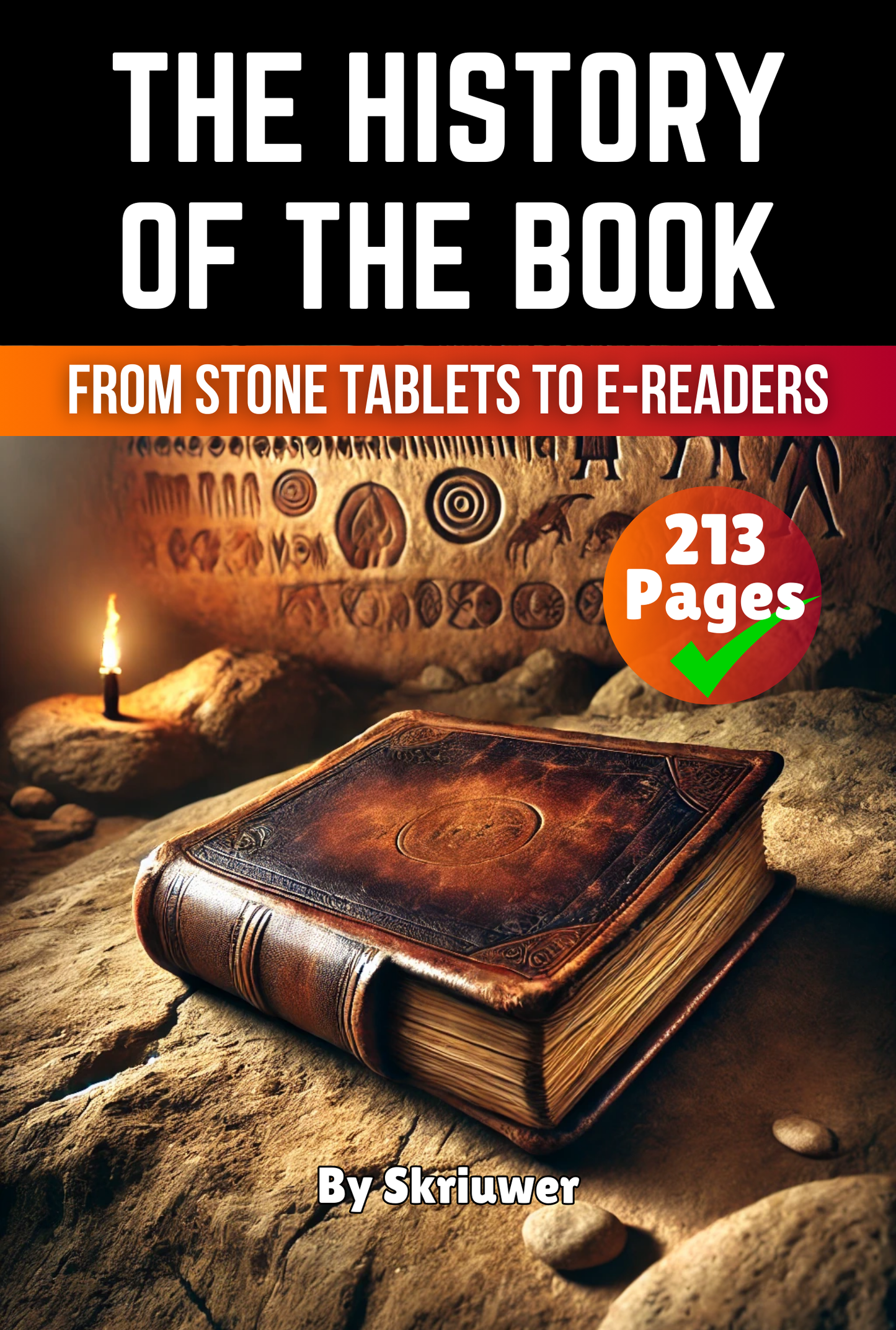

The History of the Book: From Stone Tablets to E-Readers | Paperback Book
Impossible de charger la disponibilité du service de retrait
This book explores the history of the book as a medium, from ancient writing systems to modern printing. It examines how formats and technologies influenced the preservation and dissemination of knowledge over 5,000 years.
Key Topics Covered:
- Early Writing: Clay tablets in Mesopotamia and stone inscriptions in ancient civilizations.
- Transition to Codices: The adoption of bound books in early Christian contexts.
- Paper's Development: Its introduction and spread through trade and scholarship.
- Printing Innovations: Gutenberg's press and its role in making texts more accessible.
- Censorship and Preservation: Efforts to control or protect written works, including monastic copying and underground publishing.
Additional Points:
- Format Changes: Comparisons between scrolls and codices.
- Legal and Economic Aspects: Challenges faced by early printers like Gutenberg.
- Typeface Developments: Creations like italic type by Aldus Manutius.
- Influential Texts: Examples such as religious works and reform documents.
Book Features:
- Chapter Structure: Includes discussions on specific historical shifts and figures.
- Intended Audience: Suitable for readers interested in the evolution of writing, printing, and information control.
TABLE OF CONTENTS
CHAPTER 1: THE DAWN OF WRITING
- Emergence of symbolic expression through cave paintings and tallies.
- Transition from purely oral traditions to early written records.
- Development of pictographs in Mesopotamia and hieroglyphs in Egypt.
- The scribe’s role in preserving and organizing information.
CHAPTER 2: EARLY CLAY AND STONE RECORDS
- Overview of clay tablet use in Mesopotamia and stone inscriptions in Egypt.
- Techniques of carving and pressing characters for permanent records.
- Preservation challenges and the rise of ancient archival libraries.
- The interplay between visual art and inscribed text in early civilizations.
CHAPTER 3: PAPYRUS AND PARCHMENT
- Origins of papyrus in Egypt and its spread throughout the Mediterranean.
- Transition to parchment for durability and climate resistance.
- The scroll versus codex debate and evolving reading practices.
- Impact on administrative, religious, and scholarly records.
CHAPTER 4: THE RISE OF THE CODEX
- Advantages of the codex over the scroll.
- Early adoption in Christian communities and monastic scriptoria.
- Gradual displacement of scrolls across the Roman Empire.
- Role in shaping later book formats and reading habits.
CHAPTER 5: MANUSCRIPTS IN THE EARLY MIDDLE AGES
- Monastic scribes preserving religious and classical texts.
- Scriptoria organization and the communal labor of copying.
- Influence of regional scripts (Merovingian, Insular, Visigothic).
- Seeds of later manuscript illumination and library formation.
CHAPTER 6: MONASTIC LIBRARIES AND THE GROWTH OF BOOK TRADE
- Cluniac and Cistercian reforms expanding library collections.
- Lending, copying, and cataloging systems in monasteries.
- Emergence of early commercial book trade and traveling merchants.
- The social and economic value of manuscripts in broader society.
CHAPTER 7: THE INFLUENCE OF ANCIENT LIBRARIES AND SCRIPTORIA
- Continuities between Mesopotamian, Greek, and Roman library models.
- Preservation of classical texts through Byzantine and Islamic worlds.
- Impact of Hellenistic and Roman copying centers on medieval scriptorium practice.
- How ancient precedents shaped Europe’s emerging monastic libraries.
CHAPTER 8: THE SPREAD OF PAPER ACROSS CIVILIZATIONS
- Origins of papermaking in China and its gradual westward diffusion.
- Role of Islamic states in refining and popularizing paper use.
- Replacement of parchment with paper for mass-scale text production.
- Economic and cultural implications of more affordable writing surfaces.
CHAPTER 9: EARLY PRINTING IN ASIA
- Woodblock printing traditions in Tang China and Korea’s metal movable type.
- Influence of Buddhism on text replication and dissemination.
- Technical challenges of printing with thousands of characters.
- Parallel evolution of block and movable-type printing in East Asia.
CHAPTER 10: THE BEGINNING OF MOVABLE TYPE IN EUROPE
- Precursors to Gutenberg and possible early experiments.
- Gutenberg’s background, financial struggles, and partnership with Fust.
- Emergence of the hand press as a new, flexible production tool.
CHAPTER 11: GUTENBERG’S PRESS AND ITS IMMEDIATE IMPACT
- Production of the 42-line Bible and Gutenberg’s legal conflicts.
- Spread of printing technology from Mainz to other European centers.
- Role of early printed Bibles, pamphlets, and scholastic texts in fueling literacy.
- Setbacks and successes shaping the emergent European print culture.
CHAPTER 12: THE PRINTING REVOLUTION AND ITS SPREAD
- Expansion of presses into major cities across Europe.
- Book fairs (Frankfurt, Leipzig) and new distribution channels.
- Government licensing, emerging publishers, and growing competition.
- Influence on religious upheavals and political discourse.
CHAPTER 13: BOOKMAKING IN THE RENAISSANCE PERIOD
- Humanist ideals shaping type design (Roman, italic) and page layout.
- Venetian innovations (Aldus Manutius) and refined printing aesthetics.
- Intersection of artistic illustration, scholarship, and patronage.
- Transition from manuscript illumination to engraved copperplate images.
CHAPTER 14: THE RISE OF BOOK CULTURE IN THE EARLY MODERN ERA
- Impact of religious conflicts on printing, reading, and censorship structures.
- Growth in lay literacy and changing reading habits.
- Social prestige of private libraries and institutional collections.
- Increasingly specialized book trade, spanning academic and popular genres.
CHAPTER 15: BOOKS IN THE AGE OF EXPLORATION AND CONQUEST
- Influence of voyages, colonial expansion on travel literature and cartographic printing.
- Intersection of missionary presses with indigenous scripts.
- Circulation of forbidden accounts of conquest and critiques.
- Maps, atlases, and the impetus for global geographic knowledge.
CHAPTER 16: CENSORSHIP AND RELIGIOUS CONTROL OF BOOKS
- Mechanisms of suppression in Catholic and Protestant lands.
- Underground presses, smuggling, and the clandestine book trade.
- Self-censorship and authors’ strategies for avoiding condemnation.
- Cultural impact: shaping official orthodoxy, stimulating hidden innovation.
CHAPTER 17: RISE OF SCIENTIFIC AND SCHOLARLY WORKS
- Emergence of new methods in mathematics, astronomy, anatomy.
- Role of universities, academies, and specialized treatises.
- Tensions between scientific progress and church-state censorship.
- Evolution of scholarly communication, culminating in early scientific journals.
CHAPTER 18: BOOK PRODUCTION APPROACHES BEFORE MODERN MECHANIZATION
- Labor-intensive processes in hand presses, typecasting, & papermaking.
- Interplay of craftsmanship, incremental improvements, and distribution networks.
- Continued reliance on woodcuts and copper engravings for illustration.
- The artisanal ethos shaping the final bound volumes across Europe’s print culture.
Product Details
Dimensions: 5.8 × 8.3 inches / 15.24 x 22.86 cm
Cover: Paperback

Why Skriuwer.com?
-
Supporting Frisian Language
When you buy from Skriuwer, you're not just getting a book—you’re helping create more Frisian books and educational resources like LearnFrisian.com. Your support directly helps us preserve and grow the Frisian language for future generations.
-
Making Languages Accessible
We believe in making languages easy to learn and accessible. While Frisian is our passion, we also want to help people learn other key languages like Dutch and English by providing helpful resources and learning tools.
-
Investing in Future Projects
Your purchase fuels more than just current projects. It helps us dream big and plan for the future, whether that’s developing new books, launching language-learning platforms, or supporting other educational initiatives. You're helping us build something lasting!
Préserver la langue frisonne
Chez Skriuwer.com, nous croyons que la langue frisonne est bien plus que des mots – c'est une partie vivante de notre héritage. Mais comme de nombreuses langues minoritaires, elle fait face à des défis de survie dans un monde en constante évolution. C'est pourquoi notre mission est simple mais essentielle : maintenir la langue frisonne vivante et florissante pour les générations futures.
Chaque livre que nous créons, chaque histoire que nous racontons et chaque mot que nous publions fait partie d'un effort plus large pour préserver et célébrer la culture frisonne. Mais nous ne pouvons pas le faire seuls. Avec votre aide, nous pouvons vraiment faire une différence.

Comment Vous Pouvez Aider :
Achetez un Livre : Lorsque vous achetez l'un de nos livres, vous n'ajoutez pas seulement une belle œuvre littéraire à votre collection – vous soutenez directement la préservation de la langue frisonne. Chaque livre contribue à diffuser la richesse de notre langue à davantage de personnes. Vous pouvez également contribuer à cette cause en apprenant la langue frisonne via notre site partenaire, www.learnfrisian.com.
Faites un Don : Si vous croyez en notre mission, vous pouvez également faire un don pour nous aider à poursuivre notre travail. Qu'il s'agisse de financer de nouvelles publications, de soutenir des programmes éducatifs ou de nous aider à toucher davantage de locuteurs frisons, votre don peut avoir un impact durable. Cliquez simplement sur le bouton ci-dessous pour contribuer !
Ensemble, nous pouvons faire en sorte que la langue frisonne reste une partie vivante de notre monde. Rejoignez-nous dans cette aventure – votre soutien aujourd'hui signifie un avenir plus radieux pour notre langue demain.