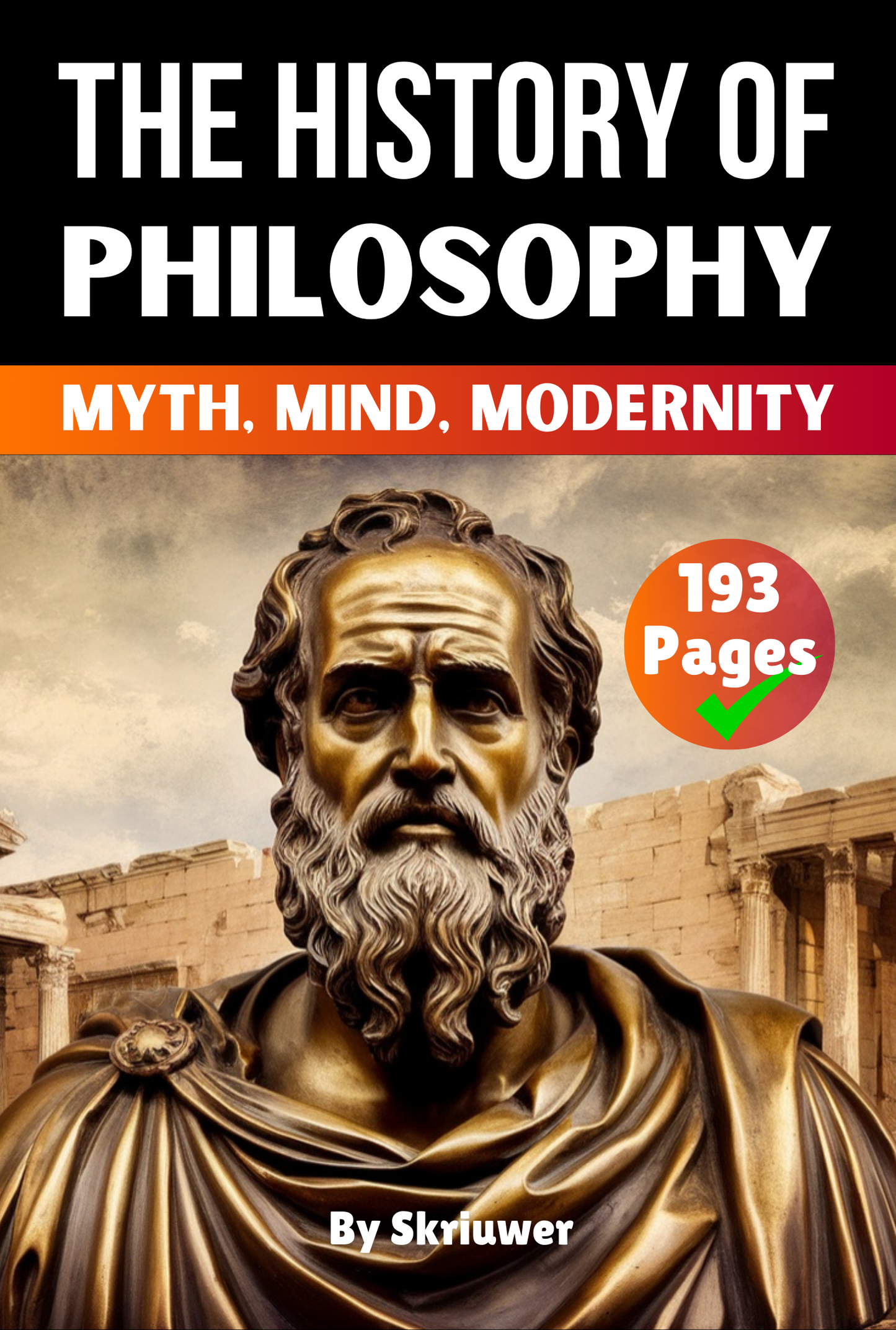

The History of Philosophy: Myth, Mind, Modernity | Paperback Book
Impossible de charger la disponibilité du service de retrait
This book traces the development of philosophy from ancient times to the modern era, exploring ideas across cultures and periods. It discusses how early myths evolved into systematic thought and influenced later thinkers.
Key Topics Covered:
- Ancient Origins: Influences from Mesopotamian and Egyptian traditions on early Greek philosophy.
- Classical Period: Figures like Socrates, Plato, and the role of institutions such as the Academy.
- Medieval Contributions: Preservation of texts by monks and advancements during the Islamic Golden Age, including thinkers like Avicenna.
- Enlightenment and Modern Philosophy: Shifts in reasoning, the Scientific Revolution, and ideas from figures like Nietzsche.
Additional Historical Points:
- Stoic Practices: Approaches to ethics and resilience.
- Religious and Political Interactions: Debates involving faith, reason, and society.
Reader Feedback Example: "This book covers contributions from various cultures and periods." — Dr. Eleanor R. (Philosophy Lecturer)
Book Features:
- Broad Scope: Connects ideas across civilizations.
- Intended Audience: Suitable for those interested in the evolution of philosophical thought.
TABLE OF CONTENTS
CHAPTER 1: THE ROOTS OF PHILOSOPHICAL THOUGHT – ANCIENT CIVILIZATIONS AND MYTHOLOGY
- Earliest mythological frameworks in Mesopotamia and Egypt
- How stories and religious beliefs paved the way for reason-based inquiry
- The shift from oral tradition to observational thinking
CHAPTER 2: THE PRE-SOCRATIC ERA AND PHILOSOPHICAL BEGINNINGS
- Rise of natural philosophy in Ionia
- Search for fundamental principles by Thales, Anaximander, and Anaximenes
- Debates on change, permanence, and the nature of reality
CHAPTER 3: THE LIFE AND TEACHINGS OF SOCRATES
- Socratic method and the pursuit of ethical living
- Importance of questioning and self-examination
- The trial of Socrates and its impact on Athenian thought
CHAPTER 4: PLATO’S THEORY OF FORMS AND THE ACADEMY
- Concept of eternal Forms as the highest reality
- Dialogue as a philosophical tool in Plato’s writings
- The founding of the Academy and its lasting influence
CHAPTER 5: ARISTOTLE AND THE LYCEUM
- Systematic approach to logic, science, and ethics
- Doctrine of the Golden Mean and virtuous living
- Establishment of the Lyceum as a center of learning
CHAPTER 6: THE HELLENISTIC AGE – STOICS, EPICUREANS, AND SKEPTICS
- Philosophy’s focus on happiness and tranquility
- Contrasting views on emotion and rational control in Stoicism vs. Epicureanism
- Skepticism’s challenge to certainty and dogmatic beliefs
CHAPTER 7: ROMAN PHILOSOPHY – CICERO, SENECA, AND THE GROWTH OF THOUGHT
- Adaptation of Greek philosophical schools for Roman values
- Cicero’s role in preserving and spreading Greek ideas
- Seneca’s moral insights and Stoic ethics in a practical context
CHAPTER 8: NEO-PLATONISM AND LATE ANCIENT PHILOSOPHY
- Plotinus’s concept of the One and the hierarchical universe
- Striving for spiritual ascent through contemplation
- Influence on early Christian thinkers and later medieval thought
CHAPTER 9: EARLY MEDIEVAL PHILOSOPHICAL DEVELOPMENTS
- Fusion of Christian doctrine with classical Greek and Roman ideas
- Preservation of knowledge through monastic scholarship
- Debates over faith, reason, and divine truth
CHAPTER 10: ISLAMIC GOLDEN AGE AND THE TRANSMISSION OF GREEK THOUGHT
- Role of translation movements in Baghdad and beyond
- Philosophical contributions of Al-Kindi, Al-Farabi, Avicenna, and Averroes
- Bridging ancient Greek ideas to the Latin West
CHAPTER 11: SCHOLASTICISM AND MEDIEVAL CHRISTIAN PHILOSOPHY
- Synthesis of Aristotle’s works with Christian theology
- Thomas Aquinas’s Five Ways and systematic approach to doctrine
- Impact of universities and structured debate on philosophical progress
CHAPTER 12: TRANSITION TO THE RENAISSANCE – RENEWED FOCUS ON HUMANISM
- Rediscovery of classical texts in Europe
- Humanist emphasis on individual potential and education
- Shifting from strictly religious themes to secular learning
CHAPTER 13: RENAISSANCE PHILOSOPHERS AND THEIR IMPACT
- Key figures shaping new views of art, science, and reason
- Reintroduction of Platonic and other ancient ideas
- Intellectual breakthroughs setting the stage for further change
CHAPTER 14: THE REFORMATION AND RELIGIOUS DEBATES
- Tensions between traditional authority and new doctrinal challenges
- Rise of personal interpretation and questioning established institutions
- Influence on political thought and freedom of conscience
CHAPTER 15: THE ROAD TO THE ENLIGHTENMENT – SCIENTIFIC DEVELOPMENTS AND RATIONAL THINKING
- Growth of observational methods and experimental science
- Challenges to medieval worldviews and superstition
- Laying the groundwork for a reason-centered cultural movement
CHAPTER 16: ENLIGHTENMENT PHILOSOPHERS – REASON, LIBERTY, AND PROGRESS
- Emphasis on rational inquiry and natural rights
- Social contract theories and the quest for political reform
- Optimism about human potential and societal improvement
CHAPTER 17: LATE ENLIGHTENMENT AND THE SHIFT TOWARD ROMANTICISM
- Growing emphasis on emotion, imagination, and individual experience
- Critiques of pure rationalism and mechanical views of nature
- Transition in cultural attitudes influencing philosophical directions
CHAPTER 18: EARLY 19TH-CENTURY PHILOSOPHY – IDEALISM AND ITS VARIANTS
- Focus on the primacy of mind or spirit as ultimate reality
- Influence of German Idealists on metaphysics and epistemology
- Debates on freedom, self-consciousness, and the nature of the Absolute
CHAPTER 19: MID-19TH-CENTURY PHILOSOPHY – SOCIAL CHANGE AND EMPIRICISM
- Philosophical responses to industrialization and social upheaval
- Refinement of empirical methods in understanding society and nature
- Growth of utilitarian and pragmatic thought
CHAPTER 20: CONCLUDING THE 19TH CENTURY – EXPANDING HORIZONS AND LEGACY
- Impact of historical, cultural, and scientific shifts on philosophy
- Summation of major schools of thought before modern developments
- Lasting influence on later generations and the transition into the 20th century
Product Details
Dimensions: 5.8 × 8.3 inches / 15.24 x 22.86 cm
Cover: Paperback

Why Skriuwer.com?
-
Supporting Frisian Language
When you buy from Skriuwer, you're not just getting a book—you’re helping create more Frisian books and educational resources like LearnFrisian.com. Your support directly helps us preserve and grow the Frisian language for future generations.
-
Making Languages Accessible
We believe in making languages easy to learn and accessible. While Frisian is our passion, we also want to help people learn other key languages like Dutch and English by providing helpful resources and learning tools.
-
Investing in Future Projects
Your purchase fuels more than just current projects. It helps us dream big and plan for the future, whether that’s developing new books, launching language-learning platforms, or supporting other educational initiatives. You're helping us build something lasting!
Préserver la langue frisonne
Chez Skriuwer.com, nous croyons que la langue frisonne est bien plus que des mots – c'est une partie vivante de notre héritage. Mais comme de nombreuses langues minoritaires, elle fait face à des défis de survie dans un monde en constante évolution. C'est pourquoi notre mission est simple mais essentielle : maintenir la langue frisonne vivante et florissante pour les générations futures.
Chaque livre que nous créons, chaque histoire que nous racontons et chaque mot que nous publions fait partie d'un effort plus large pour préserver et célébrer la culture frisonne. Mais nous ne pouvons pas le faire seuls. Avec votre aide, nous pouvons vraiment faire une différence.

Comment Vous Pouvez Aider :
Achetez un Livre : Lorsque vous achetez l'un de nos livres, vous n'ajoutez pas seulement une belle œuvre littéraire à votre collection – vous soutenez directement la préservation de la langue frisonne. Chaque livre contribue à diffuser la richesse de notre langue à davantage de personnes. Vous pouvez également contribuer à cette cause en apprenant la langue frisonne via notre site partenaire, www.learnfrisian.com.
Faites un Don : Si vous croyez en notre mission, vous pouvez également faire un don pour nous aider à poursuivre notre travail. Qu'il s'agisse de financer de nouvelles publications, de soutenir des programmes éducatifs ou de nous aider à toucher davantage de locuteurs frisons, votre don peut avoir un impact durable. Cliquez simplement sur le bouton ci-dessous pour contribuer !
Ensemble, nous pouvons faire en sorte que la langue frisonne reste une partie vivante de notre monde. Rejoignez-nous dans cette aventure – votre soutien aujourd'hui signifie un avenir plus radieux pour notre langue demain.