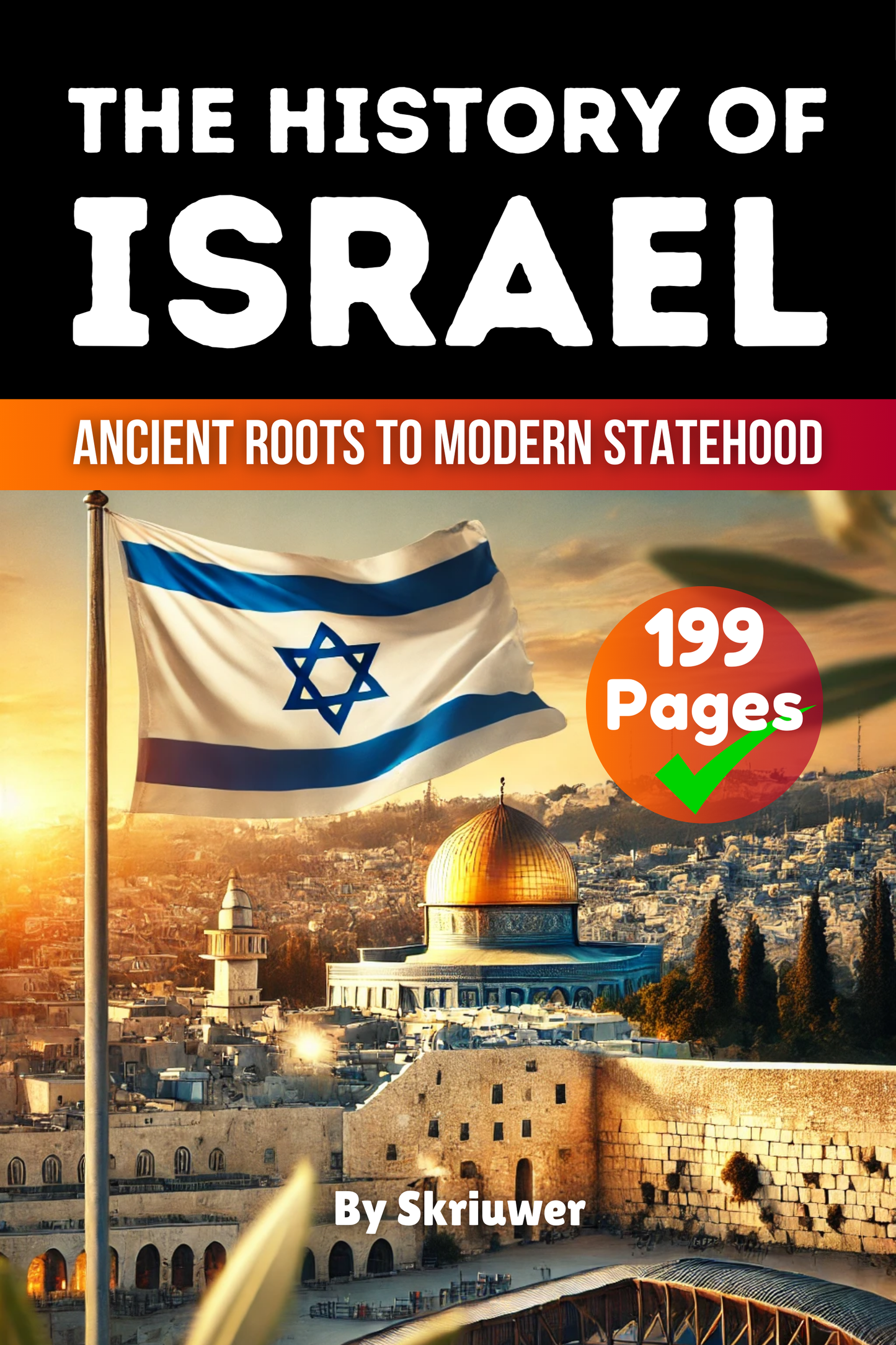
The History of Israel: Ancient Roots to Modern Statehood | Paperback Book
Impossible de charger la disponibilité du service de retrait
This book provides an overview of the history associated with the land of Israel and Judaism, spanning approximately 5,000 years from ancient times to the 20th century. It discusses archaeological findings, key figures, events, and cultural developments.
Key Topics Covered:
- Ancient Periods: Sites like Shechem and early religious practices.
- Biblical Era: Figures such as Abraham, King David, and Herod.
- Roman and Revolt Periods: The Bar Kokhba revolt and related artifacts.
- Medieval and Later Times: Interactions during Crusader, Mamluk, and Ottoman rule.
- Modern Era: The Balfour Declaration and events leading to 1948.
Additional Historical Points:
- Religious and Political Shifts: Influences from Persian, Greek, Islamic, and European powers.
- Archaeological Evidence: Discoveries including altars, siege structures, and documents.
Reader Feedback Example: "This book connects archaeology to historical events." — Dr. Rachel Stern (Hebrew University Archaeologist)
Book Features:
- Structured Chapters: Covers 20 main periods with references to sources.
- Intended Audience: Suitable for those interested in regional history and archaeology.
TABLE OF CONTENTS
CHAPTER 1: INTRODUCTION
- Overview of the region’s historical significance
- Approach and methodology for studying ancient Israel
- Purpose and structure of the book
CHAPTER 2: THE LAND AND ITS EARLIEST INHABITANTS
- Geographic features and climate
- Archaeological traces of prehistoric societies
- Transition from nomadic to settled life
CHAPTER 3: THE PATRIARCHAL TRADITIONS
- Oral narratives of Abraham, Isaac, and Jacob
- Historical context and cultural parallels
- Significance for later Israelite identity
CHAPTER 4: THE EXODUS AND SETTLEMENT
- Possible historical settings for the Exodus story
- Patterns of migration and settlement in Canaan
- Tribal confederations and early leadership
CHAPTER 5: THE RISE OF THE UNITED MONARCHY
- Saul’s kingship and early challenges
- David’s consolidation of power and Jerusalem’s importance
- Solomon’s building projects and administrative organization
CHAPTER 6: THE DIVIDED KINGDOM
- Causes behind the split after Solomon
- Rival monarchies of Israel and Judah
- Foreign alliances and internal conflicts
CHAPTER 7: THE BABYLONIAN EXILE
- The fall of Judah and destruction of Jerusalem
- Deportations and life in Babylon
- Religious and cultural developments in exile
CHAPTER 8: RETURN UNDER THE PERSIANS
- Cyrus’s decree and restoration efforts
- Rebuilding the Temple and Jerusalem’s challenges
- Religious reforms and scriptural codification
CHAPTER 9: GREEK INFLUENCE & HELLENISTIC TIMES
- Alexander the Great’s conquest and aftermath
- Cultural blending: Hellenism vs. local traditions
- Heightened tension and evolving identities
CHAPTER 10: THE MACCABEAN REVOLT AND HASMONEAN DYNASTY
- Causes and key figures of the revolt
- Emergence of an independent Jewish kingdom
- Shifts in religious and political power structures
CHAPTER 11: ROMAN CONQUEST AND RULE
- Incorporation of the region into the Roman Empire
- Herod the Great and monumental building projects
- Daily life under Roman administration
CHAPTER 12: THE GREAT JEWISH REVOLTS
- First Jewish–Roman War and the siege of Jerusalem
- The destruction of the Second Temple
- Bar Kokhba uprising and its repercussions
CHAPTER 13: LIFE UNDER BYZANTINE CONTROL
- Transition from Roman to Byzantine rule
- Spread of Christianity and monastic centers
- Religious policies affecting Jewish and Samaritan communities
CHAPTER 14: THE ARAB CONQUEST AND ISLAMIC PERIOD
- Early Islamic expansion into the Levant
- Administration under the Rashidun, Umayyads, and Abbasids
- Continuity of Christian and Jewish communities
CHAPTER 15: CRUSADER PRESENCE AND THE KINGDOM OF JERUSALEM
- Motivations and arrival of the First Crusade
- Establishment of Latin Christian states
- Impact on local Muslim, Christian, and Jewish populations
CHAPTER 16: MAMLUK DOMINANCE
- Defeat of the Crusaders and consolidation of Mamluk power
- Administrative structures and social framework
- Cultural, religious, and economic developments
CHAPTER 17: OTTOMAN CONTROL
- Selim I’s conquest and early Ottoman administration
- Provincial governance, timar system, and local autonomy
- Religious diversity and communal life under Ottoman rule
CHAPTER 18: THE LATE OTTOMAN ERA AND EARLY ZIONIST BEGINNINGS
- Tanzimat reforms and increased European influence
- Missionary activities and modernization efforts
- Emergence of proto-Zionist settlements and shifting land ownership
CHAPTER 19: WORLD WAR I AND THE BRITISH MANDATE
- Wartime diplomacy and the collapse of Ottoman authority
- The Balfour Declaration and conflicting promises
- League of Nations mandate, British policies, and communal tensions
CHAPTER 20: THE ROAD TO STATEHOOD
- UN Partition Plan and final British withdrawal
- Escalating conflict between Arab and Jewish communities
- Declaration of independence in 1948, concluding the historical survey
Product Details
Dimensions: 5.8 × 8.3 inches / 15.24 x 22.86 cm
Cover: Paperback

Why Skriuwer.com?
-
Supporting Frisian Language
When you buy from Skriuwer, you're not just getting a book—you’re helping create more Frisian books and educational resources like LearnFrisian.com. Your support directly helps us preserve and grow the Frisian language for future generations.
-
Making Languages Accessible
We believe in making languages easy to learn and accessible. While Frisian is our passion, we also want to help people learn other key languages like Dutch and English by providing helpful resources and learning tools.
-
Investing in Future Projects
Your purchase fuels more than just current projects. It helps us dream big and plan for the future, whether that’s developing new books, launching language-learning platforms, or supporting other educational initiatives. You're helping us build something lasting!
Préserver la langue frisonne
Chez Skriuwer.com, nous croyons que la langue frisonne est bien plus que des mots – c'est une partie vivante de notre héritage. Mais comme de nombreuses langues minoritaires, elle fait face à des défis de survie dans un monde en constante évolution. C'est pourquoi notre mission est simple mais essentielle : maintenir la langue frisonne vivante et florissante pour les générations futures.
Chaque livre que nous créons, chaque histoire que nous racontons et chaque mot que nous publions fait partie d'un effort plus large pour préserver et célébrer la culture frisonne. Mais nous ne pouvons pas le faire seuls. Avec votre aide, nous pouvons vraiment faire une différence.

Comment Vous Pouvez Aider :
Achetez un Livre : Lorsque vous achetez l'un de nos livres, vous n'ajoutez pas seulement une belle œuvre littéraire à votre collection – vous soutenez directement la préservation de la langue frisonne. Chaque livre contribue à diffuser la richesse de notre langue à davantage de personnes. Vous pouvez également contribuer à cette cause en apprenant la langue frisonne via notre site partenaire, www.learnfrisian.com.
Faites un Don : Si vous croyez en notre mission, vous pouvez également faire un don pour nous aider à poursuivre notre travail. Qu'il s'agisse de financer de nouvelles publications, de soutenir des programmes éducatifs ou de nous aider à toucher davantage de locuteurs frisons, votre don peut avoir un impact durable. Cliquez simplement sur le bouton ci-dessous pour contribuer !
Ensemble, nous pouvons faire en sorte que la langue frisonne reste une partie vivante de notre monde. Rejoignez-nous dans cette aventure – votre soutien aujourd'hui signifie un avenir plus radieux pour notre langue demain.