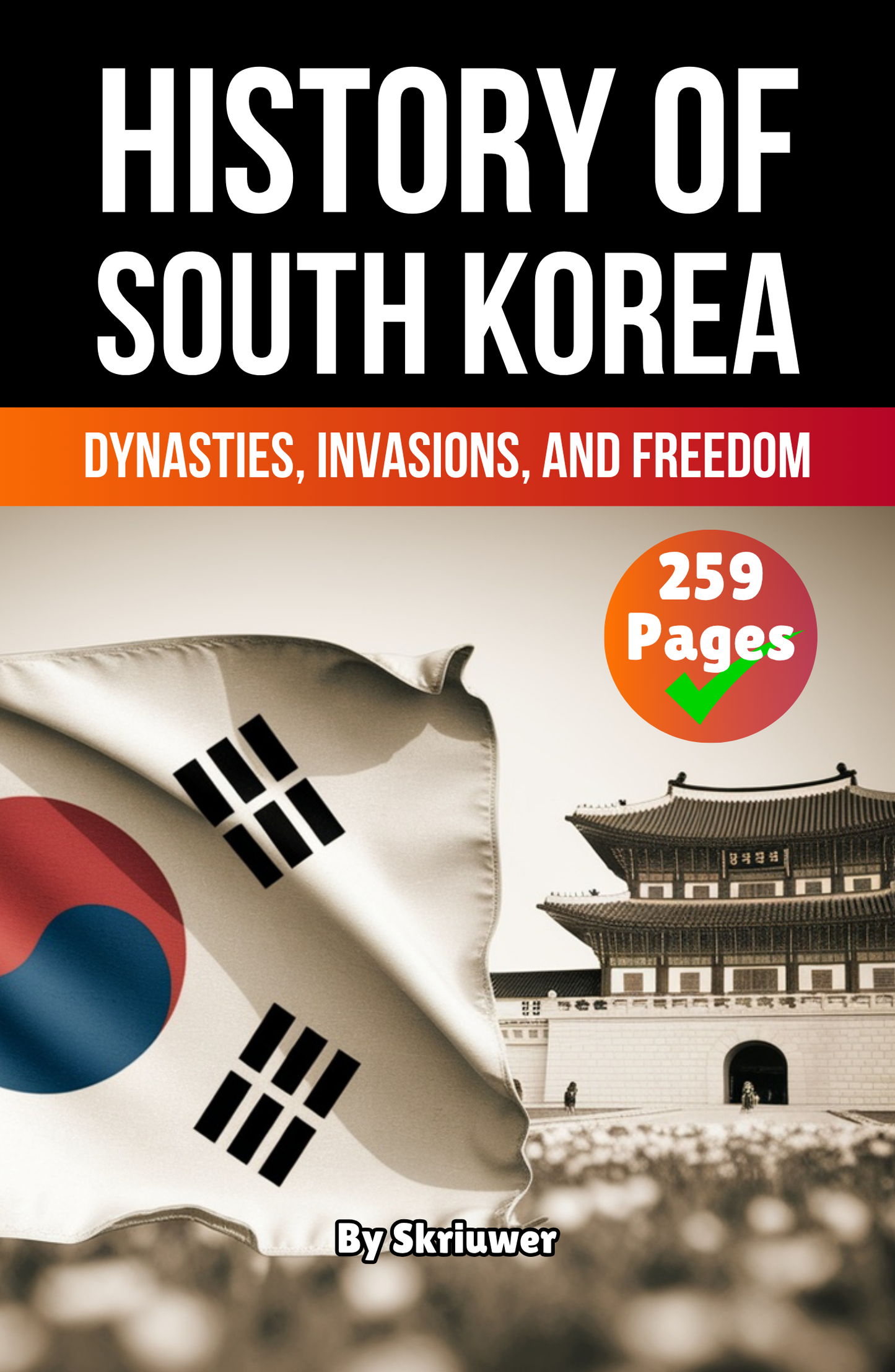
The History of South Korea: Dynasties, Invasions, and Freedom | Paperback Book
Det gick inte att ladda hämtningstillgänglighet
This book provides an overview of South Korea's history from ancient times to the modern era, covering political, cultural, and social developments. It discusses key figures, events, and changes that shaped the nation.
Key Topics Covered:
- Mythical and Early Periods: Legends like Dangun and the creation of Hangul script.
- Joseon Dynasty: Admiral Yi Sun-sin's naval innovations and defenses.
- Colonial Era: Japanese occupation (1910–1945), including impacts on language and society.
- Independence Movements: Events like the March 1st Movement and testimonies on historical issues.
- 20th Century: Military rule under Park Chung-hee, democratization protests, and division of the peninsula.
Additional Historical Points:
- Resistance Activities: Underground efforts and uprisings.
- Cultural Preservation: Efforts to maintain traditions during foreign rule.
- Modern Transitions: Economic growth and political shifts.
Reader Feedback Example: "This book covers historical events and their impacts." — Dr. Min-Jung Kim (Seoul National University Historian)
Book Features:
- Comprehensive Timeline: Spans from ancient legends to contemporary issues.
- Intended Audience: Suitable for those interested in Korean history and resilience themes.
TABLE OF CONTENTS
CHAPTER 1: INTRODUCTION: EARLY SETTLEMENT ON THE KOREAN PENINSULA
- Earliest people and archaeological clues
- Neolithic life and tribal communities
- Foundations of Korean mythology
CHAPTER 2: GOJOSEON AND THE FOUNDATION MYTHS
- Dangun legend and ancient origins
- Rise of Gojoseon and early state structures
- Historical evidence and legendary narrative
CHAPTER 3: THE THREE KINGDOMS: GOGURYEO, BAEKJE, AND SILLA
- Formation and rivalry among the Three Kingdoms
- Military conflicts and cultural developments
- Shaping the peninsula’s political landscape
CHAPTER 4: THE SPREAD OF BUDDHISM AND CULTURAL GROWTH
- Arrival of Buddhism in the Three Kingdoms
- Influence on art, architecture, and learning
- Integration of religion into society
CHAPTER 5: THE RISE OF SILLA AND UNIFICATION
- Silla’s expansion and diplomatic strategies
- Wars of unification and national consolidation
- Effects of a unified peninsula on culture
CHAPTER 6: LATER THREE KINGDOMS AND THE RISE OF GORYEO
- Political fragmentation after Unified Silla
- Emergence of new powers and reunification
- Founding principles of the Goryeo Dynasty
CHAPTER 7: GORYEO’S EARLY RULERS AND BALHAE
- Balhae’s fall and refugee influences
- Goryeo’s founding vision and leadership
- Territorial integration and regional diplomacy
CHAPTER 8: MONGOL INVASIONS AND INTERNAL STRUGGLES
- Goryeo’s resistance to Mongol forces
- Military pressure and cultural resilience
- Socio-political impacts of foreign domination
CHAPTER 9: CULTURAL ACHIEVEMENTS IN GORYEO
- Celadon pottery and artistic refinement
- Tripitaka Koreana and printing innovations
- Monastic life and enduring Buddhist influence
CHAPTER 10: FOUNDING OF JOSEON: KING TAEJO AND CONFUCIAN IDEALS
- Overthrow of Goryeo and establishing Joseon
- Land reforms and early state policies
- Rise of Confucian governance
CHAPTER 11: EARLY JOSEON SOCIETY AND REFORMS
- Yangban class and social hierarchy
- Military organization and tax policies
- Cultural framework shaped by Confucian ethics
CHAPTER 12: THE REIGN OF KING SEJONG THE GREAT
- Invention of Hangul and literary advances
- Scientific breakthroughs in astronomy and agriculture
- Balancing Confucian ideals with practical governance
CHAPTER 13: JAPANESE INVASIONS (IMJIN WAR) AND DEFENSE
- Hideyoshi’s ambitions and Joseon’s response
- Admiral Yi Sun-sin’s naval victories
- Aftermath and partial recovery
CHAPTER 14: FACTIONAL STRIFE AND LATE JOSEON
- Court politics and shifting power blocs
- Manchu invasions and foreign relations
- Conflicts leading to internal reforms
CHAPTER 15: WESTERN INFLUENCE AND INTERNAL REFORMS
- Arrival of Western powers and trade demands
- Catholic persecutions and gradual modernization
- Taewon’gun’s policies and the Ganghwa Treaty
CHAPTER 16: RISE OF NATIONAL CONSCIOUSNESS
- Donghak Peasant Revolution and Gabo Reforms
- Empress Myeongseong and power struggles
- Birth of the Korean Empire (Daehan Jeguk)
CHAPTER 17: JAPANESE COLONIZATION
- Annexation of Korea (1910) and colonial administration
- Harsh policies, forced labor, and cultural suppression
- Underground efforts to preserve identity
CHAPTER 18: INDEPENDENCE MOVEMENTS
- March First Movement (1919) and its legacy
- Korean Provisional Government in exile
- Guerrilla warfare and cultural nationalism
CHAPTER 19: THE ROAD TO LIBERATION
- Korea during World War II and forced mobilization
- Allied advances and Japan’s surrender
- Chaotic triumph of liberation in 1945
CHAPTER 20: REFLECTION ON THE HISTORICAL LEGACY
- Key themes of resilience, culture, and unity
- Lessons from dynastic transitions and colonial struggles
- Continuities into modern identity and commemoration
Product Details
Dimensions: 5.8 × 8.3 inches / 15.24 x 22.86 cm
Cover: Paperback

Why Skriuwer.com?
-
Supporting Frisian Language
When you buy from Skriuwer, you're not just getting a book—you’re helping create more Frisian books and educational resources like LearnFrisian.com. Your support directly helps us preserve and grow the Frisian language for future generations.
-
Making Languages Accessible
We believe in making languages easy to learn and accessible. While Frisian is our passion, we also want to help people learn other key languages like Dutch and English by providing helpful resources and learning tools.
-
Investing in Future Projects
Your purchase fuels more than just current projects. It helps us dream big and plan for the future, whether that’s developing new books, launching language-learning platforms, or supporting other educational initiatives. You're helping us build something lasting!
Bevarande av det frisiska språket
På Skriuwer.com tror vi att det frisiska språket är mer än bara ord – det är en levande del av vårt arv. Men precis som många minoritetsspråk står frisiskan inför överlevnadsutmaningar i en ständigt föränderlig värld. Det är därför vår mission är enkel men avgörande: att hålla det frisiska språket levande och blomstrande för framtida generationer.
Varje bok vi skapar, varje berättelse vi berättar och varje ord vi publicerar är en del av en större insats för att bevara och fira den frisiska kulturen. Men vi kan inte göra det ensamma. Med din hjälp kan vi göra en verklig skillnad.

Hur Du Kan Hjälpa:
Köp en Bok: När du köper en av våra böcker lägger du inte bara till ett vackert litterärt verk i din samling – du stödjer direkt bevarandet av det frisiska språket. Varje bok hjälper till att sprida rikedomarna i vårt språk till fler människor. Du kan också bidra till denna sak genom att lära dig frisiskan via vår partnersida, www.learnfrisian.com.
Donera: Om du tror på vårt uppdrag kan du också göra en insats för att hjälpa oss att fortsätta vårt arbete. Oavsett om det handlar om att finansiera nya publikationer, stödja utbildningsprogram eller hjälpa oss att nå fler frisistalare, kan din donation ha en varaktig inverkan. Klicka bara på knappen nedan för att bidra!
Tillsammans kan vi säkerställa att det frisiska språket förblir en levande del av vår värld. Följ med oss på denna resa – ditt stöd idag innebär en ljusare framtid för vårt språk imorgon.