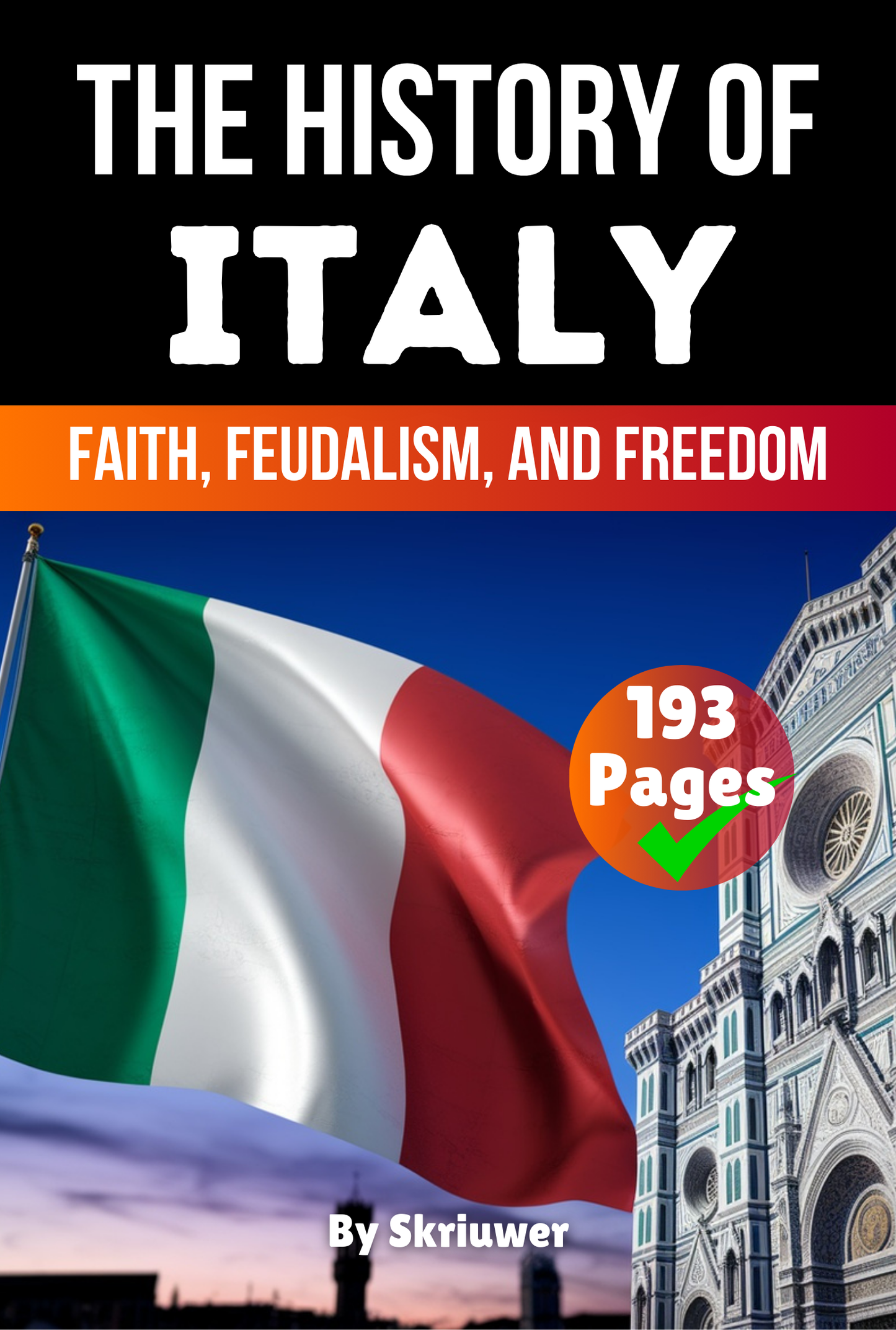
The History of Italy: Faith, Feudalism, Freedom | Paperback Book
Det gick inte att ladda hämtningstillgänglighet
This book provides an overview of Italy's history over 3,000 years, from ancient origins to unification in the 19th century. It covers political, cultural, and artistic developments across periods.
Key Topics Covered:
- Ancient Rome: Growth from early settlements to empire and factors in its decline.
- Medieval Period: Feudal structures, city-states, and interactions between religious and secular powers.
- Renaissance Era: Contributions from figures like Leonardo da Vinci and the Medici family.
- Unification Movement: Efforts by leaders such as Giuseppe Garibaldi, Giuseppe Mazzini, and Camillo Benso di Cavour.
Reader Feedback Example: "This book presents Italian history in an accessible way." — Curiosity77 (Verified Purchase)
Book Features:
- Comprehensive Timeline: Explores major eras with focus on key events and figures.
- Intended Audience: Suitable for those interested in European history, art, or travel to Italy.
TABLE OF CONTENTS
CHAPTER 1: INTRODUCTION – PREHISTORIC ITALY
- Early human settlements and migration patterns
- Impact of geography on prehistoric communities
- Archaeological discoveries and cave art
- Transition from hunter-gatherers to farming societies
CHAPTER 2: THE ETRUSCANS AND GREEK COLONIES
- Origins of the Etruscans and their culture
- Growth of Greek colonies in Southern Italy
- Artistic and architectural exchanges
- Influence on the future Roman civilization
CHAPTER 3: THE RISE OF ROME
- Founding legends and early Rome
- Social structure and political organization
- Expansion beyond the city’s borders
- Conflicts with neighboring tribes and Etruscans
CHAPTER 4: THE ROMAN REPUBLIC’S EXPANSION
- Development of republican institutions
- Conquest of the Italian peninsula
- Hannibal and the Punic Wars
- Effects of territorial growth on society
CHAPTER 5: THE TRANSITION TO THE ROMAN EMPIRE
- Internal strife and the end of the Republic
- Rise of influential leaders like Julius Caesar
- Formation of the Second Triumvirate
- Augustus and the birth of the Principate
CHAPTER 6: THE PAX ROMANA
- Stability and prosperity under Imperial rule
- Expansion to Europe, Asia, and Africa
- Infrastructure: roads, aqueducts, and cities
- Cultural integration and Roman law
CHAPTER 7: THE CRISIS OF THE THIRD CENTURY
- Economic challenges and inflation
- Threat of invasions and military turmoil
- Rise of soldier-emperors and regional power shifts
- Efforts to stabilize the empire
CHAPTER 8: THE LATE EMPIRE AND CHRISTIANITY
- Reforms under Diocletian and Constantine
- Founding of Constantinople
- Spread and acceptance of Christianity
- Social changes in the waning empire
CHAPTER 9: THE FALL OF ROME AND THE OSTROGOTHS
- Causes of the Western Empire’s collapse
- Arrival and rule of the Ostrogoths in Italy
- Role of Theodoric the Great
- Transition from Roman to Germanic rule
CHAPTER 10: THE LOMBARDS AND THE EARLY MIDDLE AGES
- Lombard settlement and governance
- Impact on Italian culture and society
- Church influence and conversion
- Emergence of localized power structures
CHAPTER 11: THE CAROLINGIANS AND EMERGENCE OF CITY-STATES
- Charlemagne’s campaign and influence in Italy
- Integration with the Holy Roman Empire
- Rise of medieval communes and civic identity
- Feudal and urban tensions
CHAPTER 12: THE RISE OF THE MARITIME REPUBLICS
- Founding of Venice, Genoa, Pisa, and Amalfi
- Trade networks and commercial expansion
- Naval power and territorial outposts
- Cultural and political independence
CHAPTER 13: THE KINGDOM OF SICILY AND SOUTHERN ITALY
- Norman Conquest in the south
- Fusion of Latin, Greek, and Arab cultures
- Prominent rulers like Roger II
- Socioeconomic impact on the region
CHAPTER 14: THE AGE OF THE COMMUNES AND MERCHANT CITIES
- Growth of independent city-states in the north
- Role of guilds and merchant families
- Conflicts between Guelfs and Ghibellines
- Urban prosperity and competition
CHAPTER 15: THE RENAISSANCE IN FLORENCE AND BEYOND
- Humanism and revival of classical learning
- Artistic achievements of figures like Leonardo and Michelangelo
- Patronage by the Medici and other elites
- Spread of new ideas to other Italian centers
CHAPTER 16: THE SPANISH AND AUSTRIAN HABSBURG DOMINATIONS
- Foreign powers and shifts in sovereignty
- Rebellions and local resistance
- Economic pressures and social changes
- Religious tensions and policies
CHAPTER 17: THE PAPAL STATES AND RELIGIOUS INFLUENCE
- Papal temporal power in central Italy
- Church administration and politics
- Relations with European powers
- Cultural developments under religious patronage
CHAPTER 18: THE ENLIGHTENMENT AND REVOLUTIONARY MOVEMENTS
- Spread of Enlightenment ideas in the peninsula
- Effects of the French Revolution on Italian states
- Rise of nationalist and liberal sentiments
- Early uprisings and secret societies
CHAPTER 19: THE NAPOLEONIC ERA AND THE RESTORATION
- Napoleon’s conquest and reorganization of Italy
- Formation of new political units
- Congress of Vienna and the return of old rulers
- Seeds of discontent fueling future revolts
CHAPTER 20: THE RISORGIMENTO AND THE ROAD TO UNIFICATION
- Key figures like Mazzini, Garibaldi, and Cavour
- Military campaigns for independence
- Diplomatic maneuvers and alliances
- Proclamation of the Kingdom of Italy
Product Details
Dimensions: 5.8 × 8.3 inches / 15.24 x 22.86 cm
Cover: Paperback

Why Skriuwer.com?
-
Supporting Frisian Language
When you buy from Skriuwer, you're not just getting a book—you’re helping create more Frisian books and educational resources like LearnFrisian.com. Your support directly helps us preserve and grow the Frisian language for future generations.
-
Making Languages Accessible
We believe in making languages easy to learn and accessible. While Frisian is our passion, we also want to help people learn other key languages like Dutch and English by providing helpful resources and learning tools.
-
Investing in Future Projects
Your purchase fuels more than just current projects. It helps us dream big and plan for the future, whether that’s developing new books, launching language-learning platforms, or supporting other educational initiatives. You're helping us build something lasting!
Bevarande av det frisiska språket
På Skriuwer.com tror vi att det frisiska språket är mer än bara ord – det är en levande del av vårt arv. Men precis som många minoritetsspråk står frisiskan inför överlevnadsutmaningar i en ständigt föränderlig värld. Det är därför vår mission är enkel men avgörande: att hålla det frisiska språket levande och blomstrande för framtida generationer.
Varje bok vi skapar, varje berättelse vi berättar och varje ord vi publicerar är en del av en större insats för att bevara och fira den frisiska kulturen. Men vi kan inte göra det ensamma. Med din hjälp kan vi göra en verklig skillnad.
Hur Du Kan Hjälpa:
Köp en Bok: När du köper en av våra böcker lägger du inte bara till ett vackert litterärt verk i din samling – du stödjer direkt bevarandet av det frisiska språket. Varje bok hjälper till att sprida rikedomarna i vårt språk till fler människor. Du kan också bidra till denna sak genom att lära dig frisiskan via vår partnersida, www.learnfrisian.com.
Donera: Om du tror på vårt uppdrag kan du också göra en insats för att hjälpa oss att fortsätta vårt arbete. Oavsett om det handlar om att finansiera nya publikationer, stödja utbildningsprogram eller hjälpa oss att nå fler frisistalare, kan din donation ha en varaktig inverkan. Klicka bara på knappen nedan för att bidra!
Tillsammans kan vi säkerställa att det frisiska språket förblir en levande del av vår värld. Följ med oss på denna resa – ditt stöd idag innebär en ljusare framtid för vårt språk imorgon.