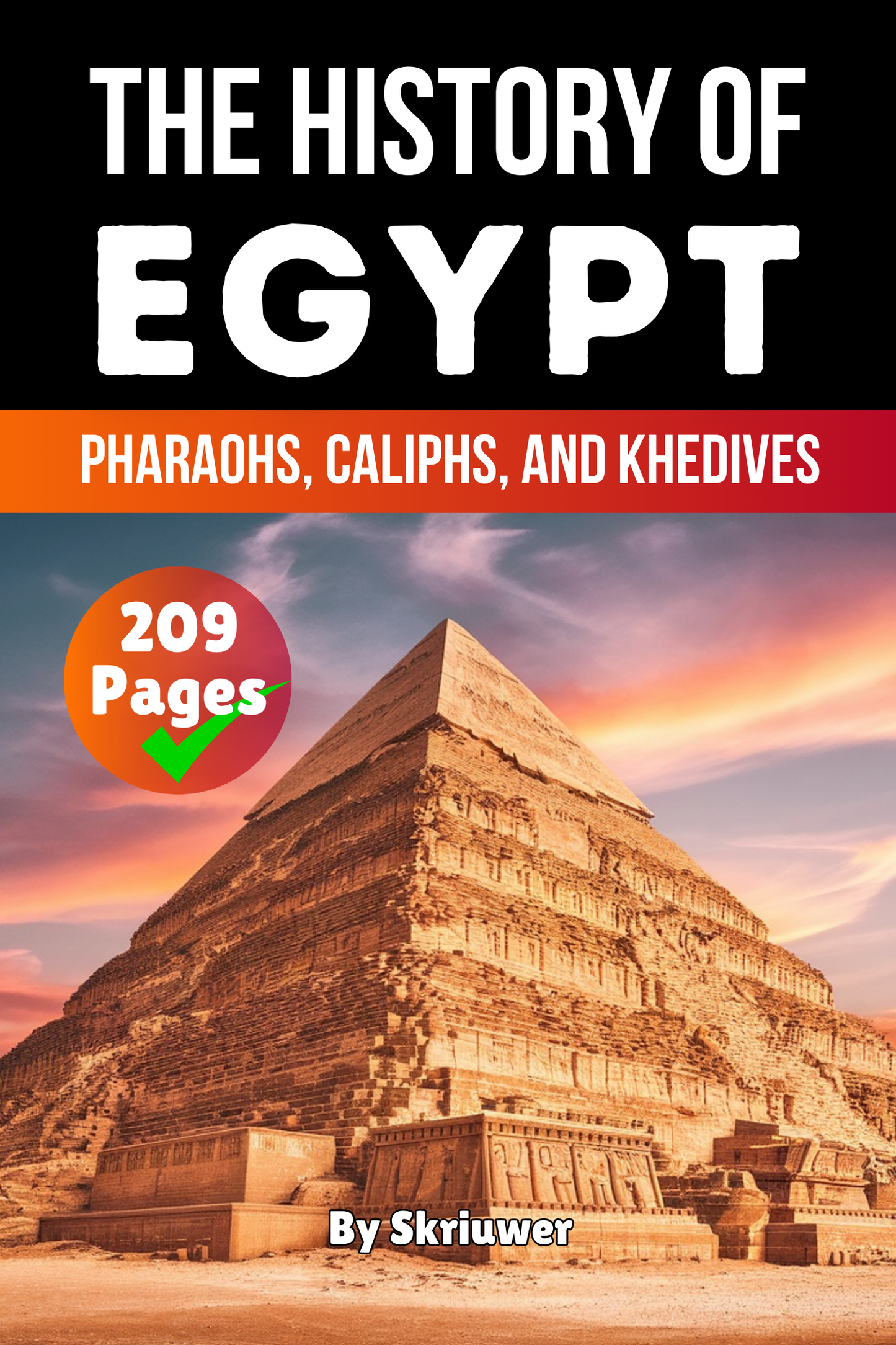

The History of Egypt: Pharaohs, Caliphs, and Khedives | Paperback Book
Det gick inte att ladda hämtningstillgänglighet
This book traces the history of Egypt from ancient times to the modern era, focusing on the Nile River's influence on its development. It covers key periods, rulers, and events that shaped the region.
- Ancient Period: The unification of Upper and Lower Egypt by early pharaohs and the role of pyramid construction in society.
- Ptolemaic and Roman Era: Cleopatra's alliances and conflicts with Rome.
- Medieval Period: Saladin's recapture of Jerusalem and the Mamluks' defense against Mongol invasions.
- Islamic and Ottoman Times: The cultural and scientific advancements during the Islamic Golden Age in Egypt, and Muhammad Ali's reforms.
- Environmental Factors: The Nile's floods and droughts affecting political stability.
The narrative connects historical events to broader themes of power and survival, drawing on archaeological and historical records.
Key Historical Contexts
Egypt's history is marked by the Nile's central role, providing fertile land for agriculture and enabling the rise of one of the earliest civilizations. Research suggests that environmental changes, such as droughts, contributed to social upheavals, though direct causation remains debated. The Islamic period in Egypt saw significant intellectual flourishing, part of the broader Islamic Golden Age, with Cairo becoming a center of learning.
Book Features and Audience
Suitable for those interested in comprehensive histories like Sapiens or Cleopatra: A Life, the book integrates themes across eras without sensationalism.
TABLE OF CONTENTS
CHAPTER 1: INTRODUCTION
- Geographic overview and the role of the Nile
- Key historical themes shaping Egypt’s identity
- Chronological framework and major eras
CHAPTER 2: PREHISTORIC EGYPT
- Transition from hunter-gatherers to settled farming
- Earliest human activity along the Nile Valley
- Foundations for later cultural development
CHAPTER 3: THE PREDYNASTIC PERIOD
- Distinct regional cultures (Badari, Naqada, Maadi-Buto)
- Increasing social complexity and craft specialization
- Momentum toward political unification
CHAPTER 4: THE EARLY DYNASTIC PERIOD
- First pharaohs establishing centralized rule
- Emergence of royal iconography and administration
- Consolidation of Upper and Lower Egypt
CHAPTER 5: THE OLD KINGDOM
- Construction of pyramids as state-sponsored projects
- Heightened pharaonic power and religious ideology
- Economic and social structures supporting large-scale building
CHAPTER 6: THE FIRST INTERMEDIATE PERIOD
- Collapse of Old Kingdom’s central authority
- Local rulers and nomarchs vying for power
- Social and cultural shifts amidst political fragmentation
CHAPTER 7: THE MIDDLE KINGDOM
- Reunification under strong pharaohs
- Administrative reforms and bureaucratic efficiency
- Literary and artistic achievements reflecting a stable society
CHAPTER 8: THE SECOND INTERMEDIATE PERIOD
- Another breakdown of centralized power
- Hyksos dominance in the Delta and Theban resistance
- Struggle leading to eventual reunification under Thebes
CHAPTER 9: THE NEW KINGDOM
- Egypt’s imperial expansions and military campaigns
- Famous rulers like Hatshepsut, Thutmose III, and Ramses II
- Vast temple-building and flourishing trade networks
CHAPTER 10: THE THIRD INTERMEDIATE PERIOD
- Decline after the New Kingdom’s peak
- Rise of Libyan and Nubian influences in rulership
- Fragmented political landscape and shifting alliances
CHAPTER 11: THE LATE PERIOD
- Saite Dynasty’s attempts at cultural revival
- Growing threats from regional powers, especially Persia
- Reform efforts in administration and military organization
CHAPTER 12: THE PERSIAN CONQUEST AND AFTERMATH
- Persian rule and local revolts against foreign domination
- Periods of Persian withdrawal and return
- Ultimate replacement by Alexander the Great’s forces
CHAPTER 13: THE GRECO-ROMAN PERIOD
- Ptolemaic dynasty blending Greek and Egyptian traditions
- Alexandria as a hub of learning and commerce
- Transition to Roman governance and gradual Christian influence
CHAPTER 14: CHRISTIAN EGYPT AND THE COPTIC ERA
- Emergence and spread of Christianity under Roman rule
- Formation of the Coptic Church with its Miaphysite stance
- Monastic movements and religious debates shaping society
CHAPTER 15: THE ARAB CONQUEST OF EGYPT
- End of Byzantine control through Islamic expansion
- Introduction of new administrative and religious frameworks
- Foundations for centuries of Islamic governance
CHAPTER 16: THE FATIMID ERA
- Isma‘ili Shi‘a caliphate centered in Cairo
- Cultural and architectural achievements under Fatimid patronage
- Decline paving the way for other Islamic dynasties
CHAPTER 17: THE AYYUBID AND MAMLUK PERIODS
- Saladin’s Sunni restoration and anti-Crusader campaigns
- Rise of the Mamluk military elite and their sultanate
- Monumental building, scholarship, and defense against Mongols
CHAPTER 18: THE OTTOMAN PERIOD
- Egypt as an Ottoman province governed by appointed pashas
- Residual Mamluk power and local autonomy within imperial structures
- Gradual weakening of centralized Ottoman authority
CHAPTER 19: EGYPT UNDER MUHAMMAD ALI AND HIS SUCCESSORS
- Sweeping military and economic reforms forging modern institutions
- Heightened foreign involvement and projects like the Suez Canal
- Attempts at modernization under a hereditary dynasty
CHAPTER 20: CONCLUSION
- Major themes of resilience, cultural synthesis, and the Nile’s continuity
- Review of Egypt’s transitions from ancient times through the 19th century
- Reflections on the enduring legacy of Egyptian history
Product Details
Dimensions: 5.8 × 8.3 inches / 15.24 x 22.86 cm
Cover: Paperback

Why Skriuwer.com?
-
Supporting Frisian Language
When you buy from Skriuwer, you're not just getting a book—you’re helping create more Frisian books and educational resources like LearnFrisian.com. Your support directly helps us preserve and grow the Frisian language for future generations.
-
Making Languages Accessible
We believe in making languages easy to learn and accessible. While Frisian is our passion, we also want to help people learn other key languages like Dutch and English by providing helpful resources and learning tools.
-
Investing in Future Projects
Your purchase fuels more than just current projects. It helps us dream big and plan for the future, whether that’s developing new books, launching language-learning platforms, or supporting other educational initiatives. You're helping us build something lasting!
Bevarande av det frisiska språket
På Skriuwer.com tror vi att det frisiska språket är mer än bara ord – det är en levande del av vårt arv. Men precis som många minoritetsspråk står frisiskan inför överlevnadsutmaningar i en ständigt föränderlig värld. Det är därför vår mission är enkel men avgörande: att hålla det frisiska språket levande och blomstrande för framtida generationer.
Varje bok vi skapar, varje berättelse vi berättar och varje ord vi publicerar är en del av en större insats för att bevara och fira den frisiska kulturen. Men vi kan inte göra det ensamma. Med din hjälp kan vi göra en verklig skillnad.

Hur Du Kan Hjälpa:
Köp en Bok: När du köper en av våra böcker lägger du inte bara till ett vackert litterärt verk i din samling – du stödjer direkt bevarandet av det frisiska språket. Varje bok hjälper till att sprida rikedomarna i vårt språk till fler människor. Du kan också bidra till denna sak genom att lära dig frisiskan via vår partnersida, www.learnfrisian.com.
Donera: Om du tror på vårt uppdrag kan du också göra en insats för att hjälpa oss att fortsätta vårt arbete. Oavsett om det handlar om att finansiera nya publikationer, stödja utbildningsprogram eller hjälpa oss att nå fler frisistalare, kan din donation ha en varaktig inverkan. Klicka bara på knappen nedan för att bidra!
Tillsammans kan vi säkerställa att det frisiska språket förblir en levande del av vår värld. Följ med oss på denna resa – ditt stöd idag innebär en ljusare framtid för vårt språk imorgon.