
What Is Manifest Destiny? Origins, Religion, And Impact
Most Americans learn about what is Manifest Destiny in a single textbook paragraph, a belief that the United States was destined to stretch from coast to coast. That sanitized summary skips the ugly parts: the forced removals, the religious fervor weaponized to justify conquest, and the political machinery that turned an ideology into policy. The full story is far more uncomfortable than a one-line definition suggests.
Manifest Destiny was the 19th-century conviction that American expansion across the North American continent was not only justified but divinely ordained. It fused Protestant theology with territorial ambition, giving settlers and politicians a moral framework for displacing Indigenous nations, provoking war with Mexico, and reshaping an entire continent. Its consequences didn't end when the frontier closed, they echo through American foreign policy and national identity to this day.
At Skriuwer, we publish the kind of history that mainstream outlets tend to gloss over, the uncomfortable chapters, the unfiltered perspectives, the stories that challenge what you thought you knew. Manifest Destiny fits squarely in that tradition. This article breaks down its origins, the religious and political forces behind it, and the real-world impact it had on millions of people who stood in its path. No textbook gloss. Just the history.
Why Manifest Destiny mattered in US history
Manifest Destiny wasn't just a slogan. It was the ideological engine behind one of the most dramatic territorial expansions in modern history, one that reshaped a continent in less than a century. To understand what is Manifest Destiny in its full context, you need to understand why it carried so much weight, not just as a phrase, but as a justification system that touched politics, religion, law, and war simultaneously. Few belief systems have done that much damage, or driven that much change, in such a short span of time.
The scale of territorial change
Between 1800 and 1890, the United States grew from roughly 800,000 square miles to over 3 million. That is not incremental growth. That is a deliberate, state-backed campaign to acquire land through purchase, war, treaty, and outright seizure. The Louisiana Purchase in 1803 doubled the country's size overnight. The Mexican-American War of 1846 to 1848 stripped Mexico of nearly half its territory, handing the US what is now California, Nevada, Utah, Arizona, New Mexico, and parts of Colorado and Wyoming. None of this happened by accident. Manifest Destiny gave politicians and settlers a ready-made justification for every acquisition.
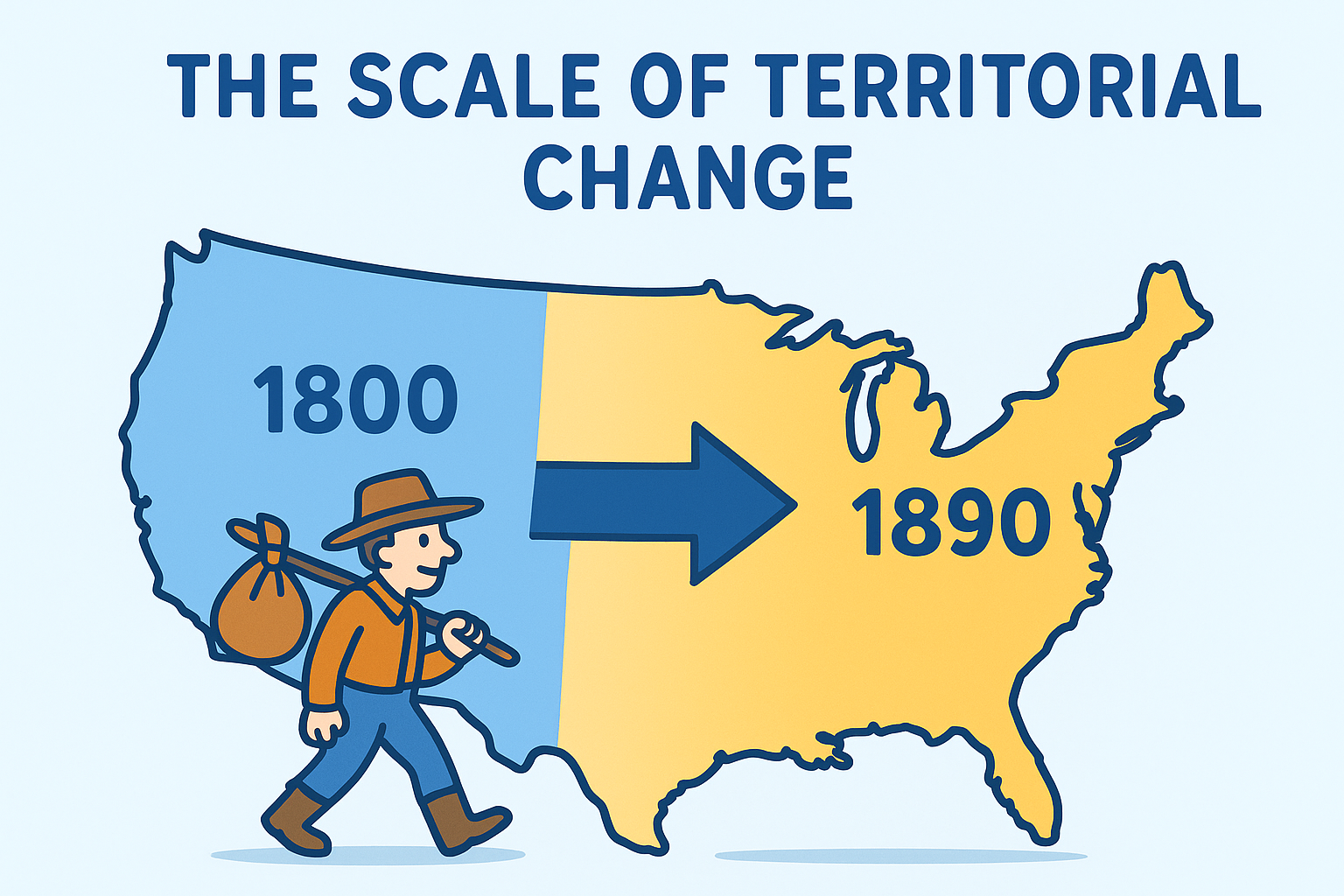
The US added more than 2 million square miles of territory in roughly 90 years, a pace of expansion with no real precedent among democratic nations.
Why the ideology, not just the territory, mattered
Territory changes on a map are one thing. What Manifest Destiny did to American political culture is something else entirely. It embedded the idea that expansion was a moral act, not just a strategic one. When a nation decides that its growth is divinely sanctioned, it stops asking permission and stops counting the cost to those in the way. That shift in national self-perception carried consequences that extended far beyond the 19th century.
You can trace a direct line from Manifest Destiny to how the United States justified later interventions in Latin America, the Pacific, and beyond. The same logic that cleared the Great Plains for white settlers later showed up in American foreign policy frameworks like the Monroe Doctrine and, much later, in Cold War rhetoric about spreading democracy. The ideology outlived the frontier.
How it shaped national identity
Americans today still carry the assumption that US power is inherently legitimate, that the country has a special role to play in world affairs. That assumption has roots in Manifest Destiny. The doctrine taught generations of Americans that their country's success was not just fortunate but proof of a higher purpose. That belief made it much harder to reckon honestly with what expansion actually cost: the lives, the cultures, the land, and the treaties signed and broken without real consequence.
Understanding why this ideology mattered means sitting with both sides of it. The territorial gains produced enormous economic and geopolitical power. The human cost was staggering and deliberately obscured for most of American history. That tension is exactly why Manifest Destiny deserves far more than a textbook footnote.
Where the idea came from and who coined it
The phrase itself has a specific origin point, but the beliefs behind it stretch back much further than 1845. To understand what is Manifest Destiny in full, you need to separate the label from the ideology it put a name to. One man wrote the words. Decades of American political and religious thought built the foundation under them.
John L. O'Sullivan and the phrase that stuck
John L. O'Sullivan was a journalist and editor of the United States Magazine and Democratic Review. In an 1845 essay arguing for the annexation of Texas, he wrote that it was "the fulfillment of our manifest destiny to overspread the continent allotted by Providence for the free development of our yearly multiplying millions." O'Sullivan was a Democratic Party advocate, and his writing reflected a political agenda as much as a philosophical one. He wanted to sell expansion to the American public, and the phrase landed exactly as intended.
O'Sullivan used the term again that same year in reference to Oregon, helping cement it as the standard shorthand for American expansionist ideology across newspapers and political speeches.
O'Sullivan did not invent the underlying conviction. He packaged existing beliefs into a phrase that politicians, newspaper editors, and settlers could repeat and rally around. His contribution was rhetorical, not ideological. The ideas already existed in full. He just gave them a name that stuck.
The older roots of the idea
Long before O'Sullivan put a label on it, American leaders had been building the intellectual scaffolding for continental expansion. John Winthrop's 1630 sermon described the Massachusetts Bay Colony as "a city upon a hill," watched by the world as a model of godly society. That Puritan conviction of special divine purpose planted itself deep in the American self-image and shaped how later generations understood national growth.
Thomas Jefferson expanded on that foundation when he described his vision of an "empire of liberty" stretching westward across the continent. Jefferson saw territorial growth as essential to sustaining a republic of independent farmers, which he believed was the only stable base for democratic government. By the time O'Sullivan coined his phrase, these ideas had already shaped two centuries of American political thought. The 1845 essay did not launch an ideology. It named one that had been operating for generations.
Religion, race, and politics used to justify it
Understanding what is Manifest Destiny means understanding the three-layered justification system that made it feel legitimate to the people who carried it out. Religion, race, and politics did not operate separately. They reinforced each other in ways that made expansion feel inevitable, righteous, and beyond serious moral question to those who benefited from it.
Protestant theology as a moral license
Protestant Christianity provided the first and most powerful layer of justification. The idea that God had set aside the American continent specifically for Anglo-Protestant civilization ran through sermons, speeches, and school curricula throughout the 19th century. Ministers framed westward expansion as a sacred obligation, not a political choice. Settlers were not taking land. They were fulfilling a divine plan.
This framing did something specific to the people it reached. When you tell a population that conquest is God's work, you remove the moral friction that might otherwise slow it down. Killing, displacing, and dispossessing others became acts of faith in this framework, spiritually repackaged so that ordinary people could participate without confronting what they were actually doing.
Racial hierarchy and the logic of civilization
Race provided the second layer, and it was explicitly pseudo-scientific by the mid-19th century. Influential writers and academics argued that Anglo-Saxon people represented the highest stage of civilizational development and that other races were either incapable of self-governance or too primitive to make legitimate use of the land they occupied. This gave expansion a biological justification to stack on top of the religious one.
The combination of divine mandate and racial hierarchy made Manifest Destiny nearly impossible to argue against from inside mainstream American culture during the 1840s and 1850s.
Politics and the machinery of expansion
Politicians turned these beliefs into legislation, military action, and treaty frameworks that formalized what ideology had already sanctioned. The Indian Removal Act of 1830 predated O'Sullivan's phrase but operated on the same foundational logic. Congressional debates over westward expansion consistently invoked both God and race to silence opposition and build consensus. Expansion was not a policy to be debated. It was a national mission that opponents were made to feel they were working against.
Each layer of justification protected the others. Religion made expansion righteous. Racial theory made it logical. Politics made it law. Together, they made the dispossession of millions feel like the natural order of things to those in power.
How Manifest Destiny shaped westward expansion
When you ask what is Manifest Destiny in practical terms, the most direct answer is this: it was the belief system that turned westward expansion from a possibility into a policy. The ideology did not just follow the wagon trains and military campaigns west. It came first, clearing the political and moral ground so that government action, settler migration, and military force could all move together in the same direction.
The trails and routes that built momentum
By the 1840s, migration routes like the Oregon Trail and the Santa Fe Trail were already channeling tens of thousands of settlers westward each year. These were not casual journeys. Families crossed over 2,000 miles of unfamiliar terrain on the assumption that land was waiting for them, land they had a right to claim. That assumption did not come from nowhere. It came from a cultural environment saturated with the message that westward movement was both natural and righteous.
The federal government reinforced that message in concrete ways. The Preemption Act of 1841 gave settlers the right to claim land before it was formally surveyed or put up for sale. That policy essentially said: go ahead and take it, the paperwork will follow. The Homestead Act of 1862 took it further, offering 160 acres of public land to any head of household willing to farm it for five years. Together, these laws turned ideology into an official invitation backed by the full weight of federal authority.
The federal government did not passively observe westward settlement. It actively subsidized and accelerated it through land grants, military escorts, and legislation designed to reward movement west.
The military as the instrument of expansion
Settlers moved west with the expectation that the US Army would clear the path and hold the ground. That expectation was justified. Military campaigns against Native nations were frequent, coordinated, and explicitly tied to the goal of opening land for settlement. Fort construction followed migration routes, and cavalry units enforced treaties that consistently favored American expansion over Indigenous territorial rights. The military did not act as a neutral party in disputes over land. It acted as the enforcement arm of Manifest Destiny, translating ideology into physical control of the continent.
What it caused: war, displacement, and slavery conflict
When you trace what is Manifest Destiny from ideology to outcome, the results are hard to sanitize. The belief that American expansion was divinely ordained produced real consequences measured in lives, broken treaties, and political crises that eventually tore the country apart.
The Mexican-American War
The most direct military consequence of Manifest Destiny was the Mexican-American War, which ran from 1846 to 1848. President James K. Polk used a border skirmish as the pretext for a conflict that was, in practical terms, a land grab. The US sent troops into disputed territory, provoked a response, and used that response to justify a full-scale invasion of Mexico.
The Treaty of Guadalupe Hidalgo in 1848 forced Mexico to cede roughly 525,000 square miles of territory, approximately 55% of its total landmass, in exchange for $15 million.
Mexico's loss became one of the largest forced territorial transfers in the Western Hemisphere. Ulysses S. Grant, who fought in the war as a young officer, later called it "one of the most unjust ever waged by a stronger nation against a weaker nation."
Indigenous displacement and removal
The forced removal of Native nations was not a side effect of westward expansion. It was the central mechanism. Tribes across the Great Plains, the Southwest, and the Pacific Northwest were pushed off their land through a combination of forced treaties, military campaigns, and deliberate destruction of food sources. The buffalo herds that sustained Plains nations were systematically hunted to near extinction as a policy tool, not an accident.
Hundreds of thousands of Indigenous people died from violence, starvation, and disease during the decades when Manifest Destiny drove federal land policy most aggressively. The human cost was not hidden at the time. It was justified as necessary progress.
The slavery conflict it forced open
Every new territory the US acquired immediately became a battleground over whether slavery would be permitted there. Manifest Destiny kept adding fuel to a fire that was already burning. The Compromise of 1850 and the Kansas-Nebraska Act of 1854 were both direct responses to the political chaos that expansion generated around slavery.
Each land acquisition forced Congress to answer a question it could not answer without splitting along regional lines. The expansion that Manifest Destiny celebrated as national triumph handed politicians an unresolvable crisis that led, by 1861, to the Civil War.
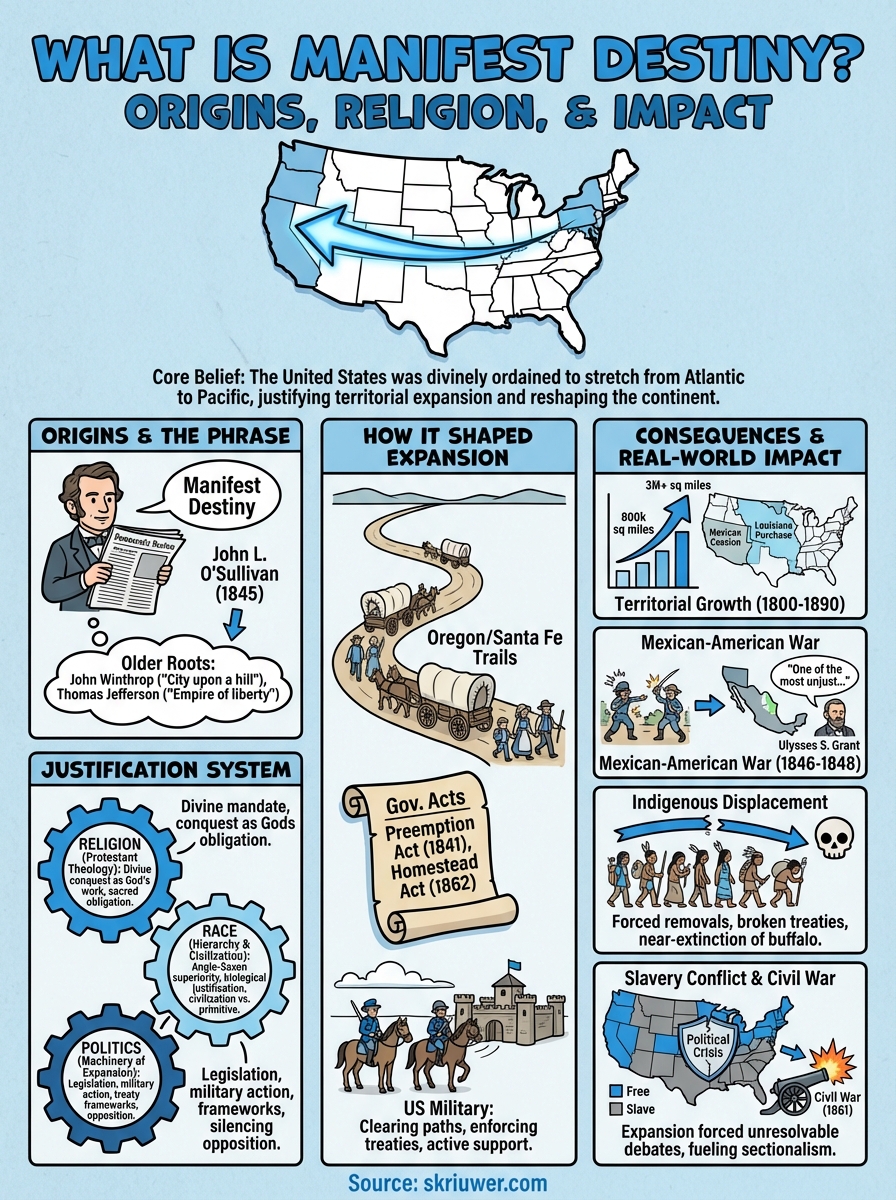
Key takeaways
Manifest Destiny was never just a geographic project. It was an ideological system built from Protestant theology, racial hierarchy, and political ambition that gave American expansion both a moral license and a federal enforcement mechanism. When you ask what is Manifest Destiny at its core, the honest answer is that it was a belief structure designed to make conquest feel inevitable, righteous, and beyond serious question to those who carried it out.
The consequences were not abstract. The Mexican-American War, the forced removal of Indigenous nations, the near-extinction of the buffalo herds, and the political crises over slavery were all direct products of this ideology. None of it happened by accident, and none of it should be reduced to a textbook footnote.
History like this deserves more than a summary. If you want unfiltered accounts of the events and forces that shaped the modern world, explore the full catalog at Skriuwer's independent bookstore.