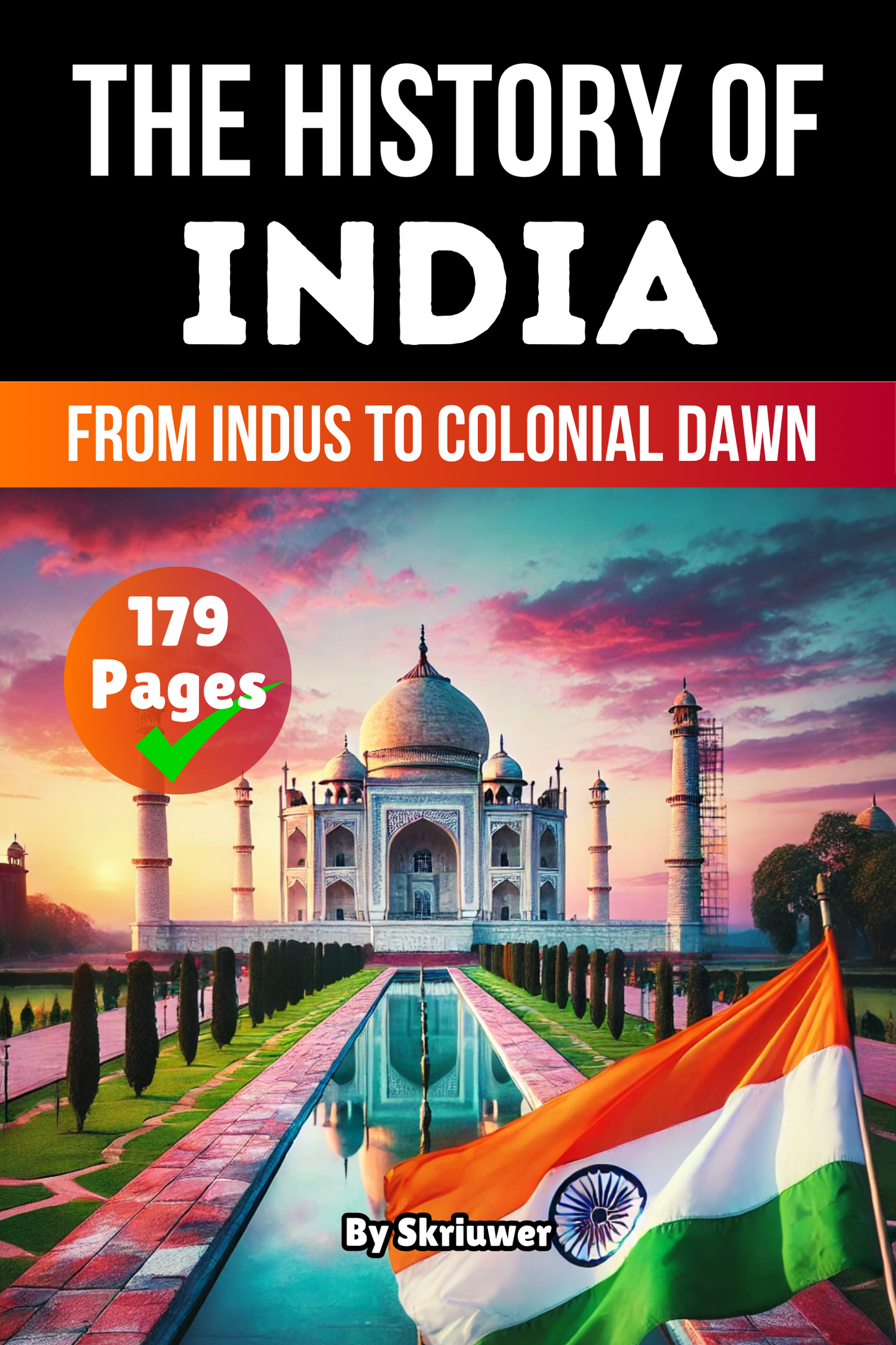

The History of India: From Indus to Colonial Dawn | Paperback Book
No se pudo cargar la disponibilidad de retiro
This book examines the historical development of India over 5,000 years, covering periods from ancient civilizations to colonial rule and independence. It discusses the formation of empires, cultural exchanges, conflicts, and the path to modern democracy, including events such as famines, partitions, and rebellions.
Key Topics Covered:
- Indus Valley Civilization: The decline of this advanced society, with archaeological findings including skeletons in atypical burial contexts (Chapter 1).
- Mauryan Empire: Aspects of governance and policies during Ashoka's reign (Chapter 4).
- Taj Mahal Construction: The involvement of approximately 20,000 laborers and the influence of European traders (Chapter 7).
- 1947 Partition: The drawing of borders using available maps, leading to migrations and conflicts resulting in around 1 million deaths (Chapter 12).
- Bengal Famine: The 1943 event where policies contributed to food shortages, affecting an estimated 3 million people (Chapter 11).
Additional Historical Points:
- Spice Trade Conflicts: Portuguese actions to control coastal areas in Kerala.
- Ancient Practices: Methods of determining guilt or innocence in historical contexts.
- Colonial Art: British artists' depictions of Indian landscapes and villages during the East India Company era.
Reader Feedback Example: "I have taught Indian history for 30 years. This book covers topics from the Indus Valley to colonial famines without idealizing historical figures." — Dr. Priya R. (Historian, Verified Purchase)
Book Features:
- Comprehensive Coverage: Explores India's resilience through various historical periods, from Mohenjo-Daro to Gandhi's movements.
- Intended Audience: Suitable for those interested in detailed historical accounts of India's past.
TABLE OF CONTENTS
CHAPTER 1: PREHISTORIC INDIA AND THE INDUS VALLEY CIVILIZATION
- Earliest stone tool usage and the transition from hunter-gatherers to farming communities
- Development of the Indus Valley Civilization’s planned cities
- Advanced drainage systems and standardized weights/measures
- Mystery of the undeciphered Harappan script
- Possible reasons behind the decline of the civilization
CHAPTER 2: THE VEDIC AGE AND THE RISE OF EARLY KINGDOMS
- Aryan migration and the importance of the Vedas
- Formation of social structures and varna distinctions
- Introduction of iron tools and expansion into the Ganges plain
- Shift from tribe-based governance to early monarchies
- Philosophical roots leading to later Upanishadic thought
CHAPTER 3: THE MAHAJANAPADAS AND THE BIRTH OF JAINISM AND BUDDHISM
- Emergence of powerful kingdoms and republics (ganasanghas)
- Socio-political and economic background for new religious movements
- Founding principles of Jainism under Mahavira
- Teachings of Siddhartha Gautama (Buddha) and the Four Noble Truths
- Growth of monastic communities and royal patronage
CHAPTER 4: THE MAURYAN EMPIRE AND ASHOKA’S INFLUENCE
- Rise of Chandragupta Maurya and unification of large parts of India
- Administrative structure and economic reforms under the Mauryans
- Emperor Ashoka’s conversion to Buddhism and spreading of dharma
- Rock edicts and pillars as instruments of royal communication
- Impact of Ashoka’s rule on Indian history and beyond
CHAPTER 5: THE SHUNGA AND KANVA DYNASTIES: AFTER THE MAURYAS
- Overthrow of the Mauryan lineage and establishment of the Shunga Dynasty
- Role of Pushyamitra Shunga in reviving certain Vedic practices
- Continuation of trade and cultural exchange despite political changes
- Transition to the Kanva Dynasty and its eventual decline
- Regional dynamics paving the way for new powers in North India
CHAPTER 6: THE KUSHAN EMPIRE AND THE RISE OF TRADE ROUTES
- Origins of the Kushans and their expansion into the Indian subcontinent
- Control over crucial segments of the Silk Road network
- Patronage of Buddhist art and creation of Gandhara sculptures
- Role of Emperor Kanishka in religious and cultural syncretism
- Growing importance of long-distance maritime and land trade
CHAPTER 7: THE GUPTA EMPIRE: A GOLDEN AGE OF CULTURE AND SCIENCE
- Founding of the Gupta Dynasty and consolidation of northern India
- Advancements in mathematics, astronomy, and literature
- Famous scholars such as Kalidasa and Aryabhata
- Flourishing of art and temple architecture
- Creation of a stable political environment promoting learning
CHAPTER 8: REGIONAL KINGDOMS: VAKATAKAS, CHALUKYAS, AND PALLAVAS
- Decentralization after the Gupta era and emergence of regional powers
- Vakataka patronage of art and religious monuments
- Chalukya contributions to temple architecture (e.g., Badami)
- Pallava innovations, including rock-cut temples at Mahabalipuram
- Interactions and occasional conflicts among these southern dynasties
CHAPTER 9: THE AGE OF HARSHA AND DEVELOPMENTS IN THE NORTH
- Rise of Harsha Vardhana in the aftermath of the Guptas
- Combination of military campaigns and diplomatic alliances
- Promotion of Buddhism and support for monastic establishments
- Famous assembly at Kannauj and cultural exchanges
- Decline of Harsha’s empire and political fragmentation
CHAPTER 10: SOUTH INDIAN KINGDOMS: CHOLAS, CHERAS, AND PANDYAS
- Distinctive political evolution in the south with early Tamil states
- Chola naval expansion and maritime trade networks
- Temple-centered urbanization and Dravidian architectural styles
- Chera and Pandya competition for regional supremacy
- Role of literature (Sangam poetry) in reflecting social life
CHAPTER 11: THE RISE OF ISLAM IN THE SUBCONTINENT AND EARLY SULTANATES
- Initial Islamic influence through trade and coastal settlements
- Military incursions by Mahmud of Ghazni and Muhammad of Ghor
- Formation of early sultanates in northwestern regions
- Cultural and intellectual exchange between local and Islamic traditions
- Foundations laid for the Delhi Sultanate period
CHAPTER 12: THE DELHI SULTANATE: SHIFTS IN POWER AND ADMINISTRATION
- Establishment of dynasties like the Mamluks, Khaljis, Tughlaqs
- Administrative reforms, land revenue systems, and urban growth
- Cultural fusion visible in architecture (Qutub Minar, mosques)
- Military campaigns and conflicts with regional powers
- Ongoing social changes and emergence of Indo-Islamic art forms
CHAPTER 13: THE VIJAYANAGARA EMPIRE AND RIVAL KINGDOMS
- Founding of Vijayanagara by Harihara and Bukka
- Defensive strategies against Deccan sultanates
- Patronage of literature, music, and temple construction
- Growth of trade, especially with the Portuguese on the west coast
- Battle of Talikota and the empire’s eventual collapse
CHAPTER 14: THE MUGHAL EMPIRE: FROM BABUR TO AKBAR
- Babur’s victory at Panipat and establishment of Mughal rule
- Humayun’s struggles and re-consolidation under Akbar
- Akbar’s administrative framework and policy of religious tolerance
- Expansion of Mughal territories and the formation of a powerful central state
- Creation of a vibrant court culture blending Persian and Indian influences
CHAPTER 15: THE REIGN OF JAHANGIR, SHAH JAHAN, AND AURANGZEB
- Jahangir’s patronage of the arts and semi-stable rule
- Shah Jahan’s architectural achievements (Taj Mahal, etc.)
- Shifts in the empire’s economic and administrative systems
- Aurangzeb’s long reign, strict policies, and military campaigns
- Growing internal and external pressures leading to Mughal decline
CHAPTER 16: THE MARATHAS AND THE DECLINE OF MUGHAL POWER
- Rise of Shivaji and the formation of the Maratha state
- Guerilla warfare tactics challenging Mughal armies
- Maratha confederacy and expansion across central India
- Administrative methods and social structure among the Marathas
- Weakening Mughal influence and the shift in regional authority
CHAPTER 17: THE SIKH CONFEDERACY AND REGIONAL SHIFTS IN NORTHERN INDIA
- Foundational teachings of Guru Nanak and Sikh Gurus
- Transformation from a spiritual community to a militarized confederacy
- Key role of Guru Gobind Singh and the Khalsa
- Sikh conquests and the restructuring of power in the Punjab region
- Balance of power among Mughal remnants, Marathas, and Sikhs
CHAPTER 18: OTHER REGIONAL POWERS AND KINGDOMS BEFORE COLONIAL EXPANSION
- Rise of various Rajput states and smaller principalities
- Expansion of Mysore under Haider Ali and Tipu Sultan
- Coastal trade powers like the Zamorins of Calicut
- Interplay of alliances and rivalries shaping the subcontinent
- Pre-colonial trade structures and their significance
CHAPTER 19: EARLY EUROPEAN CONTACT AND PRE-COLONIAL TRADE NETWORKS
- Arrival of Portuguese, Dutch, French, and British trading companies
- Competition for control of spice routes and textile exports
- Setting up of coastal forts and trading posts
- Economic and cultural exchanges influencing local states
- Seeds of larger political and commercial ambitions
CHAPTER 20: TRANSITION TOWARD COLONIAL RULE AND A CHANGING INDIA
- Gradual shifts in power from indigenous rulers to European powers
- Role of the British East India Company in regional conflicts
- Political fragmentation facilitating external dominance
- Socio-economic effects of growing European presence
- India on the brink of a new epoch under colonial influence
Product Details
Dimensions: 5.8 × 8.3 inches / 15.24 x 22.86 cm
Cover: Paperback

Why Skriuwer.com?
-
Supporting Frisian Language
When you buy from Skriuwer, you're not just getting a book—you’re helping create more Frisian books and educational resources like LearnFrisian.com. Your support directly helps us preserve and grow the Frisian language for future generations.
-
Making Languages Accessible
We believe in making languages easy to learn and accessible. While Frisian is our passion, we also want to help people learn other key languages like Dutch and English by providing helpful resources and learning tools.
-
Investing in Future Projects
Your purchase fuels more than just current projects. It helps us dream big and plan for the future, whether that’s developing new books, launching language-learning platforms, or supporting other educational initiatives. You're helping us build something lasting!
Preservar la lengua frisona
En Skriuwer.com, creemos que el idioma frisón es más que solo palabras: es una parte viva de nuestro patrimonio. Pero, como muchas lenguas minoritarias, enfrenta desafíos para sobrevivir en un mundo en constante cambio. Es por eso que nuestra misión es simple pero vital: mantener viva la lengua frisona para las generaciones futuras.
Cada libro que creamos, cada historia que contamos y cada palabra que publicamos es parte de un esfuerzo mayor por preservar y celebrar la cultura frisona. Pero no podemos hacerlo solos. Con tu ayuda, podemos marcar una verdadera diferencia.

Cómo Puedes Ayudar:
Compra un Libro: Al comprar uno de nuestros libros, no solo estás agregando una hermosa obra literaria a tu colección, sino que también estás apoyando directamente la preservación del idioma frisón. Cada libro ayuda a difundir la riqueza de nuestra lengua a más personas. También puedes contribuir a esta causa aprendiendo frisón a través de nuestro sitio asociado, www.learnfrisian.com.
Dona: Si crees en nuestra misión, también puedes hacer una contribución para ayudarnos a continuar nuestro trabajo. Ya sea para financiar nuevas publicaciones, apoyar programas educativos o ayudarnos a llegar a más hablantes de frisón, tu donación puede tener un impacto duradero. Solo tienes que hacer clic en el botón de abajo para contribuir.
Juntos podemos asegurarnos de que el idioma frisón siga siendo una parte vibrante de nuestro mundo. Únete a nosotros en este viaje: tu apoyo hoy significa un futuro más brillante para nuestro idioma mañana.