Why Are Books Banned
Every year, hundreds of books get pulled from library shelves, removed from school curricula, and flagged by parent groups or politicians. The question why are books banned seems straightforward, but the answer reaches into politics, religion, cultural anxiety, and the uncomfortable reality that someone, somewhere, gets to decide what you're allowed to read. That should concern anyone who values independent thought.
Book banning isn't a relic of authoritarian regimes or distant centuries. It's happening right now, across the United States and beyond, at a pace that has accelerated sharply since 2021. The targets range from novels about race and sexuality to historical accounts that challenge dominant narratives, the kind of perspectives that powerful institutions would rather keep quiet. Whether a book gets banned often has less to do with its content and more to do with who finds that content threatening.
At Skriuwer, we publish and sell the books that mainstream houses won't touch, titles covering hidden history, geopolitical conflict, and subjects deliberately kept out of public conversation. Book banning is not an abstract issue for us; it's the very problem our catalog exists to push back against. We believe readers deserve access to unfiltered perspectives, not pre-approved reading lists.
This article breaks down the real reasons books get banned, who holds that power, and how political and cultural forces shape what stays on, or disappears from, bookshelves in schools and libraries. You'll walk away with a clear picture of how censorship operates and why it keeps expanding.
Why book bans matter
You might assume book banning is a rare or fringe phenomenon, but the data tells a different story. The American Library Association (ALA) reported a record number of book challenges in 2022, tracking over 1,200 individual challenges in a single year, the highest figure the organization had recorded in more than two decades of tracking. Understanding why are books banned matters because the scale of the problem has grown large enough to affect what your children read, what your local library stocks, and whose perspectives get erased from public shelves.
The numbers are accelerating
The pace of book challenges and removals has not slowed. Between 2021 and 2023, coordinated campaigns pushed thousands of titles for removal from school libraries and classroom shelves across the United States. This isn't random. Groups filed hundreds of formal challenges targeting books about race, gender identity, sexuality, and historical trauma. The volume signals a deliberate strategy, not a spontaneous wave of community concern.
When the number of book challenges triples in two years, that is an organized campaign, not a grassroots reaction to harmful content.
What readers lose when books disappear
When a book gets removed from a school library, students in that school lose access to a perspective. That sounds obvious, but consider what it means in practice. A teenager trying to understand their own identity, a student researching the history of slavery, or a young reader encountering the Vietnam War for the first time may only have access to the version of those stories their school district approves. Banned books are disproportionately authored by people of color, LGBTQ+ writers, and those documenting marginalized communities, which means the erasure follows a clear pattern.
Reading a book that challenges your assumptions or describes an experience unlike your own is one of the most direct ways to build critical thinking. Removing those books from early education doesn't protect children; it trains them to expect a curated, sanitized version of reality rather than an honest one.
The broader signal a ban sends
Every book removal sends a message to authors, publishers, and librarians about what is considered acceptable. That message produces a chilling effect far beyond the single book removed. Librarians begin self-censoring acquisitions. Teachers stop assigning texts that might trigger complaints. Publishers think twice before acquiring manuscripts that cover sensitive ground. The result is a narrowing of the entire information ecosystem, not just one school's collection.
The stakes extend well beyond education. When institutions decide which histories, identities, and ideas are safe to discuss, they shape the boundaries of public knowledge. A community with access only to approved narratives is a community less equipped to question authority, evaluate evidence, or understand the full range of human experience. That is exactly why book bans draw opposition from historians, educators, civil liberties organizations, and anyone who takes the free circulation of information seriously.
Challenge vs ban: know the difference
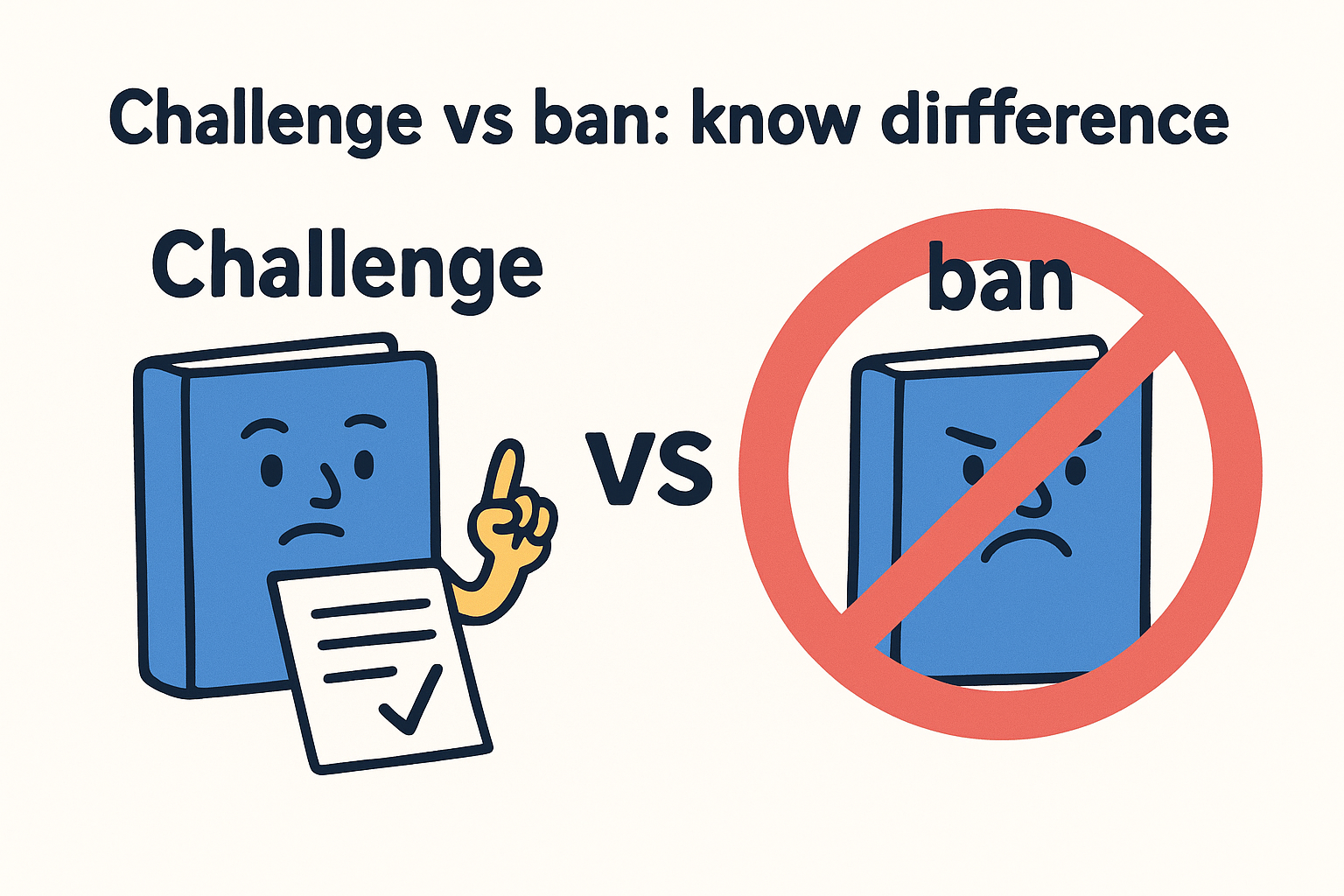
Before you can understand why are books banned, you need to know that most headlines use the word "banned" loosely. In practice, there is a meaningful legal and procedural difference between a challenge and an actual ban, and confusing the two distorts the picture of what is actually happening to books in schools and libraries.
What a book challenge is
A challenge is a formal, written request to remove or restrict a book, usually submitted to a school board, library committee, or similar governing body. Anyone can file one. A parent, a teacher, a community group, or a political organization can submit a challenge to a specific institution, arguing that a title is inappropriate, offensive, or harmful. Filing a challenge does not automatically remove the book. It triggers a review process, and the outcome depends on the institution's policies, the composition of the review committee, and, increasingly, the political climate in that district.
Most books that get formally challenged are never removed, but the challenge itself still puts pressure on librarians and teachers to reconsider what they stock.
What a formal ban looks like
Bans occur when a review process concludes with removal. The book gets pulled from shelves, taken out of circulation, or prohibited from classroom use. In some cases, this happens at the school level. In others, a state legislature or board of education issues a directive covering entire districts or statewide systems. When a ban takes effect, students in the affected institutions simply cannot access that book through official channels.
Some bans are temporary while appeals move through review. Others hold until a legal challenge or court ruling overturns them. Whether a removal sticks depends heavily on jurisdiction, the type of institution involved, and whether the decision withstands First Amendment scrutiny in a public school or public library context.
Why the distinction matters to you
Understanding the difference changes how you interpret news coverage. When a report describes a book as "banned," it may mean a single parent filed a complaint that the school ultimately rejected. When a book is actually removed, that represents a completed institutional decision with real, immediate effects on access for every student or patron in that system.
Tracking both challenges and confirmed removals gives you a far more accurate picture of censorship trends. The American Library Association maintains records of both categories, which lets you see not only how many books face pressure each year but how many actually disappear from public shelves as a result.
The most common reasons books get banned
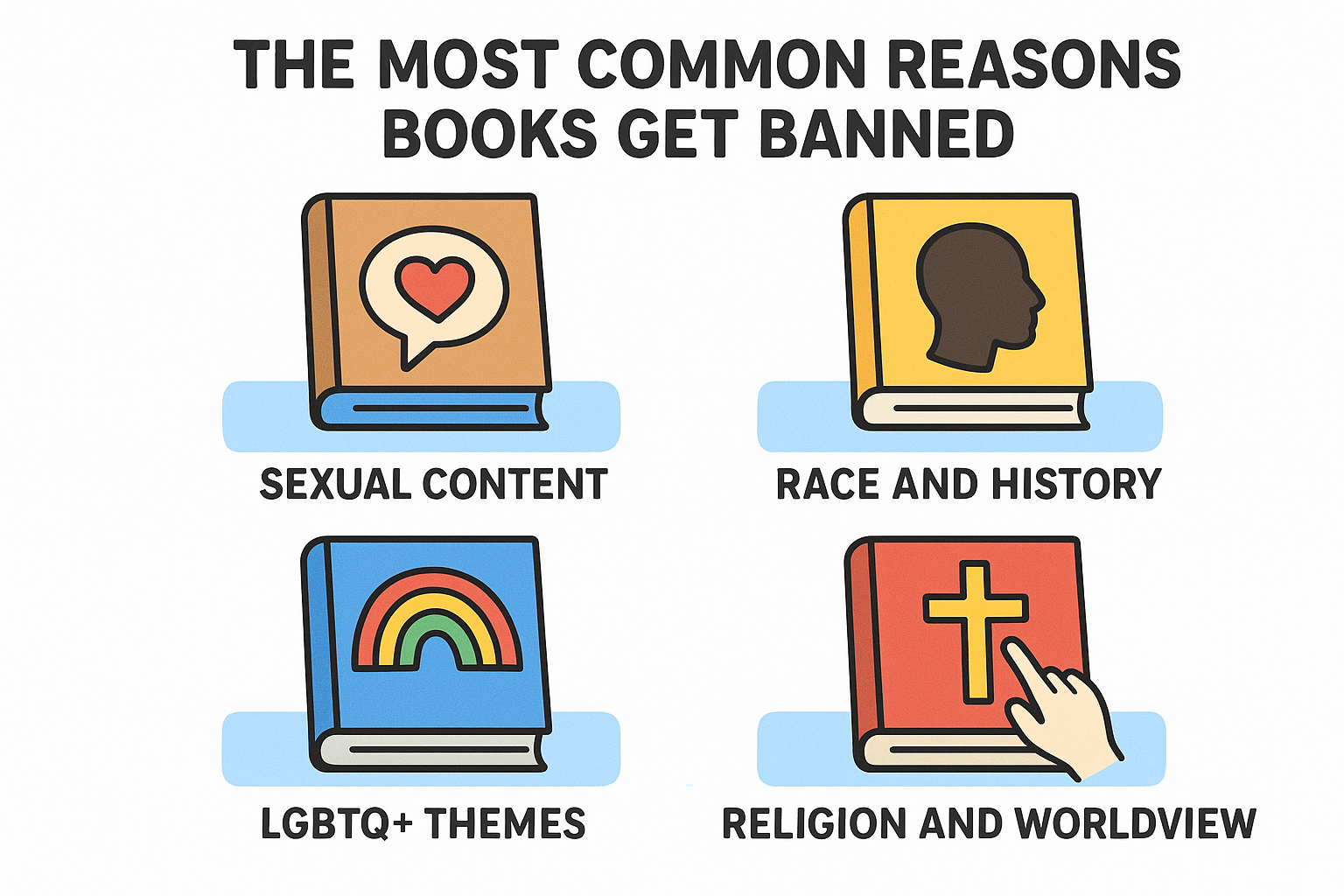
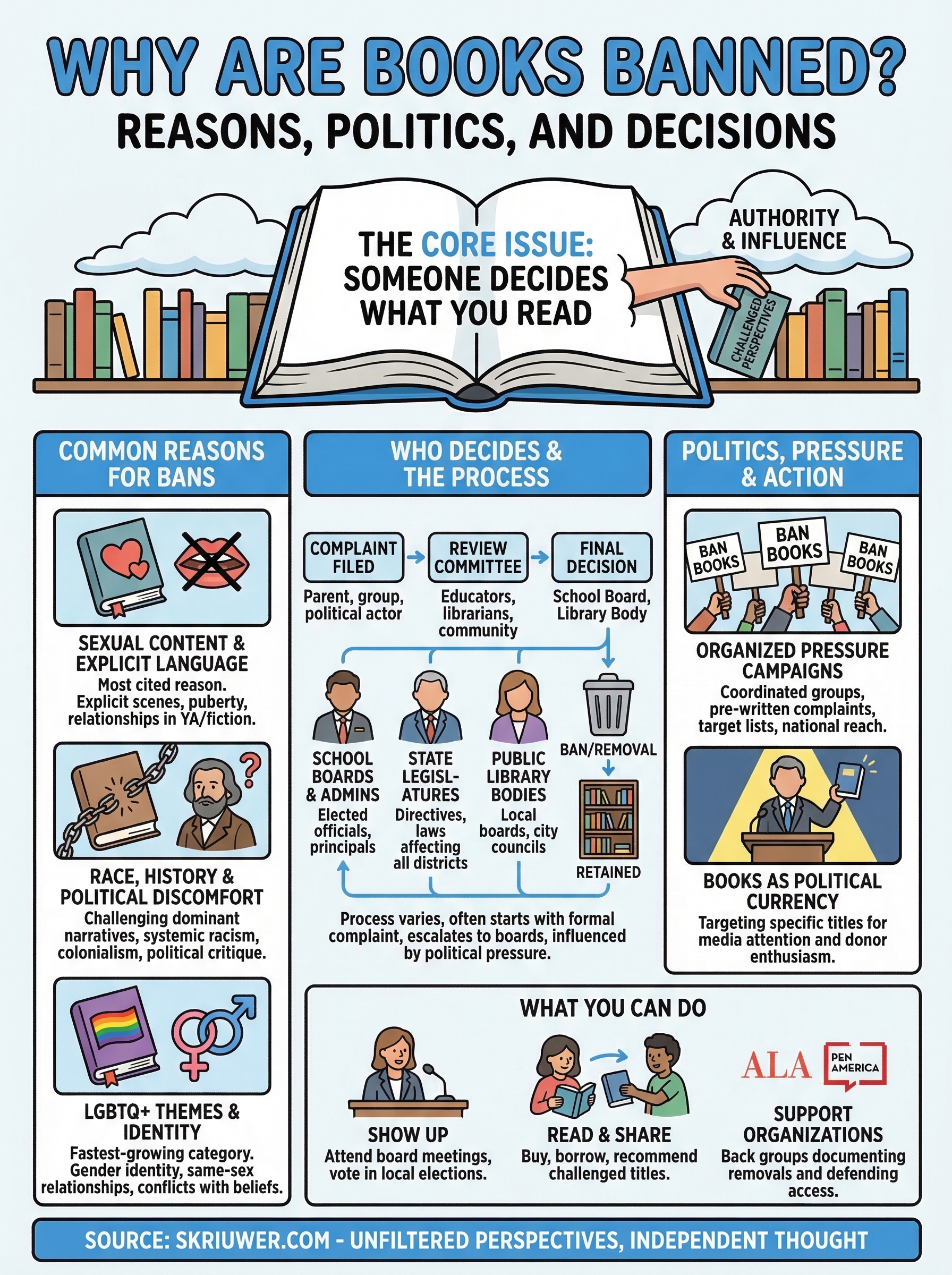
Understanding why are books banned requires looking at the specific categories of content that trigger the most complaints. The reasons aren't random. Across thousands of documented challenges, the same categories appear repeatedly, which tells you that book removal is driven by predictable anxieties rather than a case-by-case evaluation of individual harm.
Sexual content and explicit language
Sexual content is the single most cited reason for book challenges and removals in the United States. This category covers everything from explicit scenes in literary fiction to age-appropriate discussions of puberty and relationships in young adult titles. Challengers often argue that children aren't ready for such material, but the books flagged here range from health education guides to award-winning novels assigned in high school English classes. The books most frequently cited in this category include:
- "The Kite Runner" by Khaled Hosseini
- "Speak" by Laurie Halse Anderson
- "Forever" by Judy Blume
In many documented cases, the same book flagged as inappropriate in one district sits without complaint on the shelves of a neighboring school.
Race, history, and political discomfort
Books that cover the history of slavery, systemic racism, or colonialism consistently face challenges from groups who argue they make students feel guilty or promote a political agenda. Titles like "The Hate U Give" and "Beloved" have faced repeated removal attempts across multiple states. Historical accuracy offers no protection from removal if that history makes a specific community uncomfortable.
This category also captures books critical of government policy, military history told from non-official perspectives, and accounts of political violence that conflict with approved narratives. The pattern is consistent: when a book forces readers to sit with a difficult version of the past, someone usually pushes to remove it.
LGBTQ+ themes and identity
Titles featuring LGBTQ+ characters, relationships, or identity have seen the steepest rise in challenges over the past four years. Organizations tracking removals have confirmed that books addressing gender identity and same-sex relationships now represent the fastest-growing category of challenged titles in American schools. Challengers typically argue these books conflict with their religious or social beliefs, framing the objection as a parental rights issue.
Religion and worldview also drive a smaller but consistent share of removals, particularly when books portray religious belief critically, present non-Christian spiritual practices, or challenge creationist readings of history and science. These challenges appear in every state, though they concentrate in specific regions where religious objections carry the most institutional weight.
Who decides what gets removed
The answer to why are books banned in any given place depends heavily on who holds institutional authority in that location. There is no single national body controlling which books stay on shelves. Instead, decisions get made at multiple levels, and the outcome in your school or library depends entirely on which part of that structure carries the most weight at any given moment.
School boards and building-level administrators
School boards are the most immediate decision-making body for book removals in K-12 settings. When a formal challenge gets filed, it typically lands with the school principal first, then escalates to a district-level review committee, and ultimately reaches the elected school board if no resolution comes earlier. Board members are elected officials, which means their decisions reflect the political views of whoever turns out to vote in local school board elections. This is why organized campaigns targeting school board seats have become a direct tool for groups pushing large-scale book removals.
The people who show up to school board meetings and elections determine the reading lists of every student in that district.
Building-level administrators, including principals and department heads, also exercise significant informal power. A librarian receiving pressure from a principal may quietly pull a book before any formal challenge gets filed, which means many removals never appear in official tracking data at all.
State legislatures and boards of education
State-level actors can issue directives that override local decisions and apply to entire statewide systems. Several states have passed legislation since 2021 restricting the types of content permitted in school libraries, effectively handing state legislators and education commissioners authority over local library collections. When a state board of education acts, a single vote can trigger removals across hundreds of districts simultaneously, concentrating enormous power in a small number of appointed or elected officials.
Public libraries and their governing bodies
Public libraries operate under different legal standards than school libraries, with courts generally applying stricter First Amendment protections to public library collections. Local library boards and city councils govern public libraries, meaning local political leadership shapes what stays on those shelves. When a city council shifts its composition after an election, library acquisition policies and removal decisions can follow in short order.
Your local library board meetings are open to the public. Attending those meetings and learning who sits on your library's governing body is the most direct way to see exactly who controls access to books in your community.
How book challenges and bans happen
Knowing why are books banned is only part of the picture. Understanding the actual step-by-step process through which a book moves from complaint to removal shows you exactly where decisions get made and who holds power at each stage. The process isn't uniform across every state or district, but a recognizable pattern plays out in most public school and library systems.
From initial complaint to formal review
The process almost always starts with a formal written complaint, submitted by a parent, community member, or organized advocacy group. That complaint gets directed to a school principal or library director, and it typically identifies the specific book, the grounds for the objection, and the requested action, whether that means removal, age restriction, or relabeling. Most institutions require the complainant to fill out a standardized form before any formal review begins, which creates a paper trail but also gives organized groups a repeatable template to file dozens of complaints across multiple districts at the same time.
A single advocacy group distributing pre-filled complaint templates can generate hundreds of formal challenges across different states within weeks.
Once a complaint clears the intake stage, a review committee evaluates the challenged title. This group usually includes educators, librarians, and sometimes parents or community representatives. Committee members are expected to read the book, weigh the objection against educational value, and produce a recommendation. In practice, the committee's independence varies sharply depending on institutional culture and the level of political pressure the district faces. Schools operating under sustained organized pressure see committees that recommend removal far more readily than those working in lower-pressure environments.
Escalation and final removal
If the review committee recommends keeping the book and the complainant disagrees, or if the committee recommends removal, the decision escalates to the school board or library governing body. This is where the political dimension becomes most visible. Board members vote on the final outcome, and their votes reflect the community that elected them. High-profile cases attract public attendance, media coverage, and lobbying from both sides, turning what should be an educational decision into a political contest where the book itself becomes secondary to the larger culture war argument being fought.
Once a board votes to remove a book, the title gets pulled from circulation immediately or within a defined deadline. Staff receive instructions to remove physical copies from shelves and flag the title in the catalog system. Students and patrons lose access without individual notification. Appeals are possible but slow, and the book stays off shelves while the process moves forward, meaning the removal has its full intended effect regardless of the final legal outcome.
The legal and policy backdrop in the US
Any honest discussion of why are books banned has to account for the legal framework underneath the debate. The United States has some of the strongest speech protections in the world, yet those protections do not give every reader an unconditional right to access every book through every public institution. Federal law, state legislation, and local policy all shape what ends up on or off a library shelf, and those layers interact in ways that produce wildly inconsistent outcomes depending on where you live.
First Amendment protections and their limits
The First Amendment restricts government censorship, but it does not operate identically across every type of institution. Courts have consistently held that public libraries receive stronger First Amendment protection than school libraries, largely because public libraries exist to serve the general information needs of an entire community rather than to carry out an educational curriculum. The landmark 1982 Supreme Court case Board of Education v. Pico established that school boards cannot remove books from school libraries simply because they disagree with the ideas inside them, though the decision was split and its application has remained contested ever since.
The legal line between "curriculum decisions" and "viewpoint-based censorship" is the precise fault line where most book removal disputes get fought.
School boards retain wide authority to select and shape curriculum, and courts have generally allowed boards to control what gets assigned in classrooms. The complication arises when that curricular authority extends to removing already-shelved library books based on their political or social viewpoint, which is where First Amendment arguments gain the most traction.
State laws reshaping library collections
Since 2021, dozens of states have passed or introduced legislation that directly affects library collections in public schools. These laws vary in their approach but share a common goal: giving state legislatures direct influence over what content librarians can acquire or retain. Some statutes require schools to maintain searchable public databases of every library title. Others impose liability on librarians or teachers who provide students with materials that fall under broadly defined prohibited categories.
Florida, Texas, and Arkansas have each passed measures that require schools to audit existing collections and remove books that don't comply with new standards. The practical effect is that individual librarians face personal legal exposure, which creates an incentive to pull books proactively rather than wait for a formal challenge. State-level legislation has become the most efficient mechanism for driving large-scale removals, because a single law reaches every district at once.
How politics and pressure campaigns drive bans
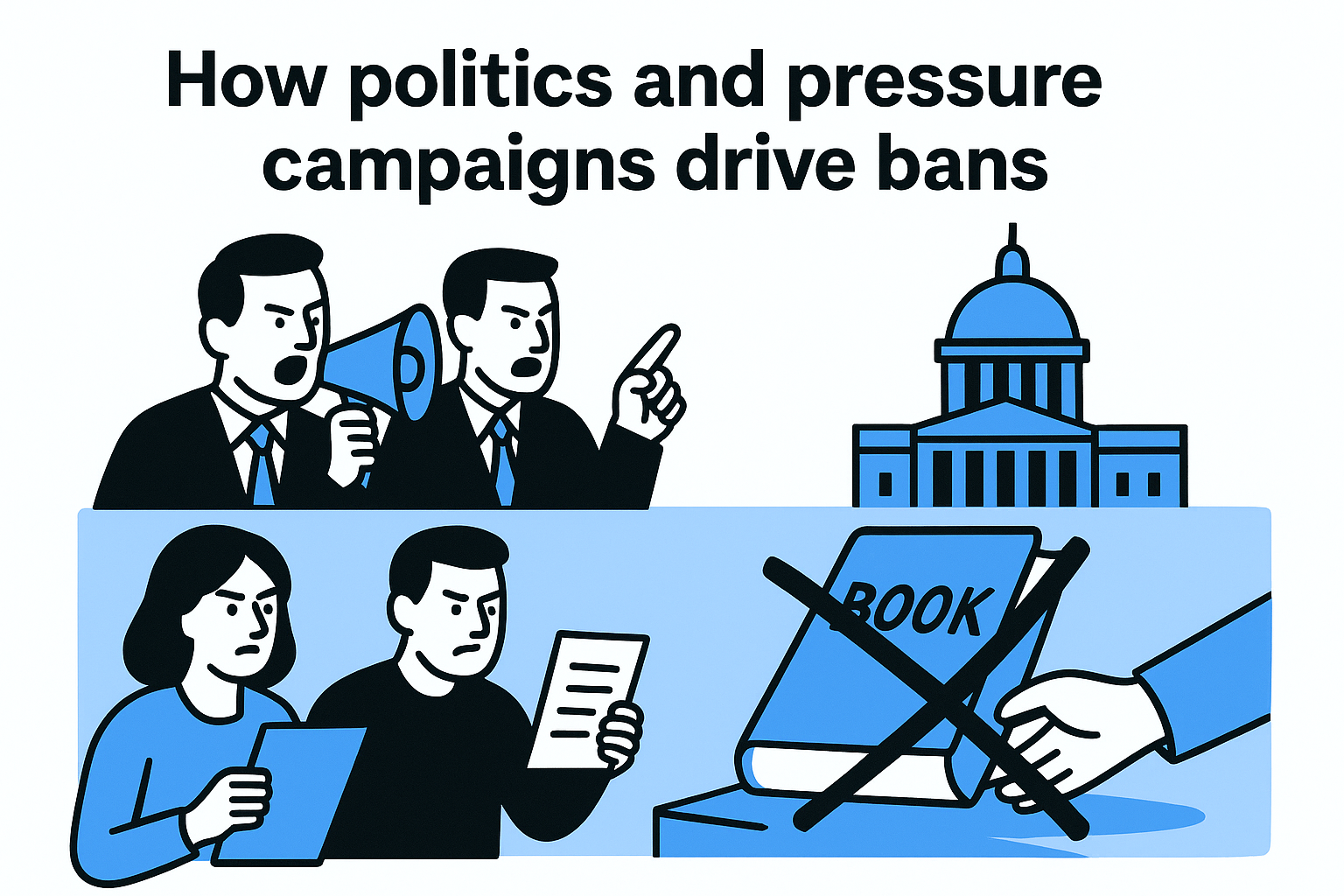
To really understand why are books banned at this scale, you need to look beyond individual parents with grievances. The sheer volume of challenges filed in recent years didn't emerge organically. Coordinated political actors treat book removal as a strategy, not a reaction, and the infrastructure behind that strategy has grown into a significant operation with national reach and local execution.
Organized groups filing at scale
Several advocacy organizations have built systematic programs specifically designed to generate book challenges across multiple school districts simultaneously. They publish target lists, distribute pre-written complaint templates, and coordinate members to file identical challenges in hundreds of separate jurisdictions. A single campaign launched from a national office can trigger formal review processes in school districts across a dozen states within a matter of weeks.
When the same complaint language appears in challenges filed in Florida, Texas, and Ohio on the same day, the source is not local parental concern.
These groups frame their work as protecting parental rights, but the operational structure looks more like a lobbying campaign than a community movement. The books appearing on their lists are selected for their political symbolism, not evaluated case by case for genuine harm.
Books as political currency
Elected officials have found that targeting specific books generates media attention and donor enthusiasm, which makes book challenges an attractive political tool at the state and local level. A politician who names a specific title and calls for its removal gets press coverage, signals cultural alignment to a particular voter base, and faces very little institutional resistance because the decision-making authority sits with local boards rather than courts.
This dynamic turns books into political currency. The content of the book matters less than what the book represents to the audience being addressed. A novel covering race or a history book challenging a dominant narrative becomes a symbol, and removing it becomes a demonstration of values rather than a judgment about educational appropriateness. You end up in a situation where the book's actual text receives almost no serious scrutiny during the removal process.
State legislators have amplified this by introducing bills that reference specific titles or categories, which gives local school boards political cover to act. When a state law backs up a removal decision, local officials face less accountability for the outcome because they can point to legal compliance rather than personal judgment as the reason a book disappeared from your local shelf.
What parents, students, and readers can do
Once you understand why are books banned and how the process works, you have enough information to push back effectively. The decisions that remove books from shelves happen at predictable points in a structured process, which means you can show up at those exact points and make your position count. Passive frustration changes nothing. Specific, repeated action at the right institutional level does.
Show up where decisions get made
School board meetings and public library board meetings are open to the public in most jurisdictions, and they are the venues where removal decisions get finalized or reversed. Attending those meetings, signing up to speak during public comment, and identifying which board members voted which way on removal decisions gives you direct visibility into the decision-making structure in your community. Organized groups drive book removals by showing up consistently; the most effective counter is to do the same.
Your presence at a school board meeting, even in silence, signals to elected officials that someone is watching how they vote on library access.
Voting in local school board elections carries equal weight. Turnout in those elections is historically low, which means a small number of engaged voters can shift board composition. If you want a direct answer to why books keep disappearing from local shelves, look at who currently sits on your school board and how they got there.
Read and share the challenged books themselves
Buying, borrowing, and publicly recommending challenged titles is a concrete act of resistance. Every challenged book that circulates widely is harder to remove and easier to defend. If your local library has flagged a title for review, checking that book out before a decision gets made demonstrates community demand and creates a usage record that librarians can cite during the review process.
Talking about specific books with friends, family, and in community spaces normalizes the content that removal campaigns try to frame as dangerous. Most challenged books are not extreme; they cover race, identity, history, and human experience in ways that readers across all backgrounds recognize as legitimate.
Support organizations that document removals
The American Library Association and PEN America both publish annual data on book challenges and confirmed removals. Following their tracking reports keeps you informed about which titles face pressure and which districts are most active in removing them. Supporting these organizations financially or as a volunteer strengthens the infrastructure that makes removal campaigns visible and harder to run quietly at the local level.
Keep the shelves open
The question why are books banned has a straightforward answer: someone with institutional power decided a book's ideas were more dangerous than its absence. That decision never serves readers; it serves the people making it. Censorship doesn't protect communities from difficult ideas; it protects certain interests from being questioned. Every book that disappears from a shelf represents a perspective someone wanted kept quiet, and the pattern of what gets removed tells you exactly which perspectives those are.
You now have a clear picture of how book bans work, who drives them, and where you can push back. None of this requires passive acceptance. Show up, vote, read the challenged titles, and talk about them openly. If you want access to the books that mainstream institutions would rather you ignore, explore the full catalog at Skriuwer, where difficult histories, suppressed perspectives, and unfiltered accounts stay on the shelves permanently.
Recommended Reading
Explore books that challenge conventional narratives:
- The Hidden History of America – The suppressed stories that challenge the official narrative.
- The History of the Bible: Texts, Traditions, Transformations – How religious texts were selected, edited, and sometimes banned through history.
Books You Might Like


Through the Language Glass
Guy Deutscher

How to Learn Any Language
Barry Farber