What Is Mkultra
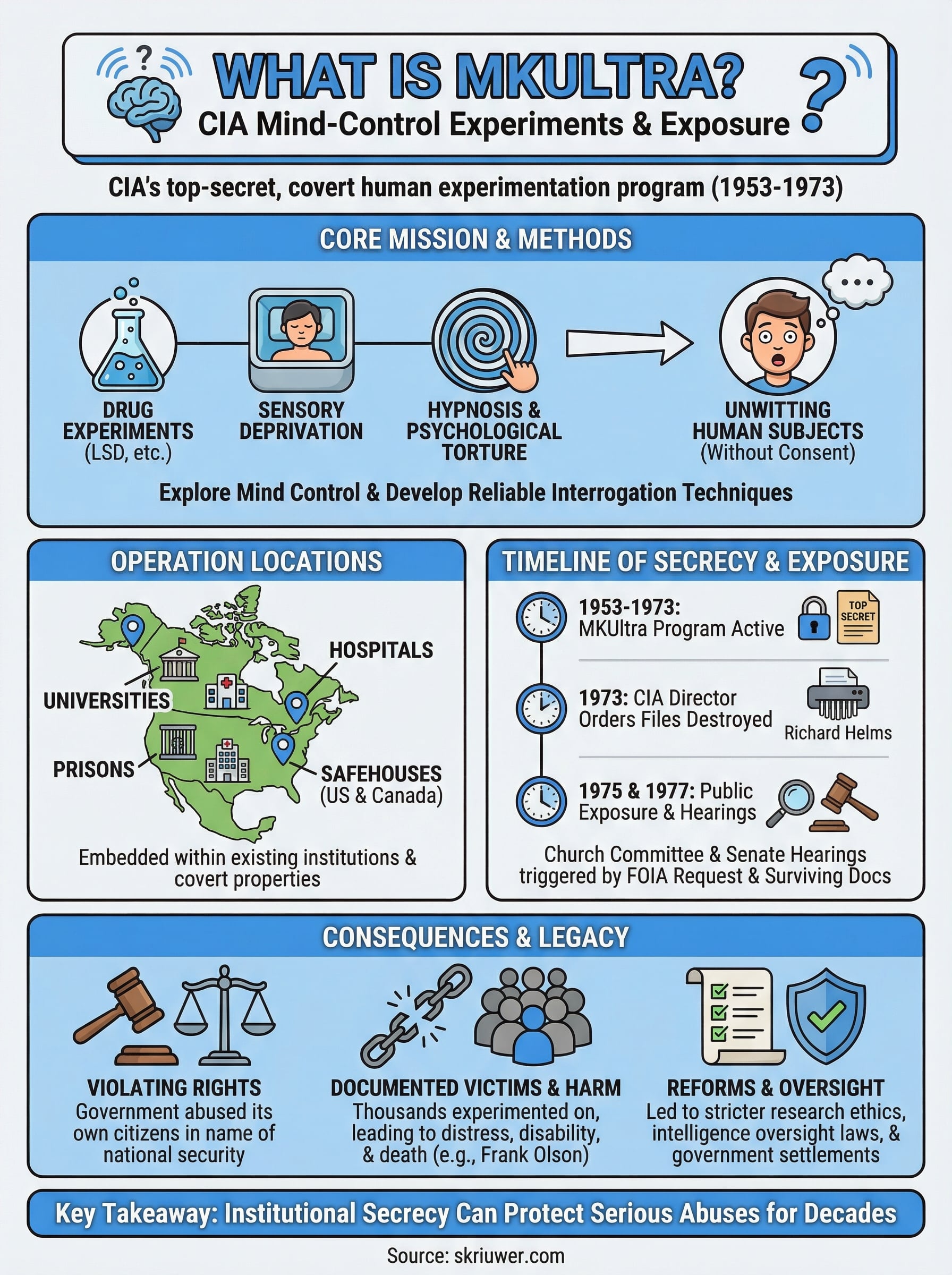
Between 1953 and 1973, the Central Intelligence Agency ran one of the most disturbing programs in American government history. So what is MKUltra? It was a top-secret project designed to explore mind control through drug experiments, sensory deprivation, hypnosis, and psychological torture, all conducted on unwitting human subjects, many of whom never consented to participation.
The program operated across universities, hospitals, and prisons in the United States and Canada. CIA Director Richard Helms ordered the destruction of most MKUltra files in 1973, and the public only learned the full scope of the project after a Freedom of Information Act request uncovered surviving documents in 1977. Congressional hearings followed, exposing a government agency that had spent decades violating the rights of its own citizens in the name of national security.
MKUltra is exactly the kind of history that tends to get reduced to a footnote or dismissed as conspiracy, until the declassified records prove otherwise. At Skriuwer, we publish books that pull these buried chapters into the open, covering the dark corners of government programs, covert operations, and institutional abuses that mainstream publishers often avoid. This article breaks down MKUltra from its Cold War origins to its eventual exposure, covering the experiments, the victims, and the aftermath that still echoes through intelligence policy today.
Why MKUltra still matters
MKUltra isn't a closed chapter. Understanding what is MKUltra requires acknowledging that the program's consequences didn't end when CIA Director Richard Helms ordered the files shredded in 1973. The institutional failures that allowed it to run for two decades without meaningful oversight shaped how the U.S. government restructured its intelligence and ethics frameworks, and those reforms remain imperfect today. When you study MKUltra, you're not looking at a historical anomaly. You're looking at a case study in what happens when unchecked government authority collides with a complete absence of accountability.
The legal and ethical precedents it set
The Senate Church Committee hearings of 1975 and the later 1977 Senate hearings directly triggered foundational changes in American law and research ethics. Before MKUltra was exposed, federal oversight of human experimentation was minimal. Researchers at universities and government agencies operated with enormous latitude, particularly when the work was classified. MKUltra demonstrated in documented detail what that latitude looked like in practice: subjects dosed with LSD without their knowledge, prisoners subjected to weeks of sensory deprivation, and psychiatric patients manipulated through electroconvulsive therapy and drug combinations.
The exposure of MKUltra was a direct catalyst for the National Commission for the Protection of Human Subjects of Biomedical and Behavioral Research, which produced the 1979 Belmont Report, a document that still governs ethical research standards in the United States today.
Following the hearings, Congress established stricter informed consent requirements and introduced new layers of institutional oversight for federally funded research. These changes were necessary, but they also came only because journalists, Senate investigators, and FOIA requests forced the information into the public record. The lesson isn't just about what MKUltra did. It's about how long institutions can conceal wrongdoing when secrecy is treated as a higher priority than accountability.
How MKUltra shaped modern intelligence oversight
The Church Committee didn't just investigate MKUltra. It reviewed a broader pattern of CIA overreach, including illegal domestic surveillance, assassination plots, and operations that violated the agency's founding charter. MKUltra was one of the most visceral examples the committee uncovered, and it gave legislators concrete justification for reforming intelligence oversight structures. The Foreign Intelligence Surveillance Act of 1978 and the establishment of permanent congressional intelligence committees both trace part of their political origin to the public outrage MKUltra generated.
These oversight mechanisms are still active. You can track the evolution of intelligence accountability through public legislative records and committee reports available through the U.S. Senate and House of Representatives websites. The point is that MKUltra didn't just produce victims. It produced a political crisis that forced structural change, and those structures now govern how intelligence agencies operate within U.S. law.
Why this history is relevant to you today
Your interest in MKUltra probably isn't purely academic. Most people who dig into this program do so because it raises questions that remain unresolved: How much does the government conceal in the name of national security? What happens to accountability when programs are classified at the highest levels? The answer MKUltra gives you is uncomfortable. A program this large, running across this many institutions, with this many documented victims, operated for roughly twenty years before anyone outside the CIA knew the full extent of it.
That track record matters when you evaluate modern debates about government transparency, surveillance programs, and the limits of executive authority. The institutional instincts that produced MKUltra didn't disappear in 1973. Understanding how the program worked, who authorized it, who looked the other way, and how it was eventually exposed gives you a sharper framework for reading current events involving intelligence agencies and classified operations.
MKUltra is also a reminder that the public record is incomplete by design. Helms destroyed the bulk of the files specifically to prevent scrutiny. What historians and journalists pieced together came from surviving documents, testimony from participants, and investigative work that took decades. The full picture may never be recoverable, and that gap itself is part of what makes this history worth studying seriously.
How to research MKUltra using reliable sources
When you start digging into what is MKUltra, the volume of unreliable information online can make it difficult to separate documented fact from speculation. The program's history is well-documented through declassified government records and congressional testimony, so you don't need to rely on secondary interpretations or fringe sources. Starting with primary sources keeps your research grounded and gives you direct access to the evidence investigators actually used.
Start with declassified government documents
The most direct way to research MKUltra is through the National Security Archive at George Washington University, which has compiled and digitized many of the surviving CIA documents recovered through Freedom of Information Act requests. The CIA's own reading room, available at CIA.gov, also contains declassified files you can search directly. These records are unfiltered and include internal memos, budget authorizations, and subproject summaries that give you the clearest available picture of how the program was structured and funded.
The 1977 Senate hearings on MKUltra produced hundreds of pages of public testimony from CIA directors, researchers, and victims, all of which are preserved in the U.S. Congressional Record and accessible through the U.S. Government Publishing Office.
For congressional testimony specifically, you can access hearing transcripts through the U.S. Government Publishing Office. These transcripts include direct statements from CIA officials like then-Director Stansfield Turner, who testified about the scope of what the agency had conducted. Reading these documents yourself, rather than relying on summaries, gives you a more accurate understanding of what was admitted versus what remained disputed.
Use academic and library databases
Peer-reviewed research on MKUltra is available through academic databases, and most major universities provide public access to at least some of their digital library holdings. Google Scholar at scholar.google.com lets you search for academic papers on CIA human experimentation, Cold War intelligence programs, and research ethics reform without requiring a paid subscription. Many of the papers available there cite specific document numbers from the declassified MKUltra files, which you can then locate through the CIA reading room to verify claims directly.
When you build your research from primary documents and peer-reviewed sources, you avoid the common problem of repeating claims that have been distorted through repeated retellings. MKUltra is a topic where the documented reality is disturbing enough on its own. You don't need embellishment, and you should treat any source that relies heavily on anonymous accounts or undocumented assertions with skepticism. The factual record, incomplete as it is due to the file destruction in 1973, still tells a detailed and verifiable story.
How MKUltra began: Cold War fears and early projects
To understand what is MKUltra, you need to understand the political climate that produced it. In the late 1940s and early 1950s, the CIA was watching reports of Soviet and Chinese interrogation techniques with serious alarm. American prisoners of war returning from Korea appeared to have been psychologically manipulated, and some had made public statements that contradicted their known beliefs. Intelligence officials convinced themselves that the communist bloc had developed working methods of mind control, and that the U.S. needed to catch up or surpass them immediately.
The predecessor programs: ARTICHOKE and BLUEBIRD
The CIA didn't jump straight into MKUltra. Two earlier programs laid the groundwork. Project BLUEBIRD, launched in 1950, focused on developing reliable interrogation techniques and exploring whether agents could be conditioned to resist enemy questioning. By 1951, the agency renamed and expanded it into Project ARTICHOKE, which went further by experimenting with hypnosis, drug-induced states, and combinations of psychological pressure designed to extract information from unwilling subjects.

ARTICHOKE researchers explicitly asked whether they could produce a subject who could carry out an act and then retain no memory of it afterward.
These early projects established a key pattern: the CIA prioritized operational results over ethical constraints, and it relied on classification to shield its activities from any outside oversight. By the time MKUltra launched in 1953, the agency had already built a network of contractors and consultants willing to conduct experiments that would never have passed independent ethical review.
The formal launch in 1953
CIA Director Allen Dulles officially authorized MKUltra on April 13, 1953. He appointed chemist Sidney Gottlieb to run the program under the Technical Services Staff. Gottlieb believed the CIA could develop techniques to control human behavior through drugs, particularly LSD, which had only been synthesized a decade earlier and was poorly understood at the time. The program received significant covert funding, much of it routed through front organizations and shell accounts to conceal the agency's involvement from the universities and research institutions participating in the work.
From the start, MKUltra was structured to avoid accountability. Gottlieb and his superiors kept documentation minimal, conducted briefings verbally rather than in writing, and ensured that most participants, including many of the researchers, had no complete picture of what they were contributing to. The Cold War urgency that drove MKUltra's creation also served as its justification for operating entirely outside normal government oversight from the moment it began.
How MKUltra worked: leadership, funding, subprojects
Understanding what is MKUltra at a structural level means looking at how the CIA built a program designed to be invisible. The agency didn't run the program through its normal administrative channels. Instead, it created a layered system of insulation that kept decision-makers separated from direct accountability and ensured that most participants never saw the full picture of what they were contributing to.
Sidney Gottlieb and the Technical Services Staff
Sidney Gottlieb served as the operational architect of MKUltra from its 1953 launch. He held a doctorate in chemistry and ran the program through the CIA's Technical Services Staff, a division responsible for developing tools and techniques for field operations. Gottlieb reported directly to Deputy Director Richard Helms, which gave the program protection at the highest administrative levels of the agency. When Helms eventually ordered the files destroyed in 1973, he was protecting a program he had personally overseen for years.

Gottlieb's approach to research was pragmatic and ruthless. He believed that results justified the methods, and he pushed researchers to test substances and techniques at doses and intensities that no ethical review board would have approved. He personally participated in some experiments and distributed LSD to colleagues without their prior knowledge, including at CIA holiday parties.
Gottlieb destroyed his own personal files on MKUltra before retiring in 1973, eliminating records that investigators later confirmed would have been central to any full accounting of the program.
How the CIA funded MKUltra without leaving a trail
Funding MKUltra required concealing its source from the institutions receiving the money. The CIA routed payments through a network of front organizations and private foundations, including the Society for the Investigation of Human Ecology and the Josiah Macy Jr. Foundation. These organizations awarded grants to universities and researchers who, in many cases, believed they were receiving standard academic funding. The actual sponsor remained hidden behind layers of administrative distance.
This funding structure gave Gottlieb access to researchers at major institutions without triggering oversight. Administrators at universities and hospitals rarely asked questions about the ultimate source of grant money, and those who did were satisfied with cover explanations. The arrangement also meant the CIA could terminate a subproject without any public record of its involvement.
The subproject structure
MKUltra didn't operate as a single coordinated experiment. It ran through approximately 150 individually numbered subprojects, each focused on a specific research area or technique. Some subprojects studied drug effects, others tested hypnosis, and several explored behavioral conditioning through environmental manipulation. This fragmented structure meant no single researcher understood the program's total scope, which served as an additional layer of security against internal leaks.
Each subproject had its own contractors, its own budget line, and in most cases its own cover story. The compartmentalization was intentional and effective, which is precisely why so much of the program's history remains unrecoverable today.
What they tested: LSD, drugs, and behavior control
The substance most associated with what is MKUltra is LSD, but the program's testing went far beyond a single drug. Researchers working under Sidney Gottlieb's direction tested dozens of chemical agents and behavioral techniques on subjects, building what the CIA hoped would become a reliable toolkit for controlling, disorienting, and extracting information from human beings. The range of what they tested reveals how broadly the agency defined its mission and how little concern it had for the welfare of the people involved.
LSD as the primary research tool
Gottlieb became convinced early that LSD held significant potential as a tool for interrogation and psychological destabilization. The CIA purchased large quantities of the drug from Sandoz Laboratories in Switzerland and distributed it across subprojects for testing on both witting and unwitting subjects. Researchers administered LSD at extreme doses, kept subjects under its influence for extended periods, and combined it with hypnosis or interrogation sessions to observe whether it could break down resistance or implant false beliefs.
Some subjects received LSD daily for weeks at a time, with researchers documenting behavioral changes without providing any medical support or follow-up care to the individuals involved.
Other chemical and biological agents
LSD was not the only substance in the program's arsenal. Researchers also tested mescaline, barbiturates, amphetamines, scopolamine, and heroin, among other compounds. Some subprojects explored whether combinations of uppers and downers could produce specific psychological states useful for interrogation. Others tested whether chemical agents could induce amnesia, erasing a subject's memory of events that had occurred during an operation or experiment.
Biological agents also appeared in the research portfolio. Certain subprojects examined the behavioral effects of airborne chemical exposure, raising questions about whether substances could be delivered covertly in controlled environments such as offices or safe houses. The breadth of the chemical testing reflected a program with no fixed ethical limits and significant financial backing.
Behavior control without drugs
Several subprojects moved beyond pharmacology and focused on non-chemical methods of psychological manipulation. Researchers tested sensory deprivation, sometimes keeping subjects in isolation for days. Electroconvulsive therapy appeared in the work of Canadian psychiatrist Ewen Cameron, who used it in combination with drug-induced sleep to attempt what he called "psychic driving," a technique meant to overwrite a subject's existing beliefs with repeated recorded messages.
Hypnosis and psychological conditioning also featured in the research. Certain subprojects asked whether subjects could be conditioned to perform specific actions on command and retain no conscious memory of having done so. The answer the program sought was operational, not scientific. Every technique pointed toward the same goal: producing reliable control over another person's behavior without their awareness or consent.
Where it happened: universities, prisons, safehouses
One aspect that surprises many people when they first study what is MKUltra is how geographically and institutionally widespread the program was. The CIA didn't run experiments in a single classified facility hidden from view. It embedded its research inside existing institutions, funding work at universities, psychiatric hospitals, prisons, and covert properties across the United States and Canada. That distribution was a deliberate strategy: spreading the program across dozens of institutions made it harder to detect and easier to disavow.
Universities and research hospitals
Academic institutions gave MKUltra a layer of scientific legitimacy it could not have manufactured internally. The CIA funneled money through front foundations to researchers at major universities, who often conducted experiments believing they were working on standard behavioral science grants. Institutions including Harvard University, Stanford University, and Columbia University had researchers connected to MKUltra subprojects, though in many cases the faculty involved did not know the CIA was their actual funder.
The most documented academic case involves Canadian psychiatrist Ewen Cameron at McGill University's Allan Memorial Institute. Cameron received CIA funding to conduct extreme experiments on psychiatric patients, combining prolonged drug-induced sleep, high-dose electroconvulsive therapy, and recorded audio loops meant to restructure a patient's personality. His subjects had come to him seeking treatment for conditions like depression and anxiety. What they received instead were procedures that left many with permanent memory loss and lasting psychological damage.
Prisons and federal facilities
Prisons gave CIA-connected researchers access to captive populations with no practical ability to refuse participation. Experiments conducted at facilities including the U.S. Penitentiary in Atlanta and the California Medical Facility at Vacaville tested drug responses on inmates, who were sometimes offered small incentives like reduced sentences or extra privileges in exchange for participation. The power imbalance made genuine informed consent impossible, regardless of what paperwork was signed.
The use of prisoners as experimental subjects reflected a broader pattern in mid-century American research, but MKUltra pushed that practice further and with less oversight than any comparable program of the era.
CIA safehouses and covert operations
Not all MKUltra testing happened inside established institutions. The CIA also operated covert safe houses in San Francisco and New York City under a program called Operation Midnight Climax. Agents hired sex workers to bring unsuspecting men to these locations, where CIA operatives dosed them with LSD and observed their behavior through one-way mirrors. The subjects had no idea they were part of a government experiment, and the operatives conducting the surveillance faced no consequences for years.

These safe houses represented the most direct form of non-consensual human experimentation the program produced, and the documentation that survived gives you a clear view of how far the CIA was willing to go when it believed no one was watching.
Notable cases and consequences for victims
When you research what is MKUltra, the documented cases of individual victims give the program's abstract history a human weight that numbers and policy summaries cannot. The CIA experimented on thousands of people, and the consequences ranged from temporary psychological distress to permanent disability and death. A handful of documented cases stand out because the evidence is clear, the harm was severe, and in some instances the U.S. government later acknowledged responsibility through legal settlements.
Frank Olson
Frank Olson was a CIA biochemist working on biological weapons research when Sidney Gottlieb dosed him with LSD without his knowledge at a work retreat in November 1953. Olson had a severe psychological reaction and grew increasingly paranoid in the days that followed. Nine days after the dosing, he fell from a thirteenth-floor window of a New York hotel and died. The CIA initially reported his death as a suicide and said nothing about the LSD.

Olson's family did not learn the CIA had drugged him until 1975, when a presidential commission investigating intelligence abuses released documents referencing his case.
President Gerald Ford apologized to the Olson family, and the government paid them a $750,000 settlement. Olson's body was later exhumed, and a forensic examination in 1994 found evidence inconsistent with a simple fall, suggesting the full circumstances of his death remain unresolved decades later.
Ewen Cameron's Patients
Ewen Cameron's subjects at the Allan Memorial Institute represent the largest documented group of MKUltra victims outside the United States. Patients admitted for routine psychiatric conditions including depression and anxiety underwent procedures that Cameron called "depatterning," which combined drug-induced sleep lasting weeks with intensive electroconvulsive therapy and recorded audio loops played on continuous repeat.
Many of Cameron's subjects lost years of memory, forgot how to speak, forgot their families, and lost basic life skills entirely. The Canadian government eventually acknowledged the damage Cameron's work caused, and in 1988, nine of Cameron's surviving patients received a settlement from the Canadian government, which had funded part of his research. The CIA settled separately with surviving victims and families in the 1980s.
Harold Blauer and Other Unnamed Subjects
Harold Blauer was a professional tennis player admitted to the New York State Psychiatric Institute in 1952 for depression. Army-funded researchers operating in connection with programs that fed into the MKUltra framework injected him with a large dose of a mescaline derivative without his informed consent. He died within hours. The U.S. government concealed the circumstances of his death for decades before investigative pressure forced disclosure.
Blauer's case, like hundreds of others, never produced a full public accounting because Helms destroyed the central files before investigators could document the complete scope of who was harmed and what was done to them.
Exposure and aftermath: files destroyed and hearings
The story of how the public came to understand what is MKUltra is itself a story about institutional resistance. The CIA did not volunteer information about the program. Every piece of evidence that reached investigators, journalists, and the public came through a combination of bureaucratic error, persistent investigative work, and a trail of documents that survived only because one CIA employee stored them in the wrong location.
The destruction of MKUltra files
In 1973, CIA Director Richard Helms ordered the destruction of all MKUltra records shortly before he left office. Sidney Gottlieb carried out the order, personally ensuring that files documenting decades of human experimentation were shredded. The destruction was thorough enough that investigators later confirmed it eliminated the central administrative records, budget documentation, and subproject summaries that would have provided the clearest account of the program's full scope.
A single batch of roughly 20,000 documents survived only because they had been misfiled in a records facility in Warrenton, Virginia rather than stored with the main files Helms ordered destroyed.
Those surviving documents formed the foundation of every subsequent investigation. Without them, the 1977 Senate hearings would have had almost nothing to work with, and the public record of MKUltra would be limited to secondhand testimony.
The Church Committee and Senate hearings
The first major public exposure came through the Church Committee in 1975, a Senate select committee investigating CIA and FBI abuses that had accumulated over decades. The committee uncovered references to MKUltra and related programs during its broader review of intelligence misconduct. Its findings alarmed Congress and the public, but the most detailed examination came two years later.
In 1977, the surviving Warrenton documents were located through a Freedom of Information Act request filed by journalist John Marks, who was researching CIA activities. The discovery triggered Senate hearings specifically focused on MKUltra, led by Senator Ted Kennedy. CIA Director Stansfield Turner testified publicly, acknowledging the program's existence and confirming that unwitting subjects had been used in drug experiments. His testimony made the institutional admission the public had never received.
What the hearings produced
The 1977 hearings resulted in concrete policy consequences, though critics argued the outcomes fell short of full accountability. Congress strengthened oversight of intelligence agencies and tightened informed consent requirements for federally funded research. Several victims and their families pursued legal action, and the U.S. government settled a number of MKUltra-related lawsuits in the 1980s without admitting broader liability.
What the hearings did not produce was a complete record of everyone harmed. With most files gone, investigators could only document what the surviving documents showed, leaving hundreds of victims and subprojects unaccounted for in any official record.
What to remember
Answering what is MKUltra goes beyond a simple definition. The CIA ran a covert human experimentation program for roughly two decades, tested drugs and psychological techniques on unwitting subjects across dozens of institutions, and then destroyed most of the evidence before investigators could reach it. The program is not a fringe theory. It is a documented chapter of American history, confirmed by congressional testimony, declassified records, and legal settlements paid to victims.
You should carry two things forward from this history. First, institutional secrecy can protect serious abuses for a very long time, and the public record only improves when people push for accountability through FOIA requests, journalism, and legislative oversight. Second, the documented facts are disturbing enough on their own without embellishment. If you want to read further into this territory, including other suppressed histories that mainstream publishers avoid, explore the full catalog at Skriuwer.
Recommended Reading
Intrigued by the hidden side of history? Explore these books:
- The Hidden History of America – Uncover suppressed stories and overlooked events in American history.
- Die 50 verrücktesten Verschwörungstheorien – From government cover-ups to secret societies, explore 50 of the most extraordinary conspiracy theories.
Books You Might Like


Through the Language Glass
Guy Deutscher

How to Learn Any Language
Barry Farber