What Is Mercantilism
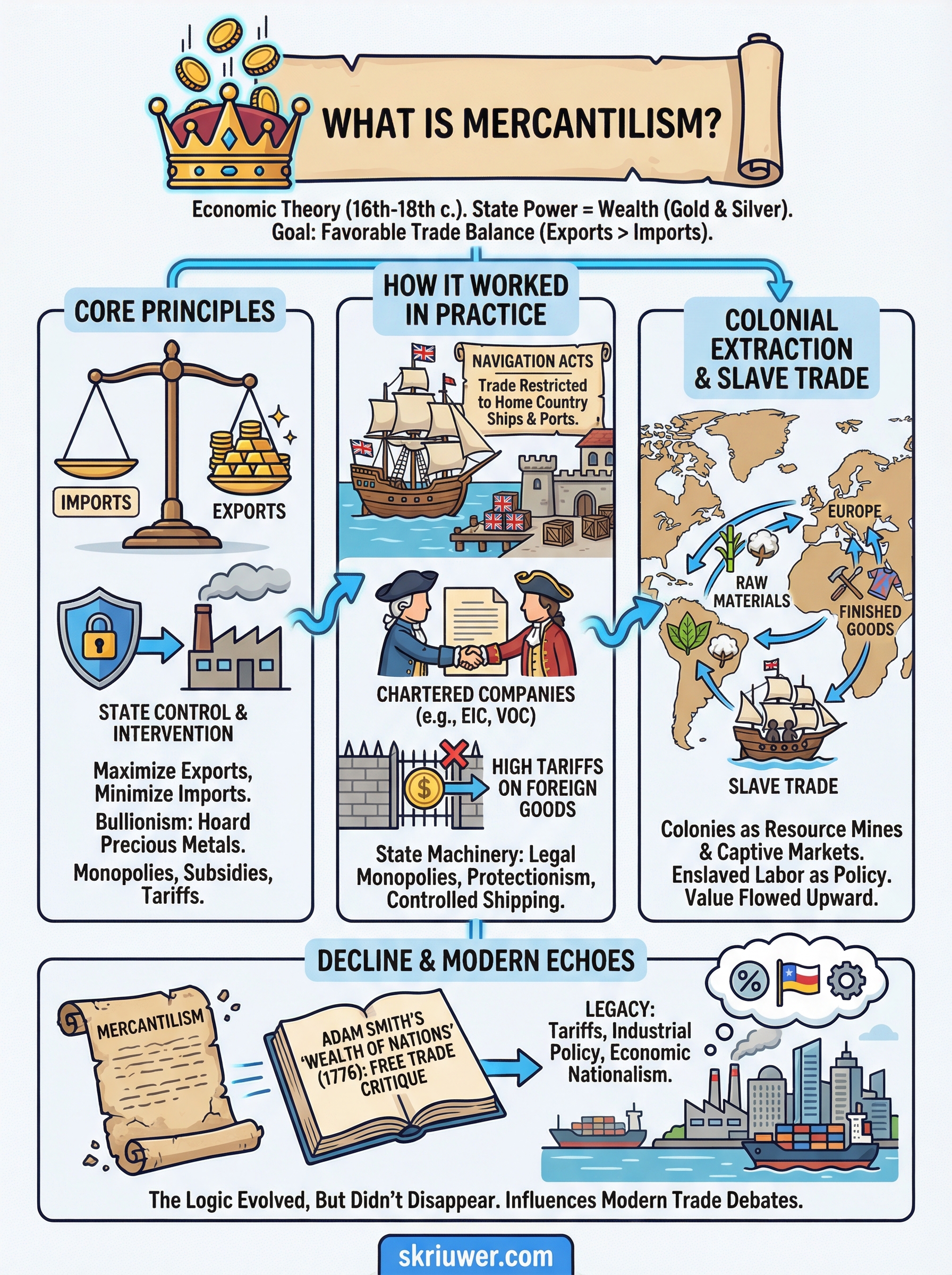
So, what is mercantilism? In short, it's the economic theory that dominated European policy from roughly the 16th to the 18th century, built on the idea that a nation's wealth depended on hoarding gold, silver, and running a favorable balance of trade. Governments taxed imports, subsidized exports, and treated colonies as resource mines. It shaped empires, sparked wars, and laid the groundwork for modern capitalism.
But most textbook summaries stop there. They rarely dig into how mercantilism justified exploitation, drove colonial violence, and created economic hierarchies that still echo today. That's exactly the kind of history worth examining more closely, and it's why we publish books at Skriuwer that go beyond sanitized overviews to explore the forces that actually shaped the world. Economic systems like mercantilism didn't operate in a vacuum; they were tied directly to conquest, slavery, and geopolitical control.
This article breaks down mercantilism's core principles, traces its historical development across Europe's major powers, and examines how it fueled the colonial trade system. Whether you're a student, a history reader, or someone who wants to understand the economic roots of empire, you'll find a thorough and honest overview below.
Why mercantilism mattered
To understand what is mercantilism and why it dominated European policy for over two centuries, you need to understand the world it emerged from. In the 1500s, Europe's kingdoms were locked in constant competition for territory, military strength, and international influence. Gold and silver were not just currency; they were the direct measure of state power. A king without a full treasury couldn't pay armies, fund wars, or maintain diplomatic leverage. Mercantilism gave governments a systematic framework for accumulating that power, and rulers adopted it aggressively because the alternative was falling behind rivals who were already doing the same.
The link between wealth and state survival
Medieval Europe had operated under feudal systems where land was the primary source of wealth. The rise of long-distance ocean trade in the 15th and 16th centuries changed that equation completely. Suddenly, controlling trade routes and access to foreign markets became as important as controlling territory. Kingdoms that figured this out early, including Spain, Portugal, England, France, and the Dutch Republic, began building commercial empires that stretched across multiple continents.
Mercantilism gave these states a clear logic for doing it systematically. The core idea was straightforward: exports bring money in, imports send money out, so a nation should maximize the first and minimize the second. Governments built entire bureaucracies around enforcing this logic. They issued trade monopolies, chartered powerful companies like the British East India Company, and passed navigation laws that forced colonies to trade exclusively with the home country. The state was not a passive observer of commerce; it was the active director of economic life.
Mercantilism was not just an economic theory, it was a political weapon that states used to gain and maintain dominance over rivals.
Why it outlasted other ideas of its era
Most political and economic ideas from the 16th century faded quickly. Mercantilism lasted for over 200 years, and it's worth asking why. One major reason is that it delivered concrete results for those in power. Merchants received protected markets. Monarchs collected tax revenue and accumulated gold reserves. Military expansion gained a clear economic justification. Everyone near the top of the social hierarchy benefited from the arrangement, which gave the system enormous staying power even when its contradictions became visible.
Another reason is that mercantilism solved a real problem that every European state faced: how do competing nation-states survive when global resources appear finite? The underlying assumption was that wealth was a fixed pie. If your neighbor got richer, you got relatively poorer. That zero-sum logic made mercantilist policies feel not just practical but essential for national survival.
This framework directly shaped how European powers treated each other, how they structured colonial relationships, and how they justified the extraction of wealth from Africa, Asia, and the Americas. You can hear echoes of this same zero-sum thinking in modern trade disputes and tariff debates, which is exactly why mercantilism is worth understanding in full rather than as a footnote in an economics textbook. The logic did not disappear; it evolved and adapted into systems that still influence international trade policy today.
Core principles of mercantilism
When you ask what is mercantilism at its foundational level, you find a consistent set of beliefs that guided policy across different countries and centuries. These principles were not accidental; they reflected a deliberate theory of state power grounded in the assumption that national wealth was finite and that governments had both the right and the duty to direct economic activity in the nation's favor.
The trade surplus as national goal
The most fundamental principle was the trade surplus. Every mercantilist government aimed to export more than it imported, ensuring that money flowed into the country rather than out of it. To enforce this, rulers imposed high tariffs on foreign goods, banned the export of raw materials that domestic industries needed, and subsidized domestic manufacturers to keep production inside national borders. The goal was direct: keep the gold at home.
A nation that imported more than it exported was, by mercantilist logic, slowly bleeding itself dry.
Bullionism and the role of precious metals
Mercantilists believed that gold and silver were the direct measure of national wealth. This view, known as bullionism, meant that governments obsessed over their precious metal reserves and passed strict laws against exporting coin or bullion. Spain, for example, tried for decades to prevent silver from leaving its American colonies through anything other than official trade channels, even as smuggling networks undermined those efforts at every turn.
State control over commerce
State intervention was not considered overreach under mercantilism; it was considered responsible governing. Rulers granted monopolies to favored trading companies, set prices, regulated wages, and controlled which ports could handle which goods. Private merchants and national governments worked in close alignment, each reinforcing the other's position. Your profit as a merchant depended on political access and state-granted privileges, which meant merchants had every incentive to support and lobby for policies that expanded state commercial power. The interests of the crown and the counting house pointed in the same direction.
How mercantilism worked in practice
Understanding what is mercantilism in theory is one thing, but seeing how governments actually enforced it reveals the true scale of state intervention involved. Mercantilist policy was not a passive set of guidelines; rulers built active legal and institutional machinery to direct trade flows, protect domestic industries, and punish those who worked against national commercial interests. The results were visible in every port, every customs house, and every colony stretching across the Atlantic and Indian Oceans.
Navigation Acts and trade monopolies
England's Navigation Acts, first passed in 1651, are one of the clearest examples of mercantilism in action. These laws required that all goods shipped to English ports arrive on English ships crewed by English sailors. The intent was to cut Dutch shipping out of English trade entirely and channel the profits of commerce directly back to English merchants and the Crown. France passed similar legislation under Jean-Baptiste Colbert, Louis XIV's finance minister, who built a comprehensive system of state-managed manufacturing guilds, tariff walls, and royal subsidies to dominate European luxury goods markets.
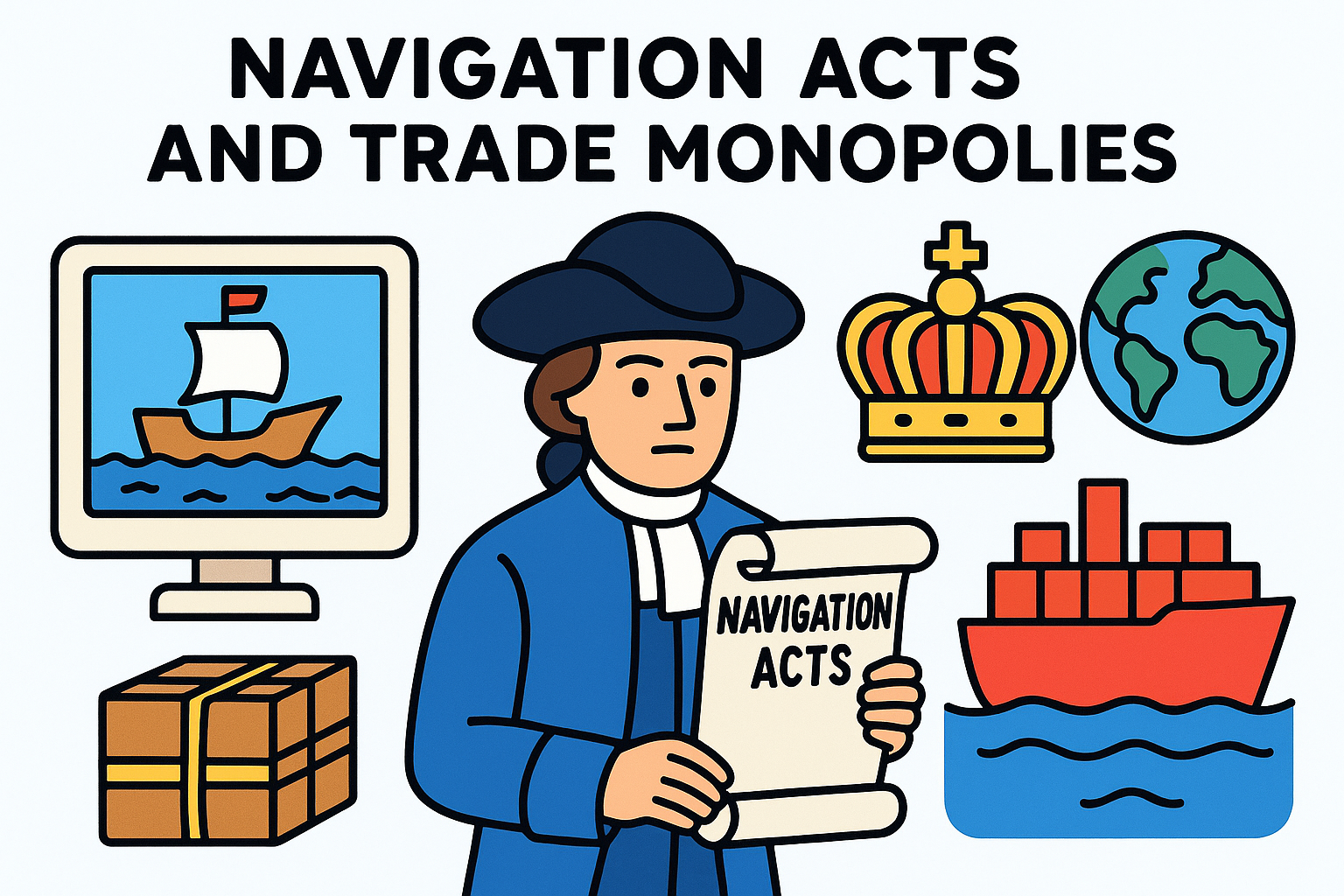
Colbert's approach became so influential that state-directed economic management in France became known as "Colbertism" long after mercantilism itself had faded.
Governments also chartered powerful trading companies to enforce these arrangements at sea and abroad. The British East India Company and the Dutch VOC received legal monopolies over entire ocean trading routes, backed by both state authority and private military force. These companies were not just businesses; they functioned as arms of the state with the power to wage war, sign treaties, and administer territory.
Tariffs, subsidies, and domestic protection
At home, mercantilist governments used tariffs and subsidies to shape industry directly. High import tariffs made foreign manufactured goods more expensive than domestic alternatives, steering consumers toward home producers even when foreign products were cheaper or better made. Subsidies flowed to industries the state considered strategically important, particularly shipbuilding, wool, and textiles. If you trace the origins of modern industrial policy, you will find these same tools appearing repeatedly because governments learned from what mercantilist states had already done, treating economic production as a matter of national security rather than individual choice.
Mercantilism, colonies, and the slave trade
When you look at what is mercantilism in its full historical scope, the colonial system stands out as its most brutal application. European powers did not acquire colonies for cultural exchange or mutual benefit; they built them as extraction engines designed to feed the home country's trade surplus. Raw materials flowed in one direction, finished goods flowed back the other, and the entire arrangement was backed by legal force that gave colonized peoples no meaningful say in the terms.
Colonies as economic machines
European empires treated their colonial territories as controlled supply chains. Spain extracted silver from Peru and Bolivia through a forced labor system called the mita, where indigenous populations were legally compelled to work in mines under conditions that killed enormous numbers of them. Britain structured its North American and Caribbean colonies to produce tobacco, cotton, sugar, and indigo that domestic manufacturers could process and sell as finished goods at a profit. Colonial populations were legally prevented from manufacturing finished goods themselves or trading with any country other than the home power, ensuring that all economic value flowed upward to the metropole.
The colonial economy was not a side effect of mercantilism; it was the system working exactly as designed.
France built its Caribbean plantation economy around sugar production in Saint-Domingue, while the Dutch VOC turned large parts of the Indonesian archipelago into forced cultivation zones for spices and coffee. Every major colonial power applied the same underlying extractive logic regardless of geography or crop.
The slave trade as mercantilist policy
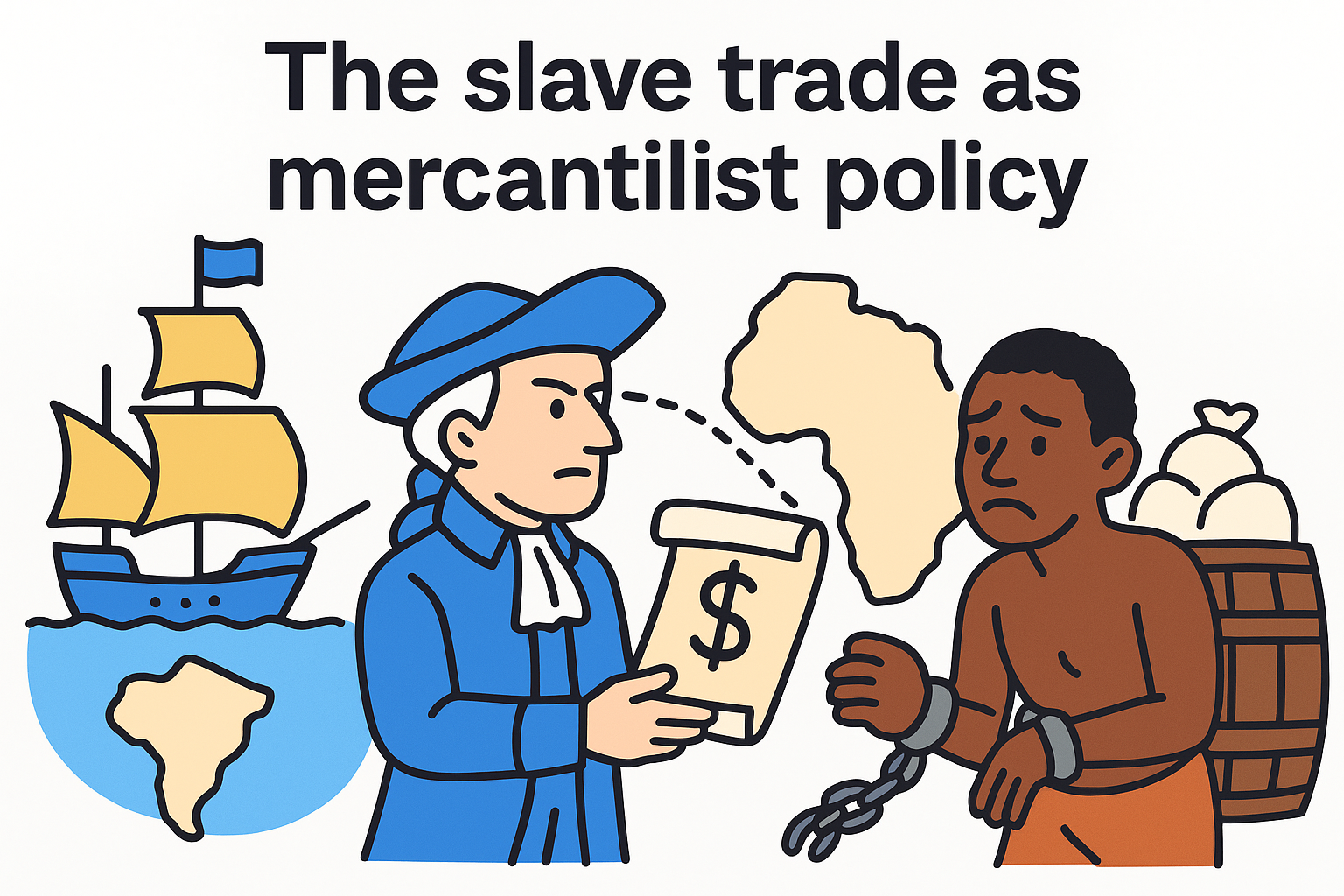
The transatlantic slave trade did not develop independently of mercantilist theory. European governments actively chartered and subsidized slave-trading companies because enslaved labor made colonial extraction far more profitable than any alternative available at the time. The British Royal African Company received a Crown monopoly over the slave trade in 1672, and when that monopoly ended in 1698, independent merchants expanded the trade dramatically because it aligned with the broader mercantilist goal of maximizing national wealth at minimum cost. Enslaved people became a commodity within the same trade ledgers that tracked sugar, tobacco, and silver. Understanding mercantilism honestly requires recognizing that this human exploitation was not incidental but structurally embedded in the economic logic that European states had spent two centuries building.
From mercantilism to free trade and today
By the late 18th century, mercantilism was losing ground to a new set of ideas. Economists and philosophers began pointing out that the system's core assumptions were flawed, that wealth was not a fixed pie and that trade could benefit multiple parties simultaneously rather than enriching one nation at another's expense.
Adam Smith and the breakdown of the old system
In 1776, Adam Smith published The Wealth of Nations, which delivered the most systematic critique of mercantilist trade policy ever written. Smith argued that restricting imports and hoarding gold weakened economies rather than strengthening them, because it prevented specialization and efficiency. Countries could produce more total wealth by focusing on what they did best and trading freely with others. Smith's ideas gave intellectual cover to the free trade movement that reshaped British commercial policy throughout the 19th century, dismantling tariff walls that mercantilism had built over generations.
Free trade did not erase the power imbalances mercantilism created; it often inherited and reorganized them.
Smith's arguments were compelling, but the transition was not clean. Industrialized nations that had already built wealth through mercantilism found free trade convenient once they held the manufacturing advantage. Less developed economies were pushed to open their markets before they could build comparable industries, locking in a hierarchy that looked different from the colonial era but operated on familiar terms.
What mercantilism looks like today
If you want to understand what is mercantilism's lasting legacy, look at contemporary trade disputes. When governments impose tariffs to protect domestic manufacturing, subsidize national industries, or restrict foreign companies from operating in sensitive sectors, they are drawing from the same toolkit that mercantilist states developed centuries ago. The language has changed, but the underlying logic of using trade policy as a tool of national power has not disappeared.
Modern debates over trade deficits, industrial policy, and economic nationalism use arguments that would have been recognizable to Jean-Baptiste Colbert. Understanding where these ideas came from helps you evaluate them more clearly, whether you encounter them in policy debates, news analysis, or the historical accounts that mainstream publishers rarely commission.
Where this leaves us
Mercantilism was not just a phase in economic history that politely ended when better ideas arrived. It was a system of organized extraction that shaped empires, justified slavery, and built the trade hierarchies that modern nations still navigate. When you understand what is mercantilism in its full context, you see that today's debates about tariffs, industrial subsidies, and trade deficits are not new arguments. They are old arguments wearing updated vocabulary, backed by the same fundamental assumption that national wealth depends on winning at the expense of others.
That context matters if you want to think clearly about the world as it actually works rather than as textbooks tend to simplify it. Honest historical analysis cuts through the sanitized versions of these stories and shows you how economic systems actually operated and who benefited. If you want books that take that approach seriously, browse the full catalog at Skriuwer, where independent publishing means you get the unfiltered history that mainstream houses routinely skip.
Recommended Reading
Explore the economic forces that shaped world history:
- The History of Gold: From Ancient Myths to Modern Markets – Discover how gold influenced trade, power, and the rise of mercantilism.
- The History of the Netherlands: Water, Walls, and Wars – Learn about the Dutch Golden Age, one of history's greatest mercantile empires.
- The History of the UK: Evolution of the United Kingdom – Explore the British Empire's trade networks and mercantilist policies.
Books You Might Like


Through the Language Glass
Guy Deutscher

How to Learn Any Language
Barry Farber