What Is Apartheid
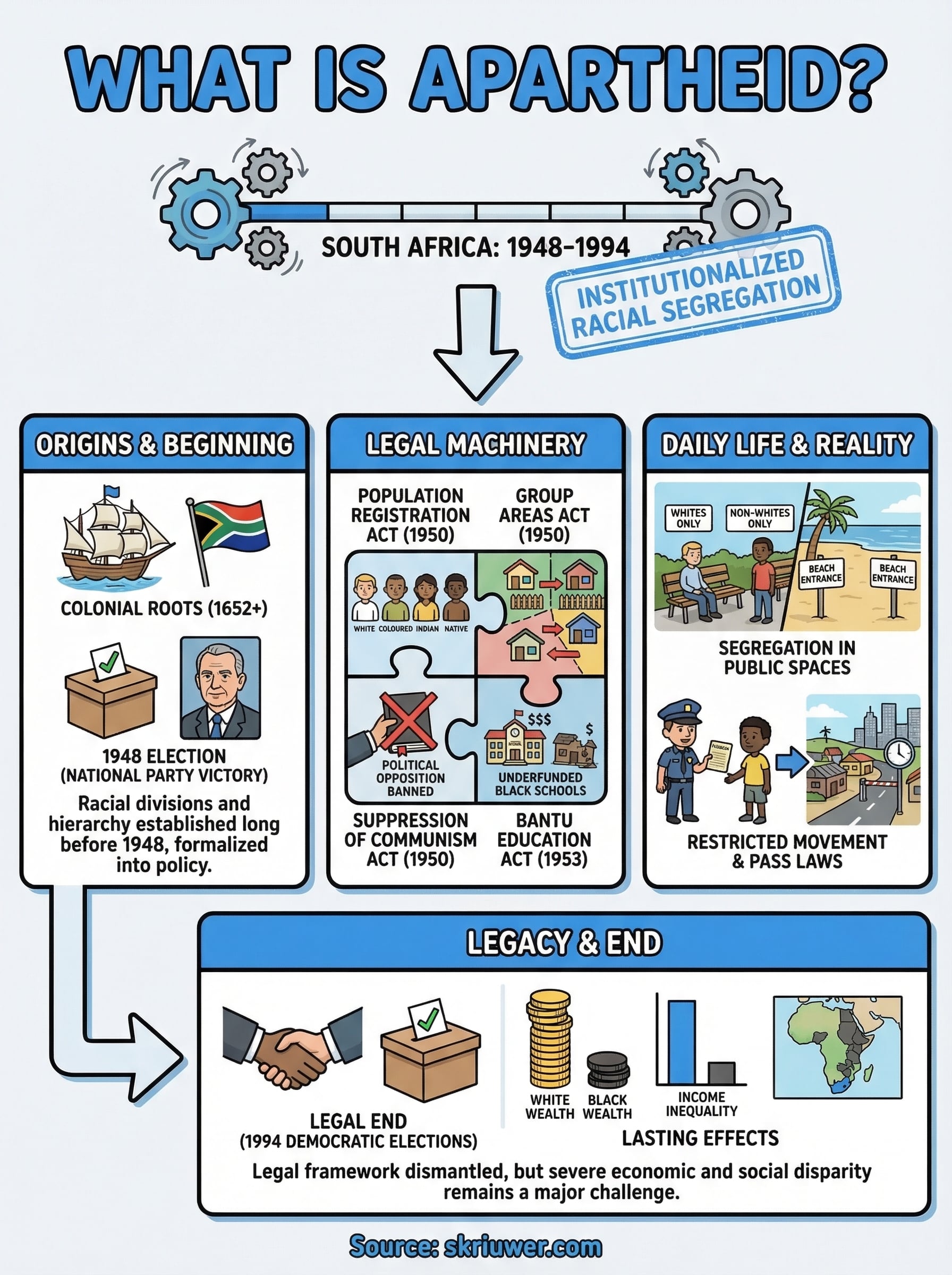
If you ask what is apartheid, the short answer is straightforward: a system of institutionalized racial segregation enforced by the South African government from 1948 to 1994. But the short answer barely scratches the surface. Apartheid was a legal architecture built on racial classification, forced removals, and political exclusion, a structure that shaped every detail of daily life for millions of people based solely on the color of their skin.
Understanding apartheid requires more than a dictionary definition. It demands a look at the political movements that created it, the laws that held it together, and the lived reality of those trapped inside it. Much of that story gets compressed into a paragraph or two in mainstream accounts, which is exactly why we publish books at Skriuwer that refuse to flatten history into convenient summaries, because the full picture matters.
This article breaks down apartheid from its roots in colonial-era segregation through the legislative machinery of the National Party to the everyday consequences for South Africans. You'll walk away with a clear understanding of how apartheid functioned, not just as an idea, but as a system, and why its legacy still echoes today.
Why apartheid matters and why people still talk about it
Apartheid ended legally in 1994, but the conversation around it never did. When you ask what is apartheid and dig past the surface, you find a system whose consequences still shape South African society, its economy, its land distribution, and its political culture. History that gets resolved on paper rarely resolves in practice, and South Africa remains one of the clearest examples of that reality.
The long shadow it left on South Africa
After 1994, South Africa held its first democratic elections and Nelson Mandela became president. But decades of enforced poverty, displacement, and restricted education don't disappear with a new government. The townships that apartheid created still exist. The wealth gap between white and Black South Africans remains one of the widest in the world, a direct consequence of a system designed to concentrate resources in the hands of one racial group.
Structural inequality doesn't vanish when discriminatory laws are repealed; it outlasts them by generations.
The economic disparity shows up in land ownership, access to quality healthcare, and educational outcomes. South Africa's Gini coefficient, a standard measure of income inequality, consistently ranks among the highest globally. These numbers trace directly back to policies that denied Black South Africans the right to own property in most of the country, work in skilled professions without restriction, or attend well-funded schools. The apartheid government built this inequality deliberately over decades, and dismantling it requires far more than changing laws on paper.
Why apartheid stays in global conversations
South Africa's apartheid has become a reference point in global discussions about racial justice, systemic discrimination, and the long-term effects of state-sanctioned segregation. Movements around the world, from debates about reparations in the United States to discussions about minority rights in Europe, regularly cite apartheid as a documented case study of how governments can engineer inequality through law. It functions as a historical standard against which other political systems get measured and critically compared.
You also hear the word apartheid applied to other political situations today, sometimes accurately and sometimes as rhetoric. That use of the term reflects how much weight it carries in modern discourse. When people reach for the word apartheid to describe a current situation, they invoke a specific history of bureaucratic, legal, and often violent exclusion. Understanding what the original system actually was makes you better equipped to evaluate those comparisons honestly, rather than accepting or rejecting them based on emotion alone.
How apartheid began in South Africa
Apartheid didn't appear out of thin air in 1948. South Africa's racial divisions stretched back centuries, shaped by European colonialism, land dispossession, and labor exploitation long before the National Party ever came to power. To understand how the system took hold, you need to trace both the colonial foundations that preceded it and the specific political moment that turned those foundations into national policy.
The colonial roots of racial segregation
The Dutch East India Company established a settlement at the Cape of Good Hope in 1652, and racial hierarchy became embedded in the colony from its earliest years. British rule introduced new laws but maintained the same fundamental structure of white control over Black and mixed-race populations. By 1910, when the Union of South Africa formed, segregationist legislation was already operating across multiple regions, making apartheid less a new idea and more a formalization of what colonialism had already built.
The 1948 election that changed everything
The National Party, led by Daniel François Malan, won the 1948 South African general election on a platform built explicitly around apartheid, an Afrikaans word meaning "separateness." That victory handed a political movement rooted in Afrikaner nationalism and racial hierarchy the tools to restructure an entire country.
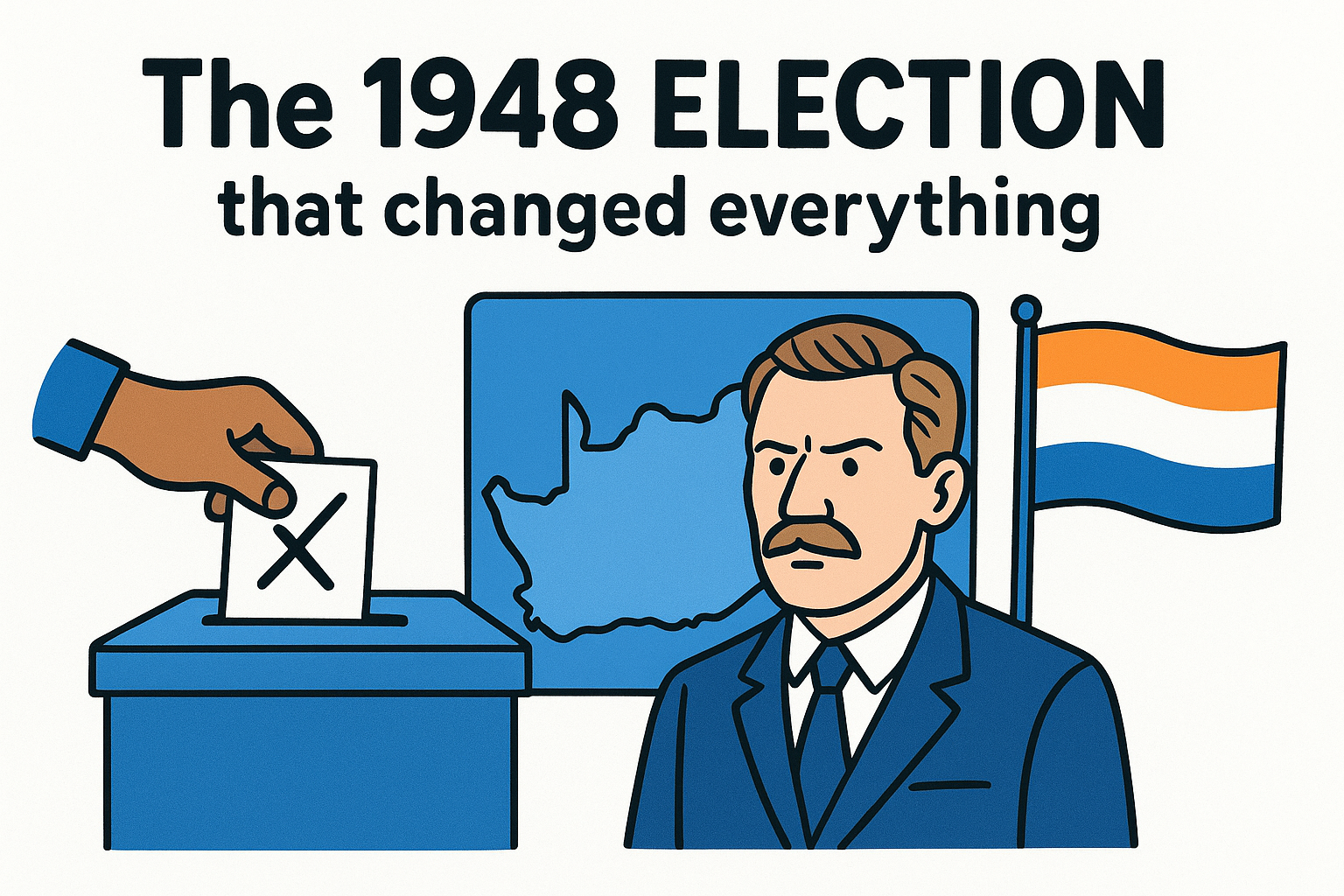
The 1948 election didn't invent racial discrimination in South Africa; it gave discrimination a government mandate and a legal system to enforce it.
Malan's government moved fast. Within just a few years, dozens of laws classified every South African by race and assigned rights and restrictions accordingly. Recognizing this timeline is essential when you ask what is apartheid, because the roots of the system run far deeper than a single election result.
How apartheid worked as a legal system
The legal machinery of apartheid was methodical and comprehensive. When people ask what is apartheid in its operational form, the answer points directly to a set of laws that classified, separated, and controlled every South African by race from birth. The National Party didn't rely on social pressure or informal custom; it built a legislative structure that left no aspect of life outside its reach.
Racial classification and population registration
Passed in 1950, the Population Registration Act required every South African to be classified into one of four racial categories: White, Coloured, Indian, or Native (later called Bantu). That classification determined where you could live, work, go to school, and even whom you could marry. Government inspectors applied tests ranging from physical appearance to social behavior, and a single reclassification could strip a person of rights overnight.
Classification wasn't just a label; it was a legal sentence that determined the entire course of a person's life.
Key laws that held the system together
Several statutes formed the backbone of apartheid's legal structure, working in concert to leave no gap for resistance or mobility:
- Group Areas Act (1950): Designated separate residential zones by race, forcing millions from their homes.
- Suppression of Communism Act (1950): Gave authorities sweeping power to ban any political opposition.
- Bantu Education Act (1953): Deliberately underfunded Black schools to limit career opportunities.
- Pass Laws: Required Black South Africans to carry identification at all times and restricted their movement between areas.
These laws reinforced one another as a connected, deliberate system. Each one closed off another avenue of resistance or advancement, creating a structure of legal control that touched every corner of South African life.
What daily life looked like under apartheid
When you ask what is apartheid in terms of lived experience, the answer shifts from legislation to something far more personal. The laws described in the previous section weren't abstract policies; they translated into daily humiliations, family separations, and physical restrictions that millions of Black South Africans navigated from the moment they woke up to the moment they went to sleep.
Segregation in public spaces and housing
Separate benches, separate beaches, separate entrances, and separate hospitals defined the physical landscape of apartheid South Africa. Signs marked "Whites Only" or "Non-Whites Only" appeared on park benches, public toilets, train carriages, and government buildings. Black South Africans could enter white-designated areas only to work, and even then under strict conditions. Entire urban neighborhoods were cleared through the Group Areas Act, forcing families into distant townships like Soweto, far from city centers and economic opportunity.
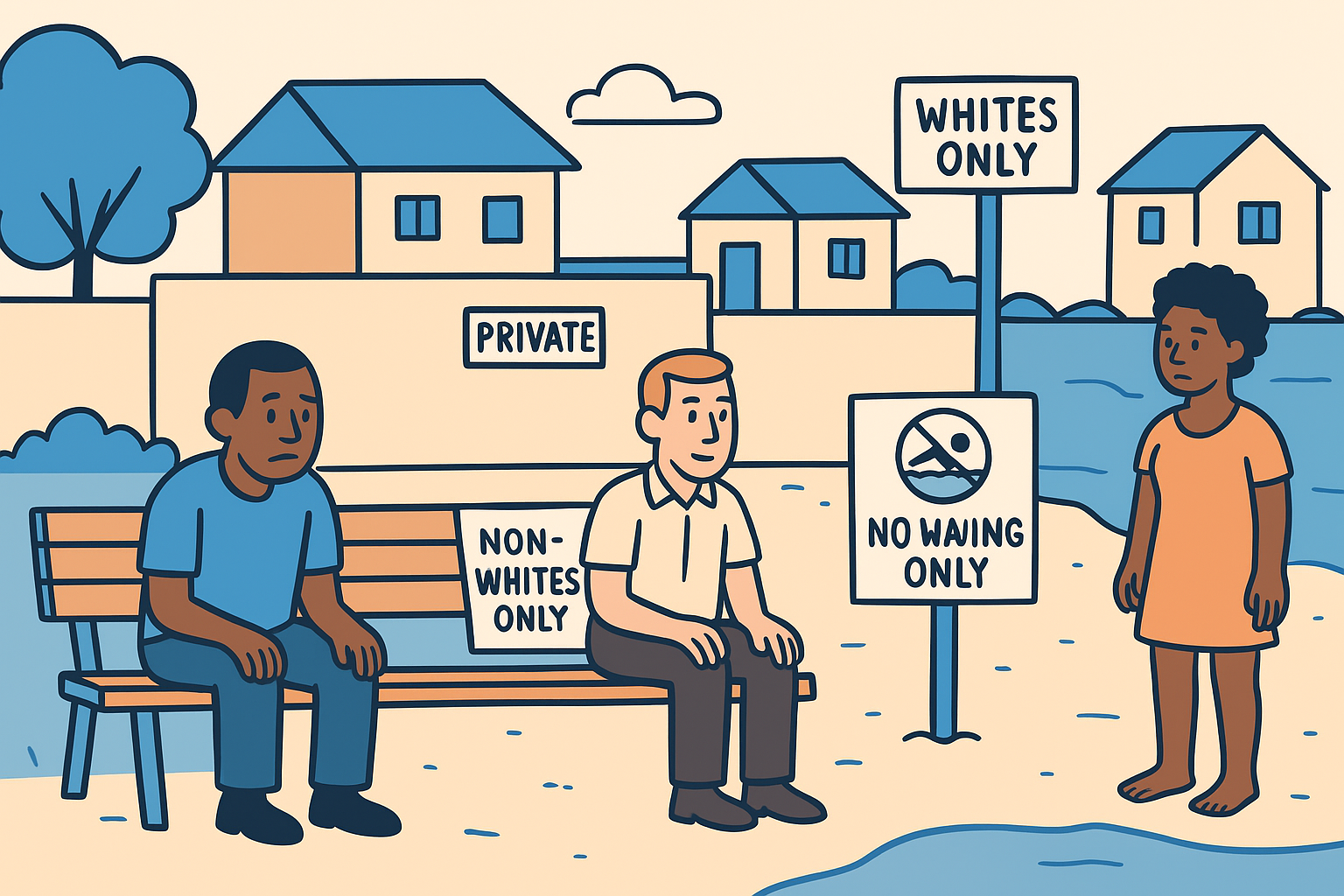
The physical separation wasn't incidental; it was the point, designed to make Black South Africans invisible in spaces of power and commerce.
Restricted movement and economic exclusion
The pass laws forced every Black South African adult to carry a passbook at all times. Police could stop anyone at any moment and demand to see it. Working in a city required the right stamp from an employer, and failing to produce valid documentation meant immediate arrest. This system controlled labor supply while keeping families apart, since a worker's passbook might not authorize their spouse or children to live in the same area. Black workers filled the lowest-paid, most dangerous roles across mining, agriculture, and domestic service, with legal barriers preventing movement into skilled or professional work.
How apartheid ended and what remained afterward
Apartheid's collapse came from sustained pressure both inside and outside South Africa. Internal resistance through strikes, protests, and organizations like the African National Congress (ANC) combined with international economic sanctions and diplomatic isolation to make the system increasingly costly for the National Party government. By the late 1980s, maintaining apartheid had become politically and financially unsustainable.
The negotiations that dismantled the legal framework
In 1990, President F.W. de Klerk unbanned the ANC and released Nelson Mandela after 27 years in prison. That decision opened a multi-year negotiation process that neither side could walk away from without consequences.
Those negotiations produced South Africa's first fully democratic elections in April 1994, which Mandela and the ANC won decisively. A new constitution took effect in 1996, and the legal architecture of apartheid was repealed statute by statute, formally ending the system that had defined South African life for nearly five decades.
Repealing discriminatory laws is a political act; reversing the material damage those laws created over generations is an economic and social challenge of an entirely different scale.
What post-apartheid South Africa inherited
When you ask what is apartheid's most durable legacy, the answer shows up in economic data rather than legislation. Land ownership, access to quality education, and generational wealth remained heavily concentrated among white South Africans well into the democratic era, a direct result of policies designed to prevent Black South Africans from accumulating either.
Unemployment stayed persistently high in townships built under deliberate underdevelopment, and the Gini coefficient measuring income inequality continued to rank among the worst globally. South Africa's democracy resolved the legal structure of apartheid, but the material consequences outlasted every law that created them.
Key takeaways and where to learn more
Understanding what is apartheid means recognizing it as more than a policy, it was a deliberately engineered legal system that classified, separated, and controlled millions of people based on race for nearly five decades. Its roots reached back to colonial dispossession, its machinery ran through dozens of interlocking laws, and its consequences survived the formal repeal of every statute that created it. Racial segregation on this scale leaves economic and social damage that outlasts the politicians who designed it by generations.
South Africa's story doesn't get told fully in most mainstream sources, and the same applies to dozens of other suppressed or flattened histories that deserve serious attention. If you want to go deeper on untold histories, dark political realities, and the chapters mainstream publishers tend to skip, explore the full catalog at Skriuwer, where books exist to challenge comfortable assumptions and replace them with something closer to the actual record.
Recommended Reading
Understand the historical forces behind racial injustice and colonial legacies:
- The History of the UK: Evolution of the United Kingdom – Explore the British colonial legacy that contributed to apartheid's foundations.
- The History of the Netherlands: Water, Walls, and Wars – Discover the Dutch colonial history that shaped South Africa.
Books You Might Like


Through the Language Glass
Guy Deutscher

How to Learn Any Language
Barry Farber