What Are Lost Civilizations
Entire cities buried under jungle canopy. Writing systems nobody alive can read. Empires that ruled millions, now reduced to a few scattered ruins and a Wikipedia entry. If you've ever asked what are lost civilizations, you're really asking one of history's most unsettling questions: how does an entire society disappear?
The answer is rarely simple. Civilizations collapse through war, environmental disaster, disease, internal decay, or some combination that historians are still arguing about. A "lost" civilization isn't necessarily one that left no trace. It's one that fell so far from its peak that its own descendants sometimes forgot it existed. That gap between what was and what survived is exactly the kind of territory we explore at Skriuwer, where we publish books on the histories that mainstream outlets tend to skip over.
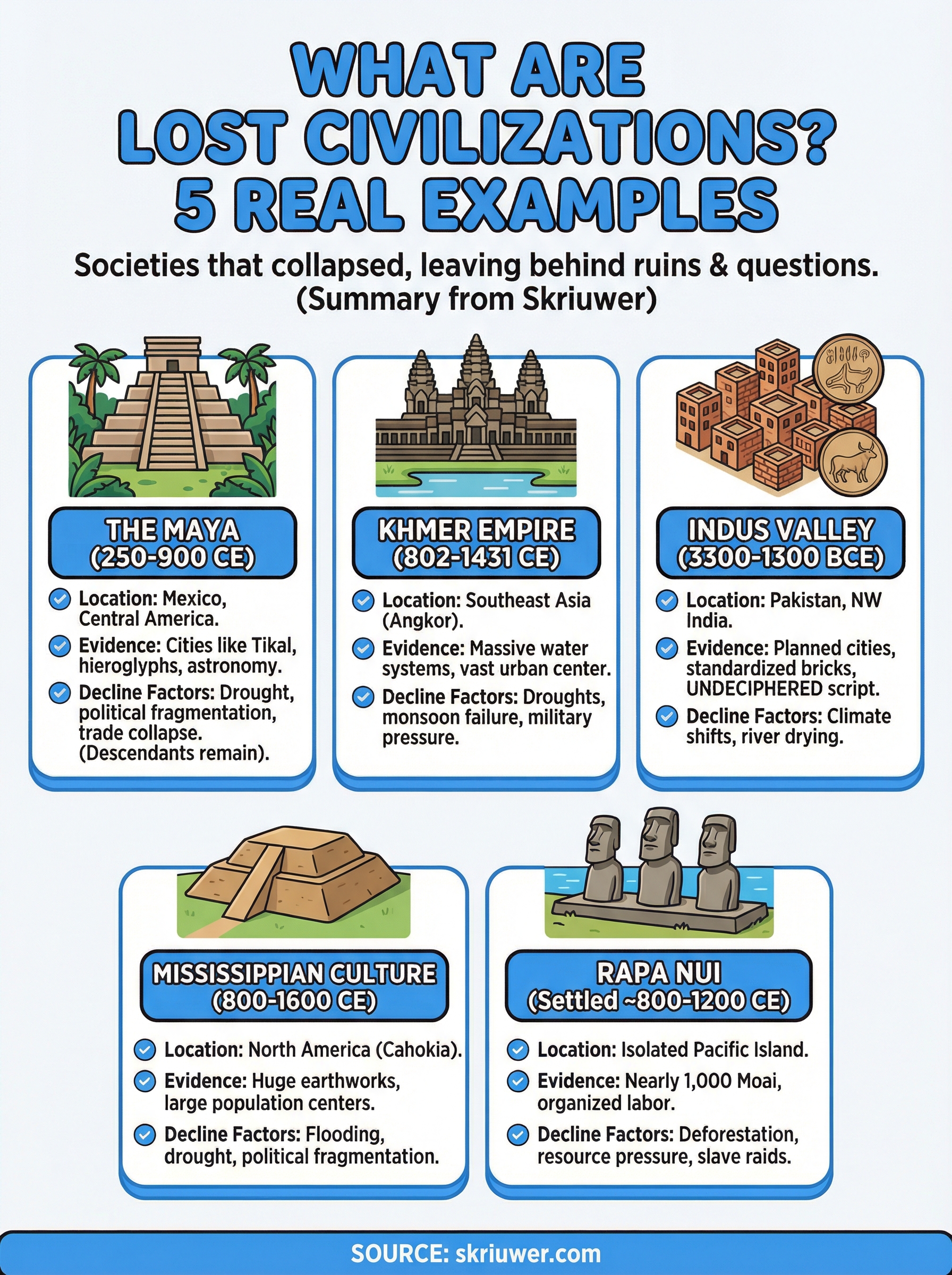
Below, you'll find a clear definition of what qualifies as a lost civilization, followed by five real examples, each one a case study in how powerful societies can vanish from collective human memory.
1. The Maya
The Maya are probably the most recognized entry on any list of what are lost civilizations. At their height, between roughly 250 and 900 CE, Maya city-states across southern Mexico, Guatemala, Belize, and Honduras supported millions of people, produced sophisticated mathematics, tracked astronomical cycles with precision, and built cities that rivaled anything in the ancient world.
Where and when the Maya flourished
Maya civilization didn't appear overnight. It developed over thousands of years, with early communities forming as far back as 2000 BCE. The Classic period, from roughly 250 to 900 CE, was when major centers like Tikal, Palenque, and Copan reached their peak population and political complexity. These weren't isolated villages. They were connected political networks with trade routes, diplomacy, and ongoing warfare between rival city-states.
What evidence of the Maya remains
You can still visit Chichen Itza, Tikal, and Palenque today, all of which preserve temples, ball courts, inscribed stone monuments called stelae, and elaborate tomb complexes. Researchers have also recovered thousands of hieroglyphic texts on stone, pottery, and the few codices that survived Spanish colonization. LiDAR surveys conducted in recent years revealed that the urban footprint of Maya cities was far larger than anyone previously estimated.
The scale of Maya construction and literacy puts them firmly outside the category of "primitive" societies, yet mainstream education rarely reflects that complexity.
Why the classic Maya city-states declined
No single cause ended Classic Maya political power. The leading factors include prolonged drought cycles, deforestation that reduced agricultural output, political fragmentation between rival centers, and breakdowns in long-distance trade. By 900 CE, major southern lowland cities were largely depopulated.
What people often get wrong about the Maya being "lost"
The Maya didn't vanish. Over seven million Maya people live today across Mexico and Central America, speaking more than 30 distinct Maya languages. What collapsed was the Classic political structure, not the population or the culture. Calling them entirely "lost" erases the living communities that preserved and continue to evolve Maya traditions.
2. The Khmer Empire
At its height, the Khmer Empire controlled a vast stretch of mainland Southeast Asia from roughly 802 to 1431 CE. When people ask what are lost civilizations, the Khmer are a strong example because their capital sat buried under dense jungle for centuries before researchers began to understand its true scale.
Where the Khmer Empire ruled
The Khmer Empire stretched across modern-day Cambodia, Thailand, Laos, and parts of Vietnam. Its administrative and spiritual center sat at Angkor, a site in northwestern Cambodia that functioned as one of the largest pre-industrial urban areas on Earth.
What Angkor reveals about Khmer life and power
Angkor Wat alone covers over 400 acres and represents the most massive religious monument ever constructed. Beyond the temples, Khmer engineers built an advanced hydraulic network of canals and reservoirs that managed water across a region entirely dependent on seasonal monsoons.

That level of hydraulic coordination required a centralized political system sophisticated enough to make most modern governments look underprepared.
The leading theories behind Angkor's decline
Researchers point to prolonged droughts and monsoon failures during the 14th and 15th centuries as major stressors on the hydraulic system. Combined with sustained military pressure from the Ayutthaya Kingdom in present-day Thailand, the Khmer political center could no longer sustain itself.
What archaeologists still debate
Scholars continue to argue over whether Angkor was fully abandoned or simply depopulated gradually after 1431. Some researchers maintain a partial administrative presence continued well past the traditional collapse date.
Recent LiDAR surveys have further complicated the picture by revealing dense suburban networks surrounding the main temple complexes, suggesting the city's true population size was significantly underestimated for decades.
3. The Indus Valley civilization
The Indus Valley civilization is one of the oldest and least understood entries in any honest answer to what are lost civilizations. Flourishing between roughly 3300 and 1300 BCE, it covered an area larger than ancient Egypt and Mesopotamia combined, yet most people couldn't name a single one of its cities.
Where the Indus Valley civilization developed
Spread across modern-day Pakistan, northwest India, and parts of Afghanistan, this civilization ran along the Indus and Ghaggar-Hakra river systems. Its two largest known cities, Mohenjo-daro and Harappa, each supported populations that researchers estimate reached tens of thousands.
What makes Indus cities so distinctive
Indus cities show planned street grids and standardized brick sizes across sites separated by hundreds of miles, which implies a coordinated administrative system that no one has fully explained. If you look at the archaeological record, the consistency across such a wide region is genuinely striking.
That level of urban standardization puts the Indus Valley in a category that challenges most assumptions about Bronze Age complexity.
The strongest explanations for its fragmentation
Climate shifts and the gradual drying of the Ghaggar-Hakra river likely pushed populations eastward and broke apart the trade networks holding the civilization together. No single catastrophic event caused the collapse.
Why the Indus script keeps it "lost" to us
Researchers have identified over 400 distinct symbols in the Indus script, but nobody has deciphered it. Without a readable written record, the political structure, religion, and ruling systems of this civilization remain genuinely unknown to modern scholars.
4. The Mississippian culture
The Mississippian culture is one of the more overlooked answers to what are lost civilizations, partly because it developed in North America rather than the regions that dominate most history curricula. These societies flourished between roughly 800 and 1600 CE across the eastern half of the continent.
Where the Mississippians built large centers
Mississippian settlements spread across a wide arc from the Gulf Coast up through the Ohio and Mississippi River valleys. The largest and most studied site sits near present-day St. Louis, Illinois, at a location called Cahokia.
What Cahokia tells us about Mississippian society
At its peak around 1100 CE, Cahokia held an estimated 10,000 to 20,000 people, making it larger than contemporary London. Monks Mound, the central earthwork, required more fill material than the Great Pyramid of Giza to construct.
That kind of construction output demands organized labor, surplus food, and political authority that most people never associate with pre-contact North America.
Likely causes of decline and dispersal
Flooding, drought, and soil depletion pushed populations away from major centers after 1200 CE. Political fragmentation between competing regional chiefdoms accelerated the dispersal significantly.
How we identify Mississippian cultures without writing
Mississippian societies left no written records, so researchers rely on ceramic styles, earthwork patterns, and burial goods to trace connections between sites. If you map those material signatures, you find a surprisingly interconnected network spanning hundreds of miles.
5. The Rapa Nui civilization
Rapa Nui, known to most people as Easter Island, sits in the southeastern Pacific Ocean, roughly 2,300 miles from the nearest populated land. It rounds out any serious answer to what are lost civilizations because its trajectory from thriving society to near-total collapse happened in near-complete geographic isolation.
Where Rapa Nui developed in isolation
Polynesian settlers reached Rapa Nui around 800 to 1200 CE, establishing a structured society that organized labor, managed resources, and built monumental architecture across an island covering only 63 square miles. That combination of ambition and geographic constraint set up a fragile equation from the start.
What the moai and sites tell us today
The island holds nearly 1,000 stone figures, called moai, carved from volcanic rock and transported across rugged terrain without wheels or large animals. Their construction reveals organized political authority and a belief system centered on ancestor veneration.
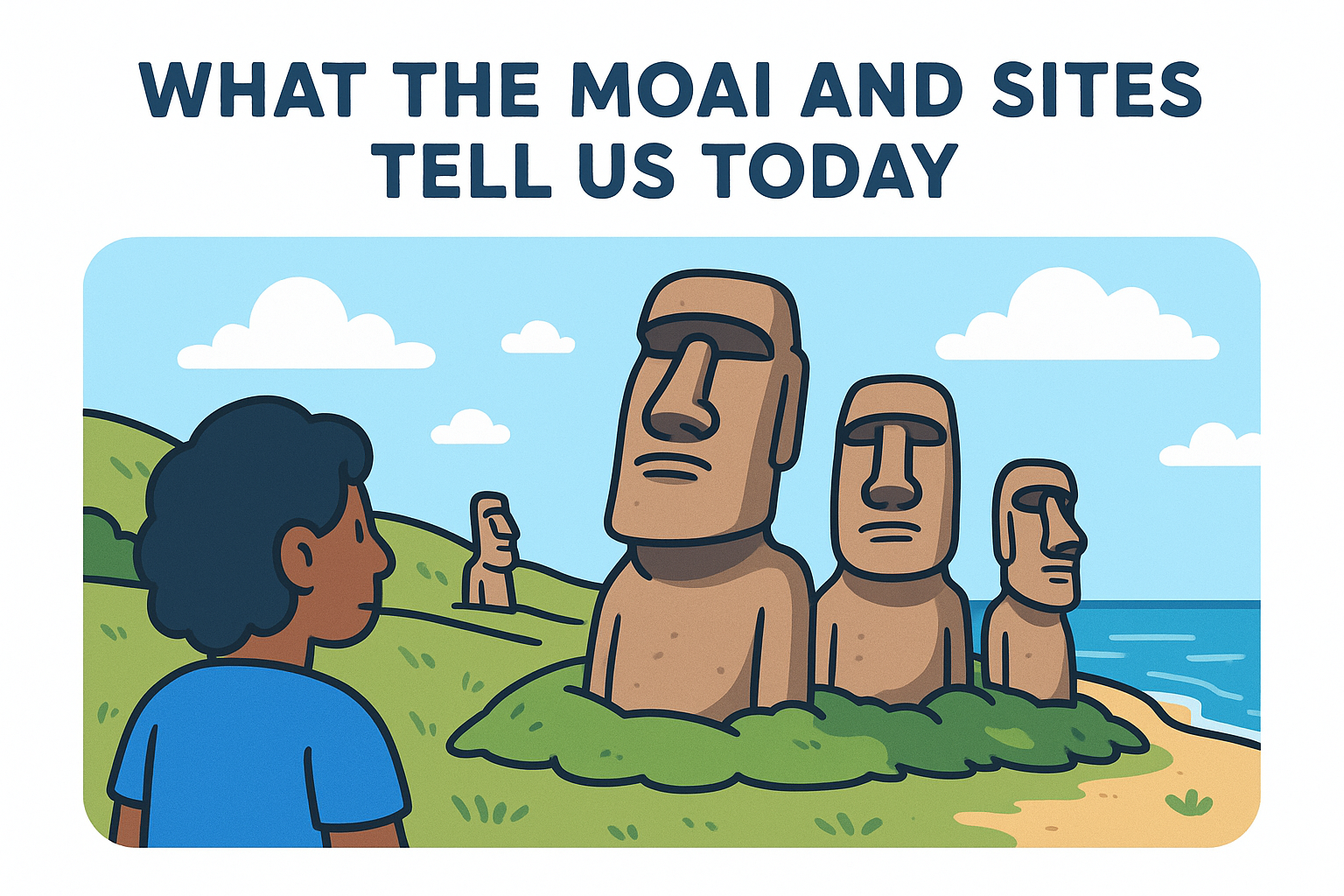
That level of coordinated monument-building on such a small island suggests a society far more complex than popular accounts typically acknowledge.
Resource pressure, conflict, and outside contact
Deforestation, soil erosion, and declining food production weakened Rapa Nui society well before European contact in 1722. Slave raids by Peruvian traders in the 1860s then devastated the remaining population significantly.
What "collapse" means on a small island
On Rapa Nui, collapse meant population loss of roughly 90% within a few generations. If you trace the historical record, the people who survived carried cultural memory forward, but the political and ceremonial systems that built the moai did not survive intact.
Final thoughts
The question of what are lost civilizations doesn't have a single clean answer. Each society on this list collapsed through its own specific mix of environmental stress, political breakdown, and external pressure. None of them disappeared without a trace. Each one left behind ruins, oral traditions, descendants, or material records that researchers are still working to interpret today.
What connects all five is that mainstream history curricula rarely cover them with the depth they deserve. You can move through years of formal education and never encounter Cahokia, never read seriously about the Indus script, and never learn the real mechanics behind Angkor's decline. That gap between what happened and what gets taught is exactly where independent publishing plays a critical role.
If you want to go deeper on hidden histories and forgotten societies, browse the full catalog at Skriuwer, where we publish books that cover stories most major outlets skip entirely. Every title exists because someone decided those histories were worth telling in full.
Books You Might Like


Through the Language Glass
Guy Deutscher

How to Learn Any Language
Barry Farber