Conspiracy Theory Definition
The phrase "conspiracy theory" gets thrown around constantly, in news segments, political debates, social media arguments, and casual conversations. But ask ten people for a conspiracy theory definition, and you'll likely get ten different answers. Some think it means any idea that contradicts official accounts. Others use it as a blanket dismissal for inconvenient questions. The term carries so much baggage that its actual meaning has become blurred almost beyond recognition.
That confusion matters. When you can't clearly define something, it becomes easy to weaponize. Legitimate historical inquiries get lumped in with baseless speculation. Proven conspiracies, and there are many, get dismissed before anyone examines the evidence. The line between critical thinking and paranoid fantasy becomes impossible to draw, which serves neither skeptics nor believers well.
This article breaks down what "conspiracy theory" actually means, where the term came from, what psychological traits these theories tend to share, and how they differ from verified conspiracies. We'll walk through concrete examples from history and explain why some theories persist for decades while others collapse under scrutiny. At Skriuwer, we publish books that dig into the hidden chapters of history, the kind of material that mainstream publishers often avoid. Understanding what separates a conspiracy theory from a genuine investigation into suppressed facts is central to everything we do, and it's a distinction every critical reader should be able to make.
Conspiracy theory definition in plain English
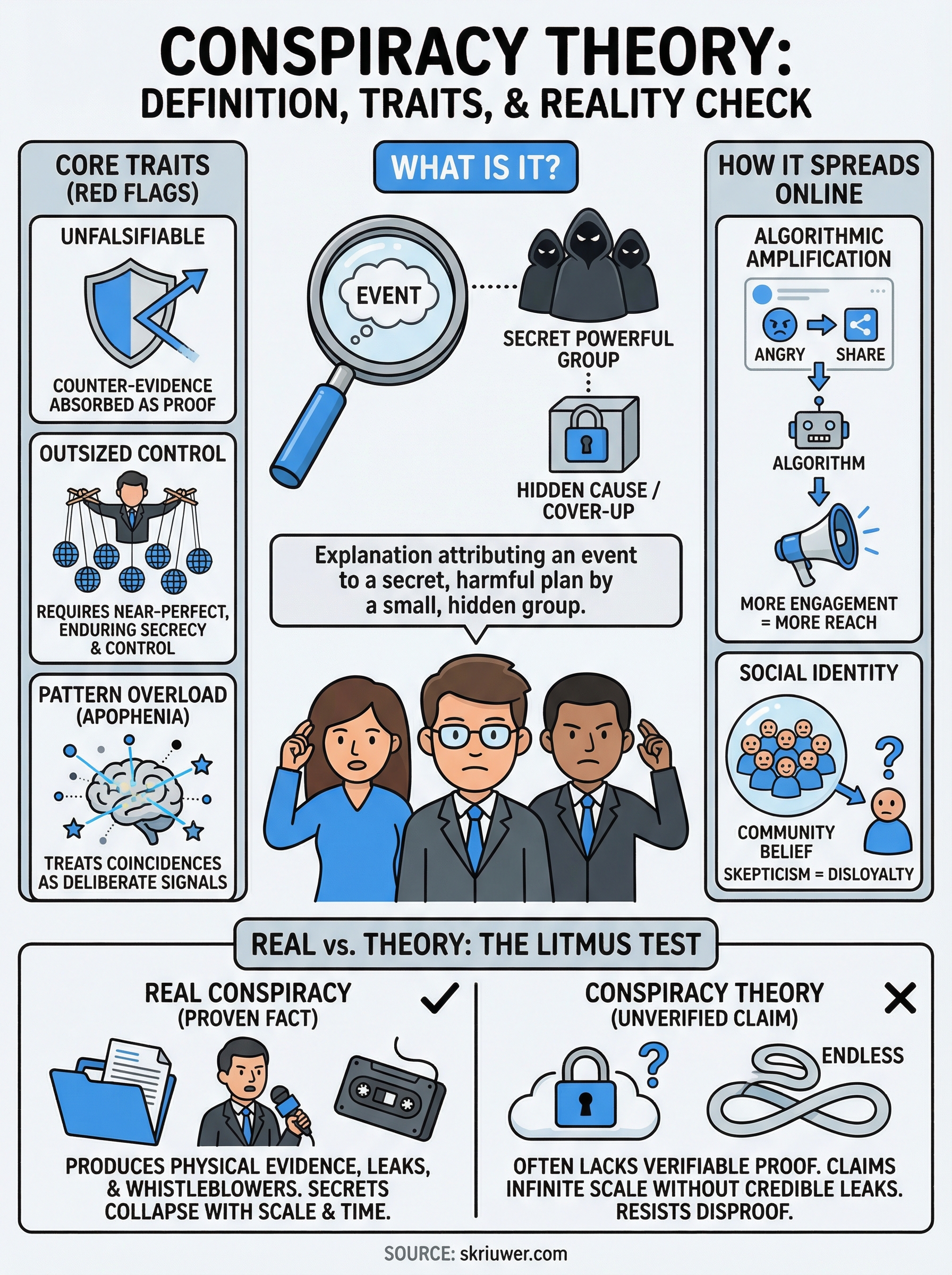
A conspiracy theory is an explanation for an event or situation that attributes the cause to a secret plan carried out by a small group of powerful people acting against the public interest. That's the core of it. The explanation doesn't have to be false to qualify as a conspiracy theory. It just has to claim that hidden actors deliberately pulled strings behind the scenes, and that the official account either ignores or actively conceals those actors. Precision here matters because the term gets misused constantly, in both directions.
What the words actually mean
Breaking the phrase apart helps clarify things. A conspiracy, at its root, is a secret agreement between two or more people to do something harmful or illegal. That's not a fringe idea. Conspiracies happen regularly, and courts convict people on conspiracy charges every day. The second part, "theory," means a proposed explanation for observed facts. In everyday speech, people use "theory" loosely to mean a guess, but in structured reasoning it means a formal account of how something works.
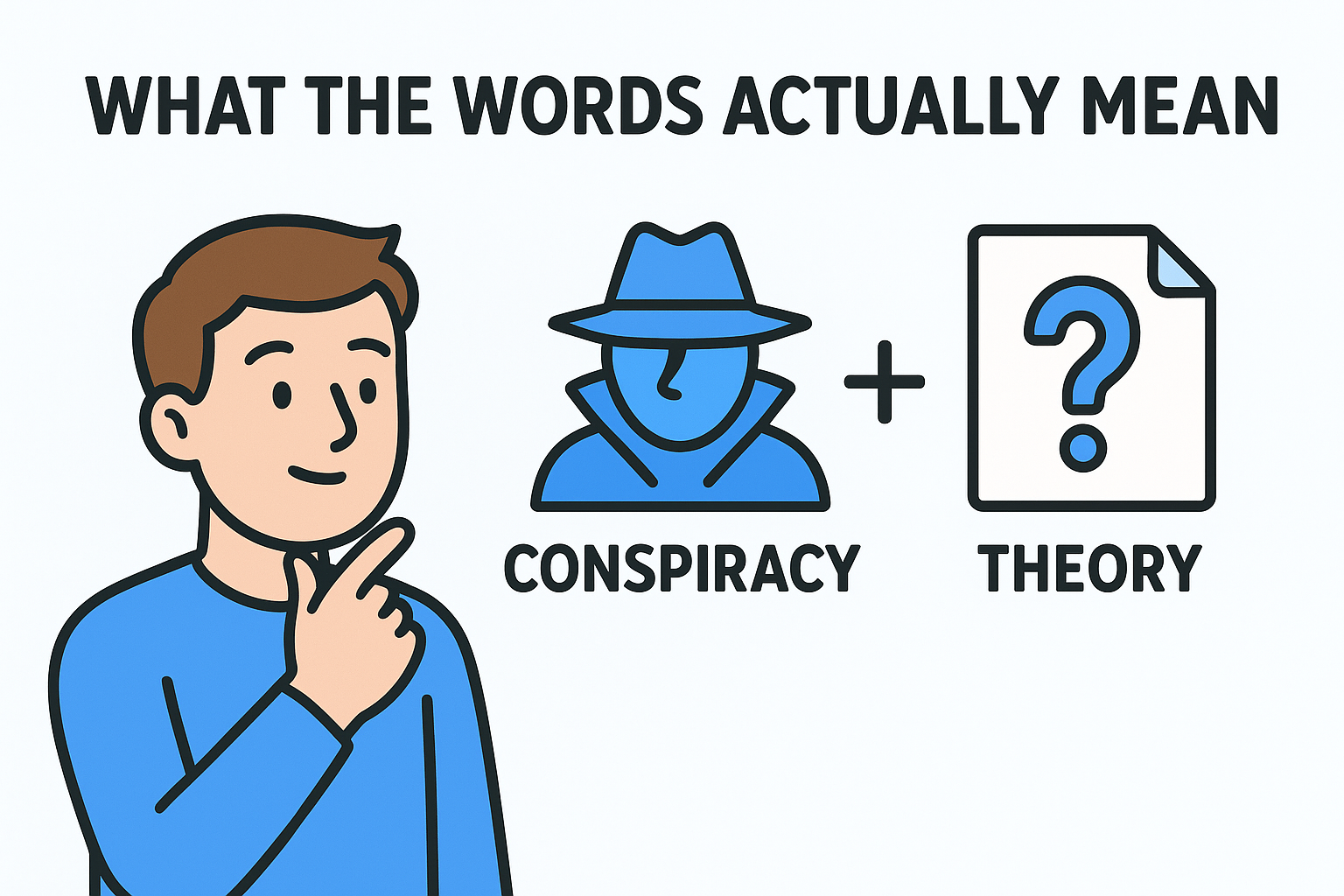
Put those two parts together and a conspiracy theory definition becomes this: a proposed explanation that centers on secret coordination among a group, usually powerful, usually hidden, usually working against ordinary people. The word "theory" tells you nothing about whether the explanation is true or false. It only identifies what kind of claim you're dealing with: one that invokes hidden agency and deliberate concealment.
The term itself is neutral. What makes a conspiracy theory worth scrutinizing is not that it involves a conspiracy, but whether the evidence actually supports the explanation being offered.
Where the term came from
The phrase didn't always carry the baggage it carries now. Historians trace its use back to the 19th century, where it appeared in political writing as a straightforward descriptive label for explanations that invoked secret plots. It wasn't an insult back then. Writers used it the way you might use "economic theory" or "political theory," simply to name the type of explanation being offered.
By the 1960s, the phrase shifted sharply. It began appearing in mainstream media as a way to describe, and often dismiss, claims that contradicted official accounts of major events. That shift wasn't neutral. Labeling something a conspiracy theory became a rhetorical move, a way to signal that a claim was fringe, paranoid, or not worth serious examination. That rhetorical function is still active today, which is exactly why precision matters when you try to define the term clearly.
What the definition leaves out
The standard conspiracy theory definition focuses on the structure of the claim: secret actors, hidden motives, deliberate concealment. What it doesn't address is truth or falsity. That gap matters enormously. Some claims that fit the structural definition turned out to be completely accurate. The COINTELPRO program, in which the FBI secretly worked to surveil and disrupt civil rights organizations, was once dismissed as a paranoid conspiracy theory. Documents released later confirmed it was real.
This means you can't use the label alone to decide whether a claim deserves attention. A claim can be a conspiracy theory and be completely true, partially true, or entirely fabricated. The definition gives you a starting point for categorizing what type of claim you're examining. It doesn't hand you a verdict. What comes after the definition matters just as much: the quality of the evidence, the track record of the sources, and whether the explanation can be tested against observable facts.
Core traits that make a theory conspiratorial
Working from a conspiracy theory definition alone isn't enough to spot one in practice. The definition gives you the category, but the traits give you the texture. Most conspiracy theories share a recognizable set of characteristics that show up regardless of the topic, the era, or the political angle they come from. Learning to spot these traits doesn't mean you dismiss every unconventional claim. It means you know what to look for before you decide how seriously to take something.
The claim resists falsification
One of the clearest markers of a conspiratorial claim is that no evidence can disprove it. If you present counter-evidence, the theory absorbs it. The counter-evidence becomes proof that the cover-up runs even deeper. Scientists call this being unfalsifiable, meaning there is no possible observation or test that could, in principle, show the claim is wrong. That's a serious problem, because any explanation worth taking seriously has to be capable of being proven wrong.
A claim that can explain everything, regardless of what evidence appears, actually explains nothing at all.
Hidden actors with outsized control
Conspiracy theories typically require a small group of actors to maintain extraordinary, almost superhuman, control over events. Governments, corporations, intelligence agencies, secret societies, or vague entities like "the elites" coordinate perfectly and indefinitely without anyone credible defecting, leaking, or making a detectable mistake. The more people a secret requires, the less likely it survives intact. Real-world conspiracies tend to collapse under their own weight the moment the circle of people involved grows large. Conspiratorial thinking tends to ignore that friction entirely.
Patterns treated as proof
Your brain is wired to find patterns. That's not a flaw. It's a survival feature. But conspiratorial thinking takes pattern recognition too far, treating coincidences as deliberate signals and unrelated events as coordinated evidence. If two things happen near the same time, the theory connects them. If an official account has any gap, the gap becomes proof of deception. This kind of reasoning starts from a conclusion and works backward to find support, rather than starting from evidence and following it wherever it leads.

Researchers sometimes call this "apophenia", the tendency to perceive meaningful connections between unrelated things. It's a normal cognitive process that conspiratorial frameworks amplify into a central method of argument. Once you recognize this trait, you'll notice it running through almost every conspiracy theory you examine, regardless of the subject matter or time period involved.
Why conspiracy theories matter
Understanding the conspiracy theory definition isn't just an academic exercise. These theories shape how millions of people interpret news, make decisions, vote, and relate to institutions. When you understand why they matter, you stop treating the topic as trivial entertainment and start seeing it as something with real consequences for public life and individual reasoning.
They influence decisions in the real world
Conspiracy theories don't stay contained to message boards or fringe websites. They move into real behavior. Research has linked belief in medical conspiracy theories to reduced vaccination rates and avoidance of professional healthcare. Belief in election fraud theories has shaped voting behavior, legislative action, and public trust in democratic systems. When a large enough portion of a population accepts a conspiratorial explanation, the effects appear in policy debates, social movements, and sometimes outright civil unrest. What starts as an idea circulating online can end up affecting public health outcomes or institutional credibility in ways that are difficult to reverse.
The question isn't whether conspiracy theories are harmless. The real question is how to engage with them without either dismissing every unconventional claim or accepting unfounded ones.
They sometimes point to real problems
Not every conspiracy theory is baseless, and that's exactly what makes the topic complicated. Some theories once dismissed as paranoid turned out to describe real events. Mass government surveillance, corporate cover-ups of health hazards, and deliberate disinformation campaigns have all been documented and confirmed after the fact. Reflexively dismissing a claim because it fits the conspiratorial structure is itself a reasoning error.
A few confirmed historical cases make this point clearly:
- The FBI's COINTELPRO program secretly surveilled and disrupted civil rights organizations for years
- Tobacco industry executives suppressed internal research linking cigarettes to cancer
- The Tuskegee syphilis study deliberately withheld treatment from Black men without their informed consent
These examples show that a theory might be wrong in its specifics while still identifying a genuine source of public concern, such as institutional secrecy or abuse of power.
They reveal how much trust has eroded
The prevalence of conspiracy theories in any given era tends to track how much trust people place in institutions. When governments, media organizations, and scientific bodies lose credibility, more people turn to alternative explanations. That shift isn't random. It reflects real failures by institutions to be transparent, accountable, or consistent. Studying why conspiracy theories gain traction tells you something important about the relationship between citizens and the institutions that govern and inform them. Ignoring that signal doesn't make it disappear.
How to tell a conspiracy theory from a real conspiracy
The hardest part of applying any conspiracy theory definition is separating claims that deserve investigation from those that don't. Both categories involve allegations of hidden coordination, which makes it tempting to treat them identically, either accepting all such claims or rejecting all of them. Neither approach works. The difference between a real conspiracy and a conspiracy theory that doesn't hold up comes down to a few concrete factors you can actually check.
Real conspiracies produce physical evidence
When a conspiracy is real, documented evidence eventually surfaces. Court records, internal memos, whistleblower testimony, financial records, or leaked communications become available. The Watergate scandal, for example, unraveled because of tape recordings, financial trails, and participants who broke ranks. Real conspiracies leave footprints because they involve human beings who make mistakes, keep records, and sometimes talk.
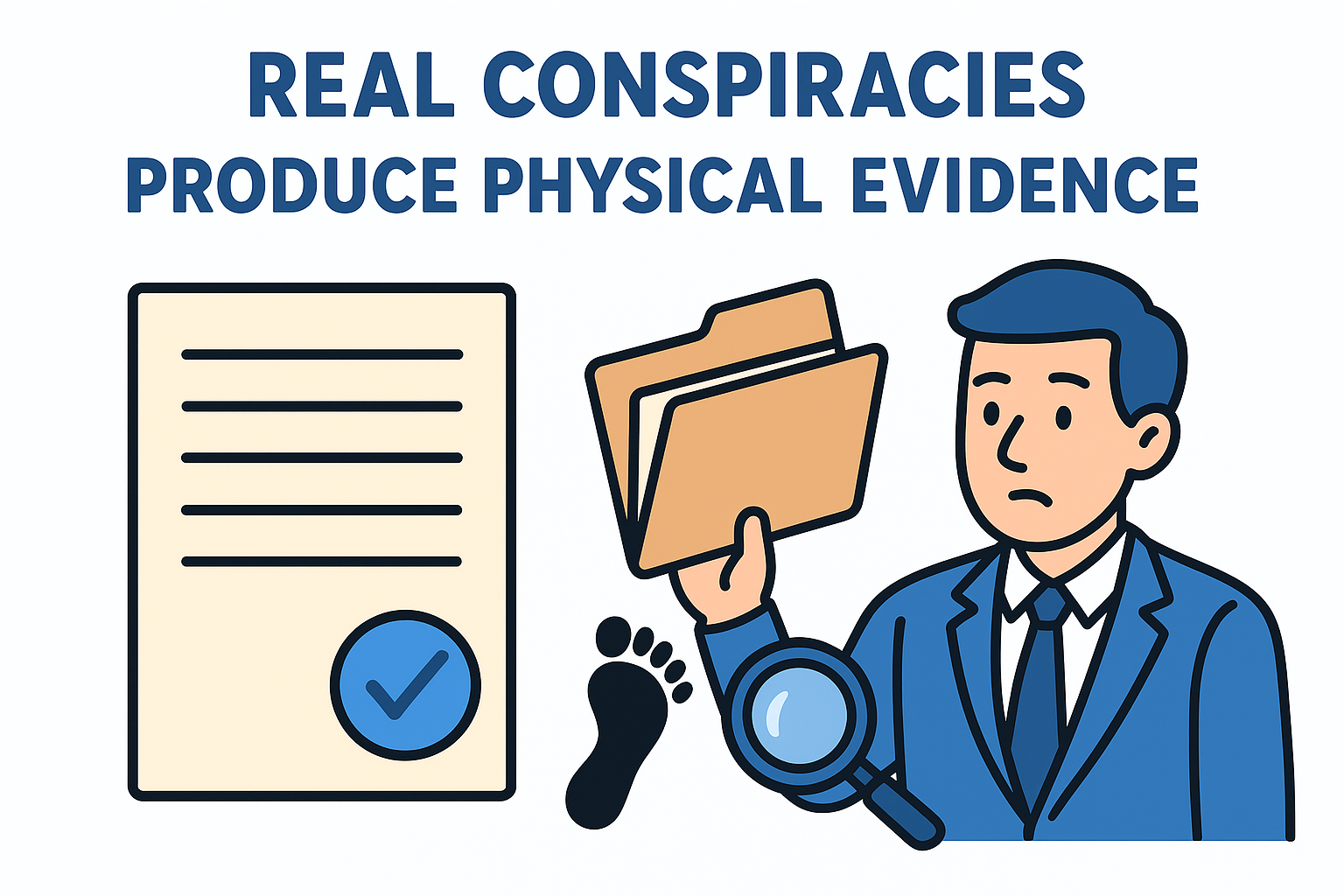
A claim that has circulated for decades without producing a single verifiable document or credible first-hand account should make you pause. The absence of evidence isn't always proof of a cover-up. Sometimes it's just absence of evidence, and the distinction between those two things is worth taking seriously.
If a claim has had years of motivated, well-resourced investigation behind it and still produces no physical trail, that matters.
Scale exposes real limits on secrecy
Actual conspiracies tend to involve small numbers of people over limited timeframes. The larger the group required to maintain a secret, the faster the secret collapses. Researchers have modeled this directly. A study published in PLOS ONE calculated that a conspiracy involving thousands of people would statistically unravel within a few years due to defections, leaks, and accidental disclosure.
When you encounter a theory that requires tens of thousands of participants across multiple governments, industries, and decades, all staying silent with no meaningful leaks or defections, you're looking at a claim that runs against how human coordination actually works. That doesn't make it impossible, but it raises the burden of proof considerably.
Ask what would change the claim
One of the clearest tests you can apply is simple: ask yourself what evidence would disprove the claim if it turned out to be false. If the person making the argument can't answer that question, or if every counter-argument gets absorbed as more proof of the cover-up, the claim isn't functioning as a testable explanation. It's functioning as a closed belief system.
Verified conspiracies respond to evidence once uncovered. The explanation shifts when new facts arrive. A claim that treats all contradictory information as confirmation is no longer behaving like an argument you can reason with. At that point, you're dealing with something that evidence alone won't resolve.
Why people believe conspiracy theories
Understanding why people accept conspiratorial explanations matters just as much as working through any conspiracy theory definition. The answer isn't that believers lack intelligence or critical thinking ability. Research consistently shows that belief cuts across education levels, income, and political affiliations. The real drivers are psychological and social, and recognizing them helps you apply that knowledge to your own reasoning.
The need for clear explanations
Human beings are uncomfortable with uncertainty. When something significant happens, a sudden death, a major attack, an economic collapse, your brain pushes toward an explanation that feels complete and proportionate to the event. A lone actor or a random system failure doesn't feel sufficient to explain something massive. A coordinated group with deliberate intent feels more satisfying to the mind, even when the evidence doesn't support it. Psychologists refer to this as proportionality bias, and it's a documented feature of how people process large-scale events.
The desire for a complete explanation isn't a character flaw. It becomes a problem when it overrides your willingness to accept incomplete but accurate answers.
Conspiracy theories meet this need efficiently. They offer clear villains, clear motives, and a narrative that connects all available details into a single coherent story. Ambiguity rarely survives inside conspiratorial frameworks, which is part of what makes them feel reassuring to people genuinely unsettled by events they struggle to understand.
Social identity and group belonging
Belief in a conspiracy theory often signals membership in a community. Sharing the same interpretation of hidden events creates a sense of being part of a group that sees what others miss. That social function is powerful. Once a conspiratorial belief connects to your group identity, examining the evidence critically starts to feel like a threat to your community rather than a straightforward intellectual exercise.
Research in social psychology shows that people evaluate evidence differently depending on whether accepting it would confirm or challenge their group's existing views. This isn't unique to conspiracy believers. Everyone does it to some degree. The difference is that conspiratorial communities often actively reward belief and treat skepticism as a form of disloyalty rather than useful inquiry.
Distrust built from real experience
Some people arrive at conspiratorial thinking through genuine, justified distrust of institutions. If your government has lied before, if your community has faced documented institutional abuse, skepticism about official explanations isn't irrational. It's a reasonable response built on a real track record.
The problem is that justified distrust of one institution doesn't automatically validate every alternative explanation you encounter. Knowing that governments sometimes deceive the public doesn't tell you which specific alternative account is accurate. That gap is where conspiratorial frameworks tend to move in, offering certainty where careful reasoning would demand more patience and more evidence.
How conspiracy theories spread online
Understanding the conspiracy theory definition helps you recognize a claim's structure, but the internet changes how fast those claims move and how many people they reach. Platforms built around engagement don't distinguish between accurate information and conspiratorial content. They optimize for clicks, shares, and time spent, and conspiracy theories often outperform straightforward reporting on all three metrics because they offer drama, urgency, and a clear narrative with identifiable villains.
Algorithms reward engagement over accuracy
When you interact with a piece of content, whether by liking, commenting, sharing, or even just pausing to read it, the platform records that behavior and shows you more content like it. Conspiracy theories tend to generate strong emotional responses: outrage, disbelief, or a sharp sense that you've discovered something others are hiding. Those emotional reactions produce high engagement signals, which the algorithm reads as a sign the content is valuable. The result is that the platform pushes conspiratorial content further and further into your feed, not because anyone programmed it to spread misinformation, but because misinformation often triggers the engagement patterns that platforms are designed to amplify.
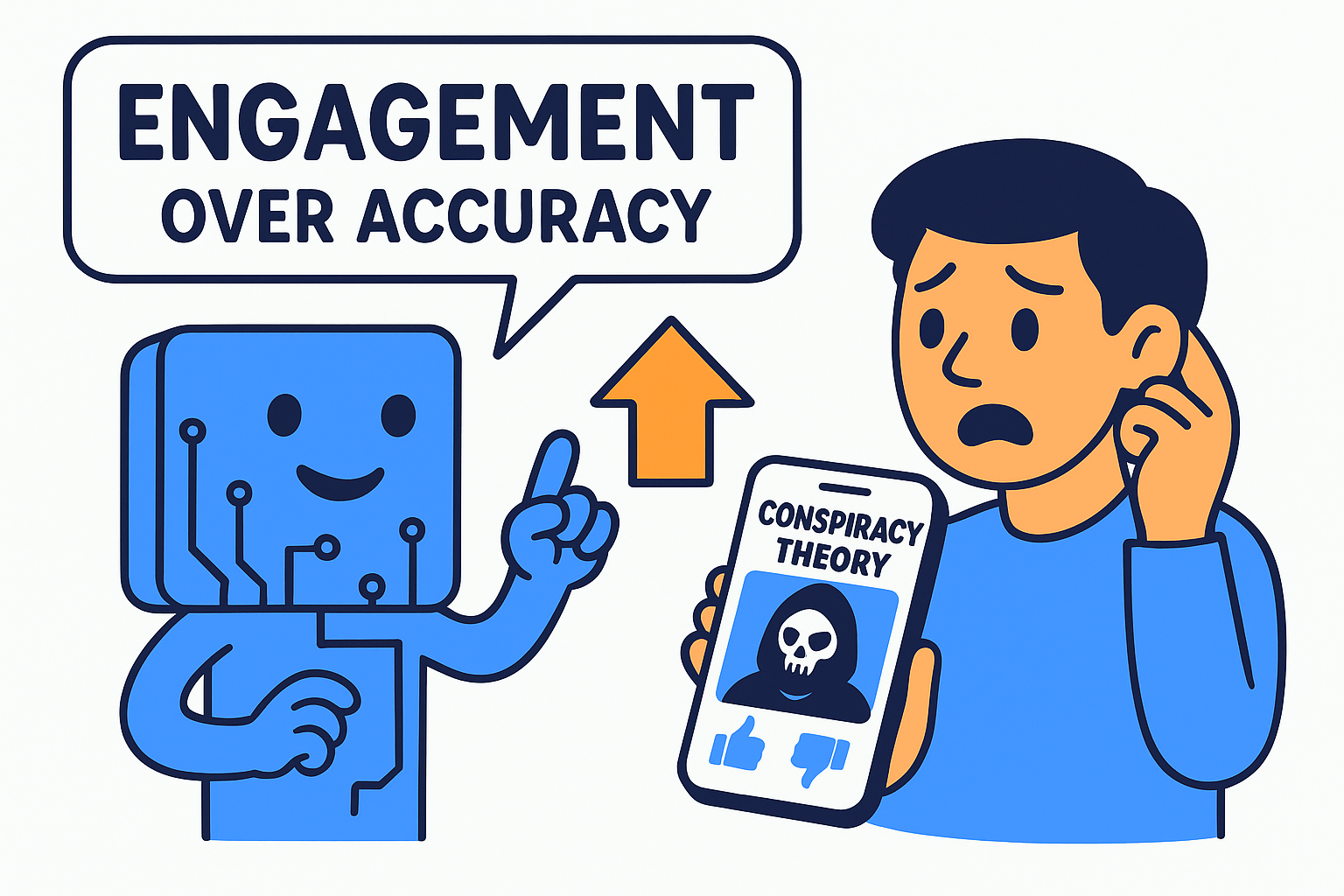
The algorithm doesn't care whether a claim is true. It cares whether you stayed, clicked, and came back.
Researchers at MIT studied the spread of true and false news on Twitter and found that false stories spread faster and reached more people than accurate ones. The difference wasn't bots or coordinated campaigns. It was human behavior. People shared false claims more readily because novelty and emotional intensity drove sharing decisions more than accuracy did.
Identity and sharing behavior
Sharing a conspiracy theory online isn't always about passing along information. Often, it functions as a signal of group membership. When you share content that confirms your community's view of the world, you reinforce your position within that group and invite others to affirm it. That social dynamic makes the spread of conspiratorial content self-reinforcing. The more your social network shares a particular claim, the more credible it appears, regardless of whether any external evidence supports it.
This process creates closed information environments where your primary exposure is to sources that confirm what your network already believes. Breaking out of that loop requires actively seeking out contradictory evidence, which takes deliberate effort most people don't apply when scrolling casually. The platform's design doesn't make that effort easier. It makes it harder by continuously surfacing content that matches your past behavior and the behavior of people similar to you. Recognizing this dynamic is the first step toward making more deliberate choices about where your information actually comes from.
Common examples and what they show
Working through specific cases helps you apply any conspiracy theory definition more clearly than abstract descriptions alone can. Real examples show the traits in action: unfalsifiable claims, demands for outsized coordination, and pattern recognition pushed beyond what evidence supports. Three cases come up repeatedly, and each one illustrates something distinct about how these theories function and why they persist.
The moon landing hoax claim
The claim that NASA faked the 1969 moon landing is one of the most studied examples in this space. It typically argues that the technology didn't exist, that the footage was filmed on a studio set, and that the government had strong political motives to deceive the public during the Cold War. What makes this case instructive is the sheer scale of coordination it requires. Thousands of engineers, astronauts, contractors, and foreign governments would all need to have stayed silent for over five decades. No credible whistleblower has ever come forward, and independent tracking stations in other countries confirmed the mission in real time as it happened.
When a theory requires lifelong silence from thousands of independent participants across multiple nations, the claim has already exceeded what human coordination realistically supports.
The 9/11 "inside job" theories
Theories surrounding the September 11 attacks range from claims about foreknowledge being deliberately suppressed to arguments that the towers were brought down by controlled demolition rather than fire damage from the plane impacts. These theories emerged partly because the scale of the attack felt incompatible with the official account of a small, independent cell operating without state backing. What they reveal is proportionality bias working at full force: the event was so large that many people found it genuinely difficult to accept a relatively contained explanation. Structural engineers, physicists, and independent investigators have reviewed the collapse mechanics extensively, and their findings consistently align with the official account. The theories persist not because new evidence keeps surfacing, but because they speak to a real psychological need for an explanation proportionate to the event's magnitude.
JFK assassination theories
The assassination of President Kennedy in 1963 stands apart from many other examples because official investigations themselves produced conflicting conclusions. The Warren Commission concluded Lee Harvey Oswald acted alone. A later House Select Committee on Assassinations suggested a probable conspiracy based on acoustic evidence, though that evidence was subsequently challenged by independent reviewers. What this case demonstrates is that genuine, documented uncertainty and a conspiracy theory are not the same thing. Some questions about the assassination remain legitimately open, and acknowledging that is intellectually honest. Treating those open questions as confirmation of a specific hidden plot with named orchestrators, however, moves beyond what the available record actually supports. The difference between an unresolved question and a settled conspiratorial explanation is worth keeping clear in your own reasoning.
How to evaluate a claim without falling for it
Applying a conspiracy theory definition to something you encounter online is a useful starting point, but it doesn't tell you what to do next. Knowing a claim fits the conspiratorial structure doesn't automatically make it false, and knowing it sounds reasonable doesn't make it true. What you need are concrete steps you can run through before you decide how much weight to give any claim you encounter.
Trace where the claim originated
Every claim has a starting point, and that origin matters. Before you accept or share something, trace it back to its original source. Ask yourself who first made this claim, what evidence they provided, and whether that source has a verifiable track record of accuracy. A screenshot of a screenshot, shared through accounts with no clear identity or history, should raise your skepticism immediately. When a credible, named organization or individual with a documented record makes a claim, you have somewhere solid to start your evaluation.
The distance between you and the original source tells you a lot about how much trust a claim has actually earned.
Separate the question from the conclusion
One of the most useful habits you can build is learning to hold a question open without rushing to a specific answer. Asking whether an institution behaved deceptively is a legitimate question. Jumping straight to a specific named group as the secret orchestrator is a conclusion that requires its own burden of proof. Many conspiracy theories conflate the two steps, treating the existence of a genuine question as confirmation that their particular answer is correct. You can acknowledge that something is worth investigating without accepting any specific explanation for what happened.
Test the claim against what could disprove it
Ask yourself what evidence would prove the claim wrong if it turned out to be false. If you can answer that clearly, the claim is at least functioning as a testable argument. If every possible counterexample would just get folded into a deeper layer of the cover-up, you're dealing with something that can't be reasoned with through evidence alone. That's a structural flaw in the argument, not a sign that the truth is being suppressed.
Run through these questions before accepting a claim:
- Can you name the original source and verify its credibility?
- Does the claim require an unrealistic number of people to stay silent indefinitely?
- Has the claim produced any physical evidence after sustained investigation?
- Can you identify what evidence would disprove it if it were false?
- Does the explanation change when new facts arrive, or does it absorb everything as confirmation?
Building this habit takes practice, but it protects your reasoning without requiring you to dismiss every unconventional claim out of hand.
Terms people confuse with conspiracy theories
Precision in language protects your thinking. Several terms get used interchangeably with "conspiracy theory" in everyday conversation, but they describe meaningfully different things. Keeping them separate helps you apply any conspiracy theory definition more accurately and avoid the sloppy reasoning that comes from treating every non-mainstream claim as the same type of thing.
Conspiracy vs. conspiracy theory
A conspiracy is a real event: two or more people secretly agree to do something harmful or illegal, and they carry it out. Courts prosecute conspiracies regularly. Corporate fraud, political corruption, and coordinated cover-ups of health hazards have all been proven through evidence and legal proceedings. A conspiracy is a documented fact once the evidence establishes it.
A conspiracy theory, by contrast, is an explanation that proposes hidden coordination without yet establishing that the coordination actually occurred. The theory might turn out to be correct. It might turn out to be wrong. The key distinction is that the theory is still an unverified claim, while a proven conspiracy is a matter of historical record. Conflating the two leads people to either dismiss verified events as mere theorizing or treat unverified claims as established facts.
Misinformation and disinformation
Misinformation refers to false or inaccurate information spread without the intent to deceive. Someone shares a wrong statistic because they genuinely believed it. Disinformation is false information spread deliberately, with the intent to mislead. Both terms describe the accuracy and intent behind a claim, not its structure.
A conspiracy theory can be entirely accurate, while disinformation can take forms that have nothing to do with hidden groups or secret coordination.
A conspiracy theory might be true, partially true, or false, and it may spread through either misinformation or disinformation. These categories overlap without being identical, and treating them as synonyms causes real confusion when you're trying to evaluate a specific claim.
Fringe theory vs. conspiracy theory
A fringe theory is any explanation that sits outside the scientific or academic mainstream but doesn't necessarily invoke secret coordination or deliberate cover-ups. Alternative hypotheses about historical events, unconventional interpretations of archaeological evidence, and minority positions within scientific debates all qualify as fringe theories without automatically being conspiratorial.
The conspiratorial element only appears when the explanation requires hidden actors working to suppress the truth. A researcher who proposes an alternative account of ancient civilizations and supports it with physical evidence is doing something structurally different from someone who claims the mainstream rejects the account because powerful institutions are coordinating to hide it. One invites scrutiny of the evidence. The other treats skepticism as confirmation of the cover-up.
Final takeaways
The conspiracy theory definition you started with matters less than what you do with it. A conspiracy theory is a claim that invokes hidden coordination to explain events, but the label alone tells you nothing about whether the claim is true or false. What separates productive skepticism from unfounded belief is the evidence you require before accepting any explanation.
You now have the tools to distinguish a real conspiracy from an unverified theory, spot the traits that make claims unfalsifiable, and recognize how platforms and social dynamics amplify conspiratorial content regardless of its accuracy. Apply those tools consistently, including to claims that confirm what you already believe.
History holds far more suppressed and inconvenient truths than mainstream sources typically acknowledge. If you want to keep reading past the surface of official accounts, explore the full catalog at Skriuwer for books that dig into the documented, verifiable parts of history that rarely make the front page.
Books You Might Like


Through the Language Glass
Guy Deutscher

How to Learn Any Language
Barry Farber