Best Books About Ancient Egypt in 2026, Ranked by Reader Reviews
Curated by Skriuwer Editors · Updated April 2026 · Affiliate links
Ancient Egypt built wonders that still defy explanation, the pyramids, the Sphinx, and a civilization that lasted 3,000 years. These are the best books about Ancient Egypt, covering everything from the pharaohs and gods to daily life along the Nile, ranked by passionate readers.
Ancient Egypt lasted for roughly 3,000 years as a recognizable, continuous civilization, longer than Rome, longer than any European state, longer than any political entity in modern history. Understanding why it lasted that long, what held it together, and why it finally fragmented is more interesting than the pyramids, which are essentially marketing material from a civilization that was very good at presenting itself to the future.
The books on this list are ranked by real reader reception rather than academic weight. We included three types: accessible general histories that cover the full sweep from the Old Kingdom to Cleopatra; focused studies of specific periods, pharaohs, or discoveries; and a small number of primary sources in good modern translations, because reading an Egyptian medical papyrus or a love poem from 3,000 years ago is a different kind of experience than reading about Egypt.
Egyptian history has benefited enormously from modern archaeology and DNA analysis, and the best recent books reflect this. Many assumptions that earlier Egyptology treated as settled, about race, about religion, about the construction methods of major monuments, are now actively contested. Books published in the last ten years are generally more scientifically current and more honest about uncertainty.
Complete beginner? The FAQ below recommends a starting point for different types of readers. Want to start with the books ranked highest by readers? Scroll straight to the list.
Quick comparison, top 5
The ranked list
- 1

Tara Westover
(195,000 reviews)Tara Westover was seventeen the first time she set foot in a classroom. Born to survivalists in the mountains of Idaho, she prepared for the end of the world by stockpiling food an…
Buy on Amazon → - 2
Harper Lee
(108,000 reviews)The unforgettable novel of a childhood in a sleepy Southern town and the crisis of conscience that rocked it, To Kill A Mockingbird became both an instant bestseller and a critical…
Buy on Amazon → - 3
Bernard Cornwell
(88,400 reviews)The first novel in Bernard Cornwell's Saxon Stories, following Uhtred of Bebbanburg through the wars between the Danes and Alfred the Great's Wessex. Historically careful, fast, an…
Buy on Amazon → - 4

Walter Isaacson
(28,000 reviews)The #1 New York Times bestseller "A powerful story of an exhilarating mind and life...a study in creativity: how to define it, how to achieve it." --The New Yorker "Vigorous, insig…
Buy on Amazon → - 5
Michelle McNamara
(28,000 reviews)A haunting true story about one woman's obsessive pursuit of the elusive serial killer known as the Golden State Killer. In the 1970s and 1980s, a man committed at least thirteen m…
Buy on Amazon → - 6
Ann Rule
(18,000 reviews)Before she was a bestselling true crime author, Ann Rule worked with Ted Bundy at a Seattle crisis hotline. She considered him a good friend. When Bundy was first identified as a s…
Buy on Amazon → - 7
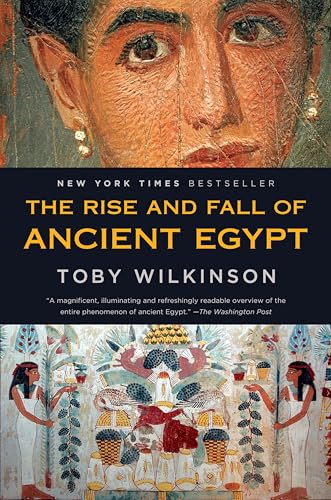
Toby Wilkinson
(3,600 reviews)Toby Wilkinson tells the full three-thousand-year story of ancient Egypt, from the first unification of the country around 3000 BCE to its absorption by Rome after the death of Cle…
Buy on Amazon → - 8

Stacy Schiff
(3,500 reviews)Pulitzer Prize-winning biography that strips away two thousand years of Roman propaganda to reconstruct the actual Macedonian queen of Egypt. Stacy Schiff is unusually careful abou…
Buy on Amazon → - 9
Stephen Kinzer
(3,400 reviews)The definitive biography of Sidney Gottlieb, the CIA chemist who ran MK-Ultra from 1953 to 1964. Stephen Kinzer, a former New York Times foreign correspondent, traces Gottlieb's ca…
Buy on Amazon → - 10
Selwyn Raab
(3,100 reviews)Selwyn Raab spent thirty years covering organised crime for the New York Times. Five Families traces the Gambino, Genovese, Lucchese, Bonanno, and Colombo families from Prohibition…
Buy on Amazon → - 11
Eric H. Cline
(2,500 reviews)Eric Cline's standard treatment of the Late Bronze Age collapse, the systems failure that wiped out the Hittite Empire, drove Egypt into decline, ended Mycenaean Greece, and ruptur…
Buy on Amazon → - 12

Geraldine Pinch
(1,400 reviews)Spanning ancient Egyptian culture--from 3200 BC to AD 400--Pinch opens a door to this hidden world and casts light on the nature of myths and how they relate to the evolution of Eg…
Buy on Amazon → - 13

Stephan Weaver
(1,200 reviews)The gods of Ancient Egypt conjure up images of hieroglyphs with animal-headed people, fantastic civilizations, and a past that seems both unimaginably distant and still tenuously c…
Buy on Amazon → - 14

robert a armour
(900 reviews)"Robert Armour's classic text, long cherished by a generation of readers, is now complemented with more than 50 new photographs by Egyptologist Edwin Brock and drawings by Elizabet…
Buy on Amazon → - 15

Skriuwer.com
(146 reviews)America tells its own story better than any country in the world. This book asks whether that story is complete. It covers American history from the pre-Columbian era through colon…
Buy on Amazon →
Frequently asked questions
What is the best Ancient Egypt book for beginners?
The Oxford History of Ancient Egypt, edited by Ian Shaw, is the academic standard but reads more accessibly than its title suggests. For a faster and more narrative read, Bob Brier and Hoyt Hobbs's Daily Life of the Ancient Egyptians covers exactly what the title says, food, clothing, work, religion, and family, from the perspective of ordinary people rather than pharaohs. If you want something that reads like a story, Toby Wilkinson's The Rise and Fall of Ancient Egypt is the best single-volume narrative history currently in print.
How were the pyramids really built?
By organized labor, probably including well-fed skilled workers rather than enslaved people, using sledges, ramps, and an enormous logistical system. The workers' village at Giza has been excavated and shows evidence of good nutrition and medical care. The precise ramp configuration is still debated, multiple systems have been proposed and partially evidenced. Mark Lehner's The Complete Pyramids is the most authoritative single book on construction methods. The short answer is: organized human labor over decades, not aliens, not slaves.
What do we actually know about Cleopatra?
More than popular culture suggests, and less than biographical treatments claim. We know she was the last ruler of the Ptolemaic dynasty (Macedonian Greek, not ethnically Egyptian), that she was the first of her dynasty to learn the Egyptian language, that she had political relationships with both Julius Caesar and Mark Antony, and that she died in 30 BCE after Antony's defeat. Stacy Schiff's Cleopatra: A Life is the best modern biography. Adrian Goldsworthy's Antony and Cleopatra gives more context on the Roman side. What she looked like, how she felt, most of what films show about her: invention.
What is the Book of the Dead?
A collection of spells, prayers, and instructions compiled to guide the soul through the afterlife journey and the judgement of Osiris in the Hall of Two Truths. Different versions were assembled for wealthy individuals who commissioned their own copies. It was not a single canonical text but a customizable religious document. The E.A. Wallis Budge translation is the free public-domain version. The Raymond Faulkner translation, with Andrew George's introduction in the British Museum edition, is the most readable modern choice.
Is everything we know about ancient Egypt based on the pyramids?
No, and this is a common misconception. Egypt produced enormous quantities of text: religious texts, administrative records, private letters, love poetry, medical manuals, legal documents, and literary narratives. Many survive on papyrus, ostraca (pottery shards), and carved stone. The Egyptians were prolific writers and record-keepers, and Egyptology has produced detailed pictures of ordinary life, trade economics, judicial processes, and popular religion that go far beyond the monumental sites most people associate with the civilization.
Were ancient Egyptians black or white?
This question has a politically charged history and a scientific answer that is more complex than either side of the debate usually presents. The ancient Egyptian population was genetically diverse and changed over time. Early Egyptians show closer genetic ties to North African and Levantine populations than to sub-Saharan Africa, but the population was never uniform, and trade, migration, and conquest introduced continuous genetic mixing. The modern racial categories of 'black' and 'white' did not exist in antiquity. Books that claim ancient Egyptians were straightforwardly one or the other are doing politics, not history.