
What Is Critical Race Theory? Origins, Ideas, Controversy
Few academic concepts have jumped from law school seminars to school board shouting matches as fast as critical race theory. But ask ten people what is critical race theory, and you'll likely get ten different answers, some informed, most not. The term has become a political football, thrown around by both sides with little regard for what it actually says or where it came from.
At its core, critical race theory is a framework that emerged from legal scholarship in the late 1970s and 1980s. It examines how laws and institutions, even those appearing neutral on paper, can produce racially unequal outcomes. That's a far cry from how it's often portrayed in cable news segments or campaign ads. The gap between the academic framework and the public debate around it is wide enough to drive a truck through.
At Skriuwer, we publish and sell books on topics that mainstream publishers tend to sidestep, hidden histories, uncomfortable truths, and subjects where the conventional narrative doesn't tell the full story. Critical race theory fits squarely in that territory: a subject people argue about constantly but rarely examine on its own terms. This article breaks down the origins, core ideas, and controversy surrounding CRT so you can form your own conclusions based on what it actually proposes, not what someone on a podium told you it means.
What critical race theory is
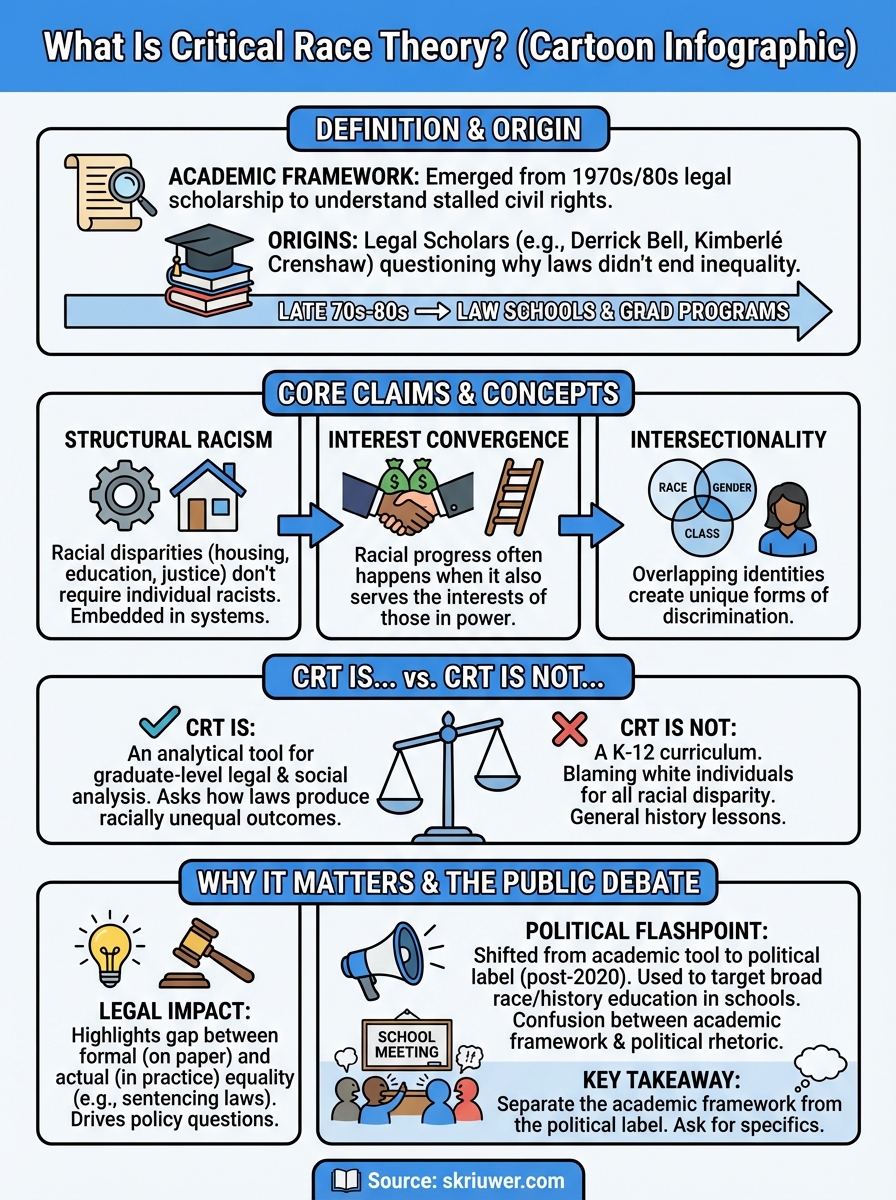
Critical race theory is an academic framework developed primarily by legal scholars who wanted to understand why civil rights legislation alone didn't eliminate racial inequality in the United States. The central argument is that race is not just a matter of individual prejudice but is embedded in legal systems, policies, and institutions. When scholars ask what is critical race theory, the answer they offer is this: a set of analytical tools for examining how laws can produce racially unequal outcomes even when those laws contain no explicit racial language.
CRT does not argue that every American is racist. It argues that systems can produce racially unequal outcomes regardless of individual intent.
The core claims CRT makes
CRT rests on a few foundational ideas. The first is "structural racism", which holds that racial disparities in areas like housing, education, and criminal justice don't require individual racists to sustain themselves. Policies like redlining, which barred Black families from buying homes in certain neighborhoods, created wealth gaps that persisted long after the policy ended. The second core idea is "interest convergence", a term coined by legal scholar Derrick Bell. Bell argued that advances in racial equality tend to happen when they also serve the interests of those already holding power, not purely because justice demands them.
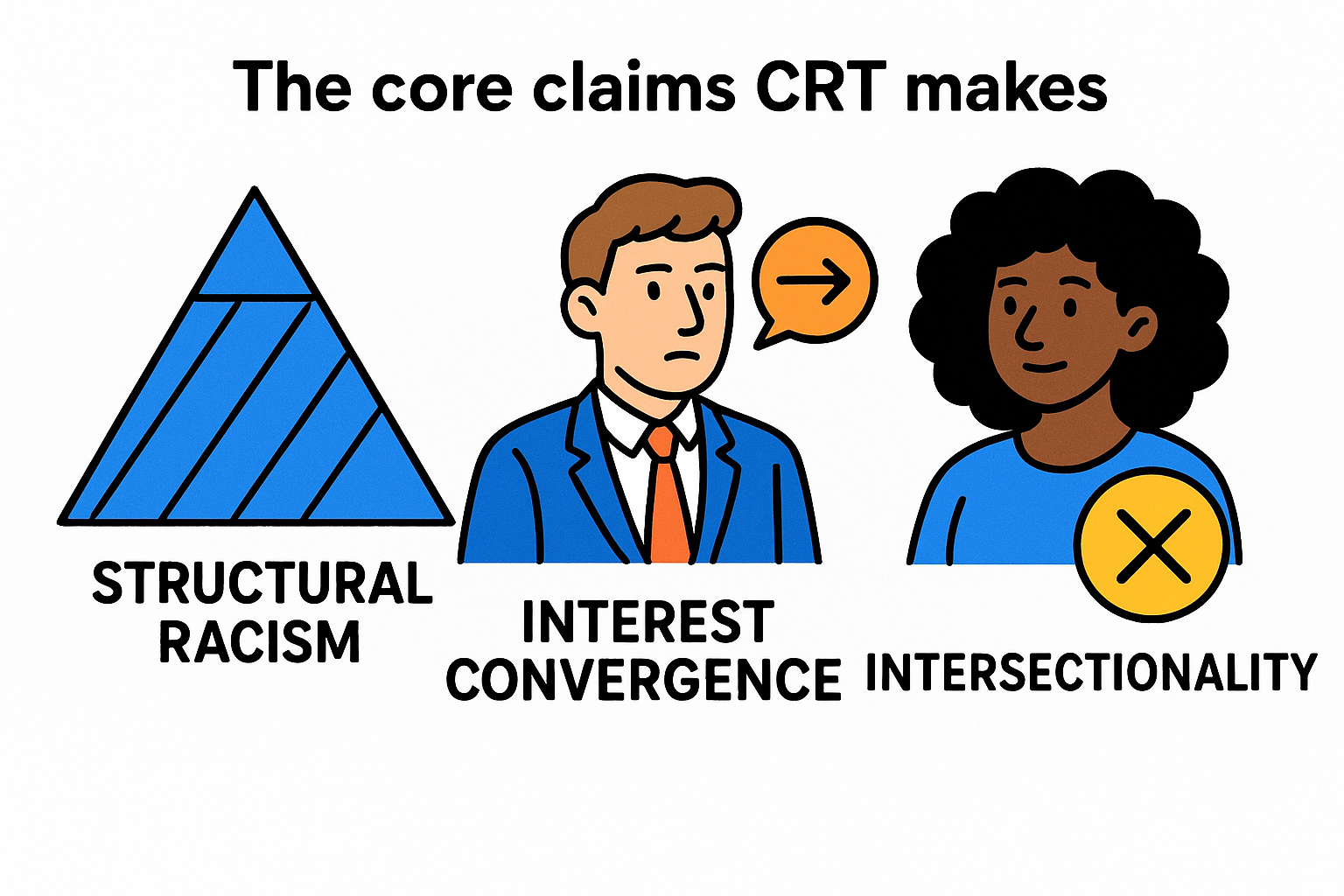
A third concept is "intersectionality", a term developed by legal scholar Kimberlé Crenshaw. Intersectionality describes how overlapping identities, like race and gender combined, create specific forms of discrimination that neither category captures on its own. For example, a Black woman may face workplace discrimination that is distinct from what a white woman or a Black man experiences separately. These concepts were designed as academic tools, not political slogans, and that distinction matters when you try to evaluate what the public debate is actually arguing about.
What CRT is not
Understanding CRT also means knowing what it does not claim. CRT is not a K-12 curriculum. It originated in law schools and graduate programs, not elementary school classrooms. When politicians argue that CRT is being taught to young children, they are almost always pointing at something else: lessons about slavery, segregation, or systemic inequality. Those lessons may or may not reflect CRT-influenced thinking, but calling them CRT blurs the line between a graduate-level analytical framework and general historical education.
CRT also does not claim that white people are inherently immoral or collectively responsible for every racial disparity. The framework is analytical, meaning it asks questions about systems and measurable outcomes rather than issuing moral verdicts about individuals. Whether you find its conclusions persuasive or not, the version of CRT circulating in most political conversations is a distortion of the original scholarship, and that distortion now shapes the debate far more than the actual academic texts do.
Where CRT came from
Critical race theory did not emerge from political activists or school boards. It grew out of frustration inside American law schools during the late 1970s, when a group of legal scholars noticed that the civil rights gains of the 1960s had stalled. Anti-discrimination laws were on the books, but racial disparities in wealth, housing, and criminal justice continued to widen. These scholars wanted a sharper set of tools to explain why formal legal equality had not produced actual equality in practice.
The scholars who built it
The foundational work came from Derrick Bell, a Harvard Law professor who had spent years working on civil rights litigation before turning to academia. Bell grew skeptical of the assumption that the legal system would eventually self-correct on race. His "interest convergence" thesis, published in 1980 in the Harvard Law Review, argued that civil rights progress tends to occur when it benefits white political and economic interests, not simply because courts or legislators decide justice demands it. That was a provocative claim inside legal academia, and it opened a debate that drew in other scholars quickly.
Kimberlé Crenshaw, another central figure, built on Bell's work and introduced the concept of intersectionality, which you've already seen described earlier in this article. Alongside scholars like Richard Delgado and Mari Matsuda, she helped shape what became a recognizable academic movement through the 1980s. The term "critical race theory" itself was coined and organized during a 1989 workshop in Madison, Wisconsin, where these legal thinkers gathered to define the framework more explicitly.
The phrase "critical race theory" was first used as a formal label in 1989, a decade after its core ideas began appearing in legal journals.
From law schools to public debate
For most of its history, CRT stayed inside graduate programs and legal journals, the kind of material that law students and academics read. If you went looking for an answer to what is critical race theory in the 1990s, you'd have been reading dense law review articles. The framework moved into public schools indirectly, as educators drew on related concepts like structural racism and systemic inequality when updating history and social studies curricula. That shift, gradual and largely unannounced, is what eventually made CRT a target in legislative chambers and school board meetings decades after its academic origins.
Why critical race theory matters
Understanding what is critical race theory is not just an academic exercise. The framework raises questions that have direct consequences for how laws get written, challenged, and enforced in the United States. When scholars and policymakers use CRT as a lens, they are asking whether a law that looks neutral on paper actually produces equal outcomes in practice. That question has driven real changes in housing policy, criminal sentencing reform, and educational funding debates, which is why the framework carries weight well beyond university lecture halls.
What it reveals about legal outcomes
CRT draws attention to a gap that standard legal analysis tends to overlook: the difference between formal equality and actual equality. A law can treat every citizen identically on paper while still producing outcomes that fall unevenly across racial lines. Drug sentencing laws from the 1980s and 1990s are a well-documented example. Those laws applied the same penalties to everyone convicted, yet prosecution patterns and sentencing data showed Black defendants received longer sentences than white defendants for comparable offenses. CRT provides a vocabulary for examining that kind of disparity without requiring proof of deliberate racist intent from any single judge or prosecutor.
The power of CRT as an analytical tool is that it asks you to look at outcomes, not just intentions.
Researchers and lawyers working in civil rights have used CRT-derived concepts to challenge discriminatory lending practices, exclusionary zoning rules, and unequal school funding formulas. Even if you disagree with CRT's conclusions, the outcomes it examines are measurable and documented in court records and government data. Dismissing the framework entirely means you also have to dismiss the evidence it uses as a starting point.
Why it affects more than legal scholars
You don't need a law degree for CRT to affect your understanding of how institutions work and who benefits from existing rules. The framework influences how historians frame narratives about slavery and segregation, how sociologists study poverty, and how journalists cover criminal justice and housing. Its reach extends into any field that examines why racial inequality persists despite formal legal prohibitions against discrimination. Whether that reach is appropriate or overextended is a legitimate debate, but the framework's influence on how researchers and educators frame social questions is not something you can simply ignore.
How to talk about CRT without confusion
Conversations about CRT tend to break down fast because the same label gets applied to very different things. One person says CRT and means a graduate-level legal framework. Another says CRT and means a fifth-grade history lesson about slavery. Before you can have a useful discussion about what is critical race theory, you need to establish which version of the term both people in the conversation are actually using.
Separate the academic from the political
The academic version of CRT is a set of analytical concepts developed inside law schools to examine how laws produce racially unequal outcomes. The political version is a catch-all phrase that critics use to describe any instruction, curriculum, or policy they believe promotes a particular view of race. These two things overlap occasionally but are not the same, and treating them as identical shuts down any chance of a clear exchange.
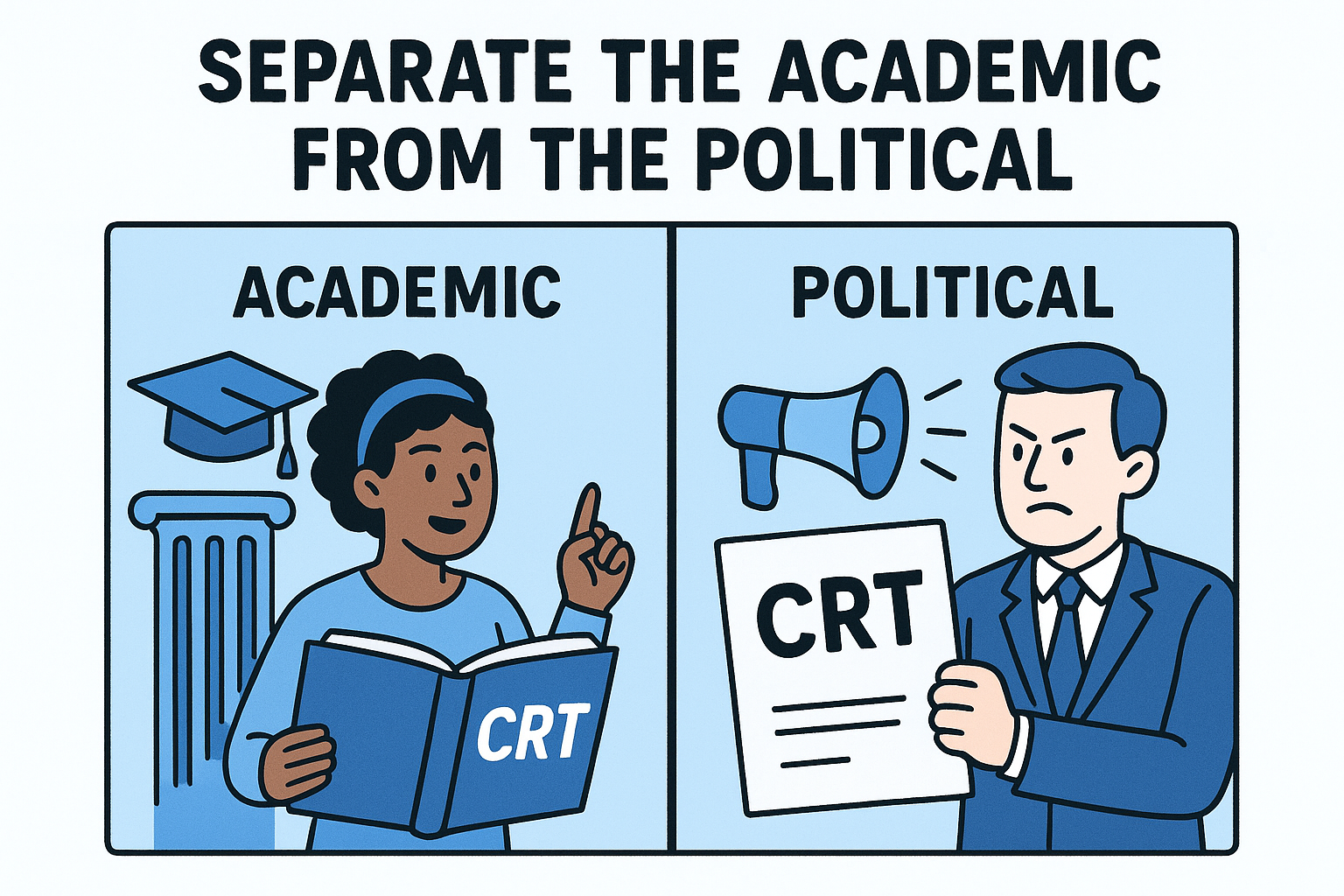
Treating every race-related school lesson as CRT is like treating every economics class as Marxism. The label replaces the analysis.
When you hear someone make a strong claim about CRT, it helps to ask which version they mean. If they are referencing Derrick Bell, Kimberlé Crenshaw, or peer-reviewed legal scholarship, they are engaging with the academic framework. If they are pointing at a school reading list or a company diversity training, they may be working from a very different definition entirely.
Ask what someone actually means
The most practical step you can take is to ask a clarifying question before you agree or disagree with any claim about CRT. What specific material are they pointing at? What outcome do they think that material produces? These questions do not require you to take a side. They just require you to make sure the conversation is about something specific and verifiable rather than a label both parties interpret differently.
This distinction matters because poorly defined debates produce poor decisions. When school boards vote to ban CRT without specifying what they are actually banning, teachers often self-censor broad swaths of historical content to avoid controversy. That consequence affects what your children learn, regardless of where you stand politically. Clarity about terms is not a courtesy. It is a prerequisite for any decision worth making.
Why CRT became a school and political flashpoint
CRT stayed in graduate programs for decades without triggering mass public backlash. The shift happened around 2020, when a combination of events brought race and history education to the front page simultaneously. The killing of George Floyd sparked nationwide protests, and many school districts announced plans to address structural racism and historical inequity in their curricula. Conservative commentators and politicians began describing these changes as CRT infiltrating public schools, and the label stuck fast.
The role of media and political organizing
What is critical race theory became a search term millions of Americans typed for the first time in 2020 and 2021. Political organizations and media figures amplified the term without defining it precisely, which made it easy to attach to a wide range of education policies and corporate diversity trainings. By the time state legislatures began drafting bills to restrict CRT in classrooms, the label had expanded far beyond its original legal meaning. Over a dozen states passed laws restricting race-related instruction between 2021 and 2023, though the specific content those laws targeted varied widely from state to state.
When a term enters politics without a fixed definition, it becomes a weapon rather than a concept.
Why schools became the center of the fight
Parents occupy a unique position in education debates because school boards are locally elected and far more accessible than state or federal government. When national conversations about race reached classroom level, parents who disagreed with how teachers framed history showed up to school board meetings. Their concerns ranged from specific lesson plans to broader questions about how their children would be taught to think about race and identity. On the other side, educators and civil rights groups argued that restricting historical content about slavery and segregation caused direct harm to students' understanding of American history.
The conflict also exposed a deeper disagreement: who holds authority over public school curricula, parents, teachers, elected boards, or state legislatures. You can find that argument playing out in federal court cases, state ballot measures, and local elections across the country right now. That conflict remains unresolved, which is exactly why understanding the actual academic framework matters more than accepting whatever definition a political ad hands you.
Final takeaway
What is critical race theory is a question worth taking seriously, not because you need to pick a side, but because the gap between the academic framework and the political label is wide enough to distort every conversation built on it. CRT began as a set of legal tools inside graduate programs, designed to examine how laws produce racially unequal outcomes even without explicit discriminatory intent. What it became in public debate is something far more vague and far easier to weaponize.
Your best defense against that distortion is direct engagement with primary sources and serious scholarship rather than relying on what political figures say it means. If you want books that tackle uncomfortable historical and social questions without flinching, explore the full catalog at Skriuwer. The titles there cover hidden histories and contested narratives that mainstream publishers tend to avoid, exactly the kind of reading that sharpens your ability to think through complex topics on your own terms.