
Ethnocentrism vs Cultural Relativism: Differences & Example
Every culture tells its own version of history. The lens through which people judge foreign customs, beliefs, and traditions shapes everything from classroom textbooks to foreign policy. That tension sits at the heart of ethnocentrism vs cultural relativism, two opposing frameworks that determine whether we measure other societies against our own standards or try to understand them on their terms.
At Skriuwer, we publish books that mainstream houses often won't touch, titles covering untold histories, geopolitical conflicts, and cultural studies that challenge comfortable narratives. We've seen firsthand how ethnocentric bias filters what stories get published and which ones get buried. Understanding these two concepts isn't just an academic exercise; it's a practical skill for anyone who wants to think critically about the information they consume.
This article breaks down both frameworks with clear definitions, real-world examples, and an honest look at their strengths and weaknesses. Whether you're studying sociology, researching a specific conflict, or simply trying to sharpen your perspective, you'll walk away with a solid grasp of how these ideas shape the way entire societies see each other, and themselves.
Why the difference matters in real life
The gap between ethnocentrism vs cultural relativism isn't just a debate for sociology classrooms. It directly influences what you read, what you believe, and how governments justify their actions abroad. When a society defaults to ethnocentric thinking, it builds a hierarchy where its own values sit at the top and everything else gets measured against them. That produces blind spots, and those blind spots carry real consequences.
How it shapes media and recorded history
Major publishing houses, news networks, and academic institutions reflect the cultural assumptions of the people running them. When editors, historians, and journalists apply an ethnocentric filter to their work, they choose which stories deserve coverage and which ones get buried. The result is a version of history that feels complete but is actually partial and curated to fit a dominant cultural narrative.

The stories that never get published are often the most important ones to read.
That selective process shapes public opinion at scale. If you only consume content produced inside one cultural framework, you end up with a distorted map of the world rather than an accurate one. Seeking out alternative histories and non-mainstream perspectives is one concrete way to push back against that narrowing effect.
How it affects your daily decisions
Ethnocentric assumptions show up in places most people don't expect: job interviews, travel experiences, food preferences, and political opinions. When you encounter a custom that feels strange or wrong, your first instinct often comes from your cultural baseline, not from an objective standard. Recognizing that instinct gives you the option to pause and ask whether your discomfort reflects a genuine ethical concern or simply an unfamiliar practice.
Cultural relativism gives you a tool to make that distinction. It asks you to gather context before forming a verdict. That doesn't mean every practice escapes scrutiny, but it means your conclusions rest on understanding rather than assumption.
Ethnocentrism explained with clear examples
Ethnocentrism means evaluating another culture using the standards and values of your own as the reference point. It treats your cultural norms as the default and frames everything else as a deviation from that baseline. Sociologist William Graham Sumner coined the term in 1906, and it shows up in both blatant and subtle forms across every society on earth.
The most dangerous form of ethnocentrism is the kind you don't notice in yourself.
Where ethnocentrism shows up in practice
Colonial-era missionaries who labeled indigenous spiritual practices as primitive represent one of the most documented historical examples. They applied European Christian standards to communities operating on entirely different philosophical and social frameworks, and those judgments justified enormous harm. That pattern repeats throughout history: one group decides its way is the correct way, then acts on that decision with confidence.
Everyday examples are less dramatic but just as revealing. Calling a foreign dish "disgusting" because it uses ingredients unfamiliar to your palate is a mild form of ethnocentrism at work. When the ethnocentrism vs cultural relativism contrast comes up in introductory sociology courses, instructors often use food as an accessible entry point precisely because cultural food judgments expose deeply held assumptions most people never stop to examine. The reaction feels personal, but it almost always reflects learned cultural conditioning rather than an objective standard.
Cultural relativism explained with clear examples
Cultural relativism holds that you can only understand a culture's practices within that culture's own context. Rather than measuring behavior against an external standard, it asks you to examine why a practice exists, what function it serves, and what meaning it carries for the people inside that culture. Anthropologist Franz Boas developed this approach in the early 20th century as a direct challenge to the racial hierarchies that dominated academic thought at the time.
Understanding a practice is not the same as endorsing it.
Where cultural relativism shows up in practice
In the ethnocentrism vs cultural relativism debate, relativism often gets misread as moral surrender. It isn't. When researchers studied extended family structures in West African communities, relativism pushed them to understand those arrangements on their own economic and social terms rather than comparing them to Western nuclear family models. That shift produced far more accurate analysis and genuinely useful scholarship than any ethnocentric framework could have delivered.
Your everyday encounters offer smaller versions of the same challenge. A gesture considered polite in one country might be rude in another, and a meal that reads as strange to your palate may carry deep ceremonial significance for the people who prepare it. Rather than defaulting to "they're doing it wrong," cultural relativism asks you to first ask why. That single shift moves you from assumption to understanding, which is exactly what serious historical and cultural research requires.
Ethnocentrism vs cultural relativism side-by-side
Placing ethnocentrism vs cultural relativism next to each other makes their core differences immediate and concrete. Both frameworks influence how you interpret cultural practices, but they start from opposite assumptions and lead to very different conclusions about the people you're observing.
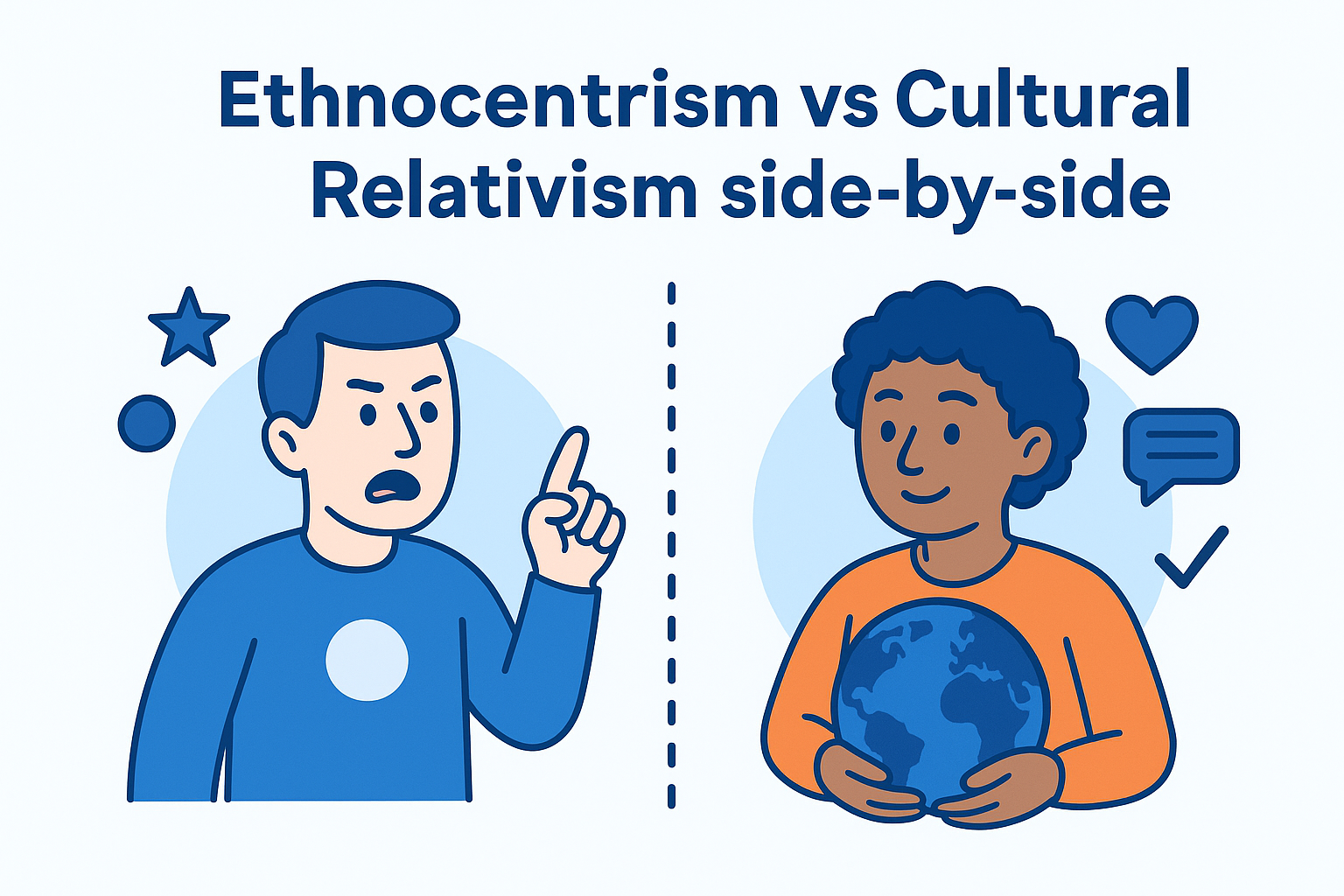
The framework you apply shapes every conclusion you draw.
Key distinctions at a glance
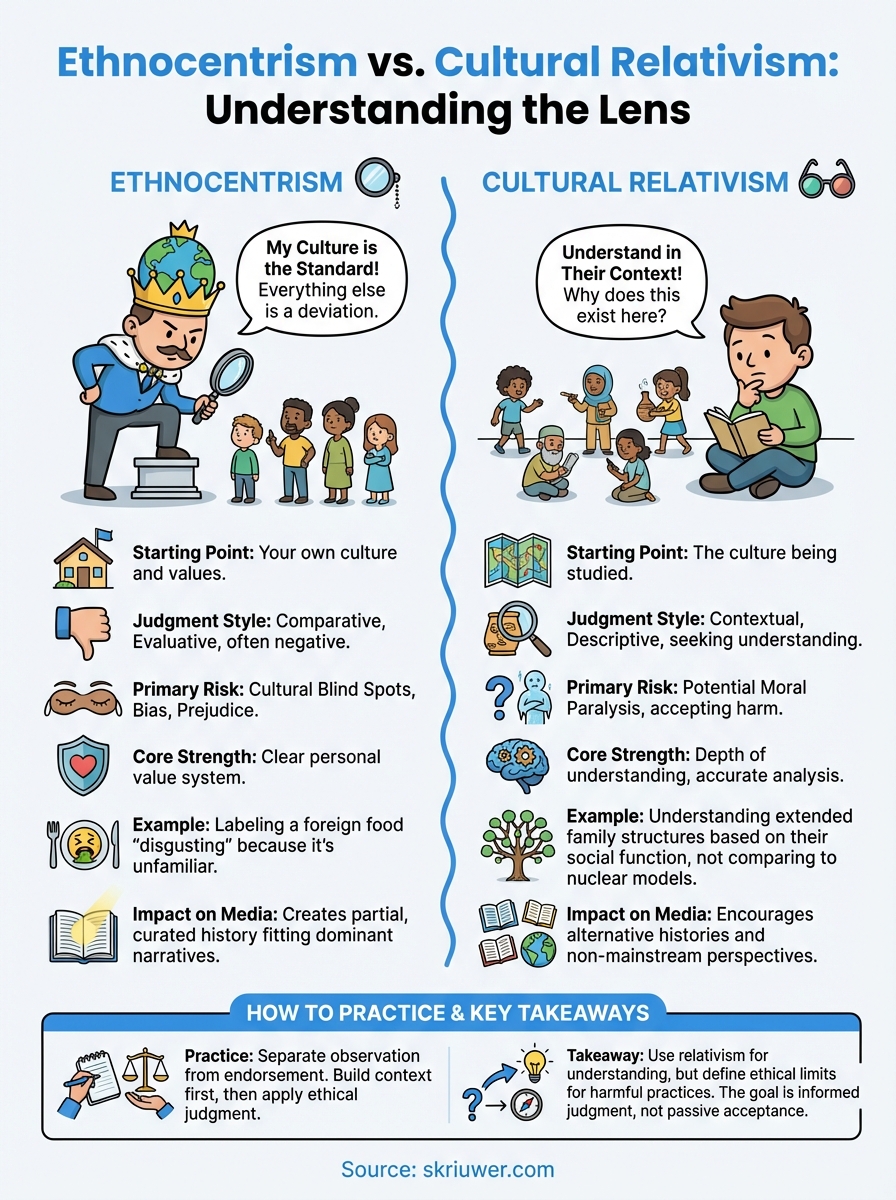
The table below maps the defining characteristics of each approach so you can see exactly where they diverge across several practical dimensions.
| Feature | Ethnocentrism | Cultural Relativism |
|---|---|---|
| Starting point | Your own culture as the standard | The culture being studied |
| Judgment style | Comparative and evaluative | Contextual and descriptive |
| Primary risk | Bias and cultural blind spots | Potential moral paralysis |
| Core strength | Clarity of personal values | Depth of understanding |
| Historical use | Colonial justification | Anthropological research |
Neither framework is entirely without fault. Ethnocentrism delivers a clear value system but closes off genuine understanding of people who operate on different premises. Cultural relativism opens that understanding but requires you to consciously draw ethical boundaries so the approach doesn't collapse into the position that all practices are equally acceptable by default. Serious researchers, historians, and critical readers tend to move between both positions depending on what the situation demands, using relativism to build understanding and personal ethics to form judgments when they're genuinely needed.
How to practice cultural relativism without harm
Cultural relativism is a practical tool, not a blank check. When you apply it thoughtfully in the ethnocentrism vs cultural relativism spectrum, you gather context before judging, which leads to sharper analysis and fewer blind spots. The challenge is knowing where to draw the line between understanding a practice and accepting harm.
Understanding a practice does not require you to approve of it.
Separate observation from endorsement
You can describe a practice accurately without endorsing every aspect of it. The goal is to build a complete picture first, then apply your ethical judgment from a position of informed understanding rather than cultural reflex. Anthropologists use this two-step method because conclusions formed without context tend to reflect bias more than truth.
Start by asking what purpose a practice serves within its own community, who benefits, and what historical conditions shaped it. Those questions don't erase your values; they strengthen your conclusions by grounding them in evidence rather than assumption.
Know where your ethical limits sit
Clear personal ethics act as a safeguard when relativism risks sliding into moral passivity. Practices that produce documented harm to individuals, particularly when those individuals have no meaningful choice in the matter, deserve scrutiny regardless of cultural context. You don't need to abandon relativism to reach that position.
Apply it fully and honestly: gather the context, weigh the evidence, then form your judgment from a position of genuine knowledge rather than instinct.
Key takeaways
The ethnocentrism vs cultural relativism debate comes down to one core question: do you judge other cultures by your own standards, or do you first try to understand them on their own terms? Both frameworks carry genuine strengths and real risks, and knowing when to apply each one makes you a sharper thinker and a more informed reader.
Ethnocentrism gives you a clear personal baseline but blinds you to the full picture. Cultural relativism builds depth and accuracy but requires you to set conscious ethical boundaries so it doesn't slide into passive acceptance of harm. The most useful position moves between both: use relativism to gather understanding, then apply your own values to form judgments grounded in evidence rather than reflex.
If you want to keep challenging comfortable narratives and exploring untold histories, browse the full catalog at Skriuwer's independent bookstore and find titles that push past mainstream filters.