
7 Ancient Religious Symbols and Meanings Across Cultures
A cross, a crescent, a coiled serpent, symbols like these carried deep spiritual weight long before they ended up on bumper stickers and jewelry. Ancient religious symbols and meanings have shaped how entire civilizations understood life, death, and the divine. Yet the original contexts behind many of these icons have been buried under centuries of reinterpretation, co-option, and selective storytelling by dominant cultures.
That gap between what we think a symbol means and what it actually meant is exactly the kind of territory we explore at Skriuwer. As an independent publisher specializing in overlooked history and cultural studies, we dig into the stories that mainstream sources tend to flatten or skip entirely. Religious iconography is a perfect example, rich, layered, and often misunderstood.
This article breaks down seven ancient religious symbols from traditions spanning Egypt, Celtic Europe, early Christianity, and beyond. For each one, you'll get a clear picture of its origins, its spiritual significance within its original culture, and how its meaning shifted over time. No surface-level listicle filler, just the deeper history these symbols deserve.
1. Ankh
The ankh is one of the most recognized ancient religious symbols, and the meanings attached to it stretch far beyond the simple "eternal life" tag most people apply. It looks like a cross with a loop at the top, and that compact shape carried substantial theological weight in ancient Egypt.
Where it comes from
Scholars trace the ankh back to the Early Dynastic Period, around 3100 BCE. Its exact origin is debated, with some researchers linking it to a sandal strap viewed from above and others connecting it to the knot of Isis or a stylized union of male and female principles. Whatever its precise beginning, by the time Egypt's first dynasties consolidated, the ankh was already fixed in religious imagery.
What it meant to ancient Egyptians
To ancient Egyptians, the ankh represented life itself, but not merely biological life. It captured the concept of eternal existence, the continuation of the soul through death and into the afterlife. Gods and pharaohs are repeatedly shown holding the ankh by its loop, extending it toward a person's nose or mouth as an act of granting divine breath.
The ankh did not simply mean "alive." It meant the full divine force that made existence possible across all realms.
How people used it in daily life and ritual
The ankh appeared on amulets worn by ordinary Egyptians seeking protection and divine favor. It also showed up on temple walls, papyrus scrolls, and royal burial goods as a constant reminder of the life force connecting humans to the gods. Priests carried it during rituals, and artisans carved it into objects placed inside tombs.
How to spot it and what it often gets confused with
The ankh features a teardrop or oval loop at the top of a standard cross shape. People frequently confuse it with the Christian cross, which has no loop, or the Venus symbol, which features a circle sitting above a cross without a lower vertical bar extending downward. The loop is the defining visual feature that sets it apart.
What modern uses get right and wrong
Modern jewelry and tattoo culture uses the ankh constantly, often as a general nod to Egyptian aesthetics. What you need to understand is that the symbol was tied to specific beliefs about divine breath and the afterlife, not a vague idea of positivity or good vibes. Respectful use means acknowledging that theological context rather than treating it as decoration stripped of meaning.
2. Eye of Horus
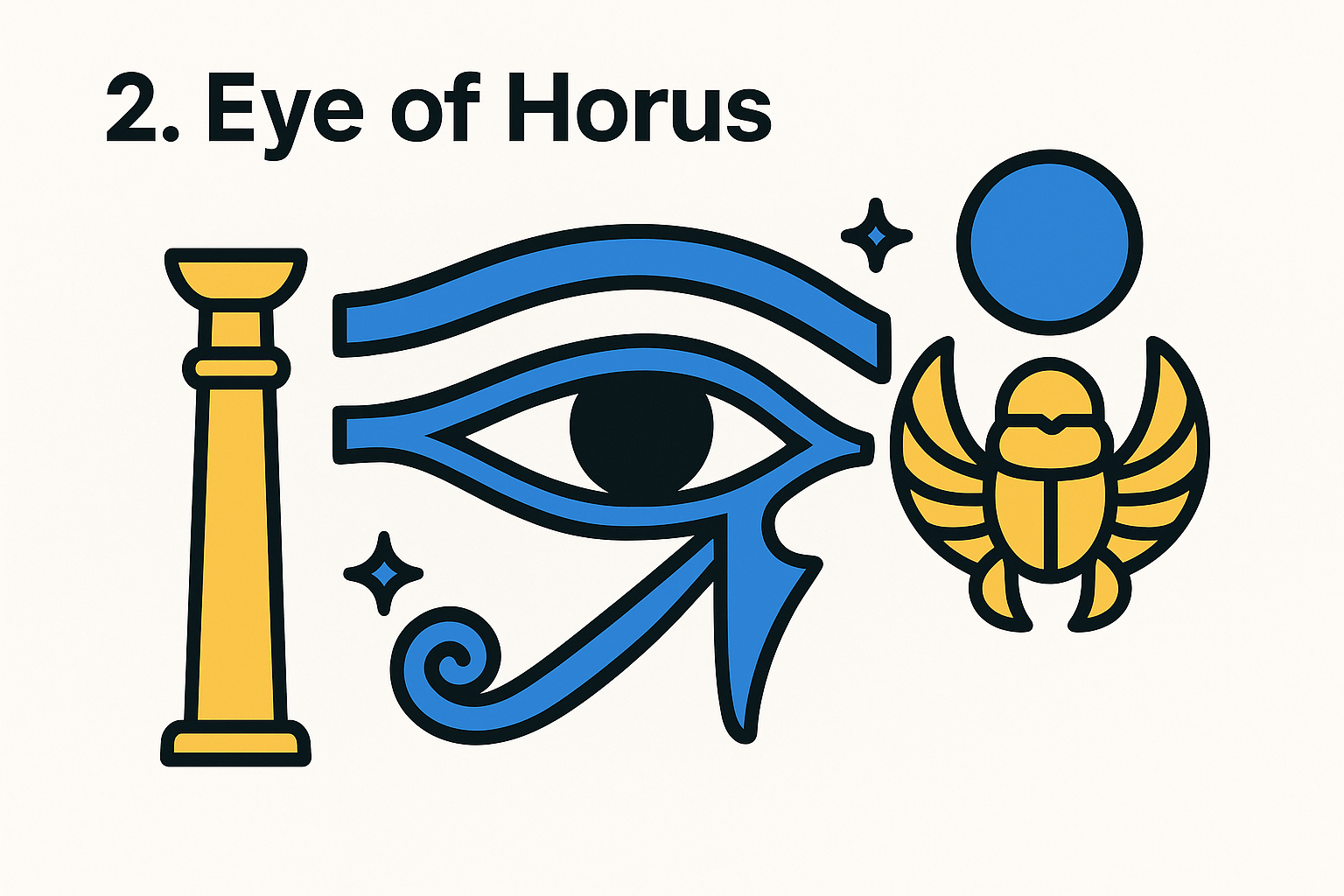
The Eye of Horus ranks among the most layered ancient religious symbols and meanings in Egyptian tradition. It carries mythological, protective, and healing significance that goes well beyond its modern use as a decorative motif.
The myth behind the symbol
In Egyptian mythology, Horus lost his eye in battle against Set, who had murdered Horus's father Osiris. The god Thoth fully restored the eye, making it a permanent symbol of miraculous healing and divine intervention within Egyptian belief.
Core meanings: protection, healing, restoration
The restored eye came to represent wholeness and protection. Egyptians called it the "wedjat," meaning whole or healthy, directly linking the symbol to completeness after catastrophic loss.
The Eye of Horus was not just a talisman. It was a theological statement about the power of restoration over destruction.
How Egyptians used it on objects, bodies, and tombs
Egyptians painted or carved wedjat amulets onto coffins, jewelry, and tomb walls. Sailors also painted it on boat prows to guard against unseen dangers at sea, extending its protective role into everyday life.
Eye of Horus vs Eye of Ra
If you study both symbols closely, you'll notice they look similar but carry opposite energies. The Eye of Ra represents the sun god's fierce, destructive power, while the Eye of Horus holds protective and restorative meaning rooted in mythological suffering and recovery.
Modern misconceptions and respectful use
Many people display the Eye of Horus as general mystical decoration, unaware of its specific mythological roots. Respectful engagement means treating the wedjat as a product of grief, war, and miraculous healing rather than just an ancient aesthetic.
3. Triskelion
The triskelion is one of the most visually striking ancient religious symbols and meanings in European history. Its three interlocking spirals radiate from a central point, creating a sense of motion that mirrors what the symbol represents.
Early appearances and Celtic context
The triskelion predates Celtic culture by millennia. The oldest known example is carved at Newgrange in Ireland, dating to around 3200 BCE, well before Celtic peoples arrived in the region. Celtic communities later adopted the symbol and carried it across Ireland, Scotland, and Brittany.
Common meanings: cycles, triads, motion
Most scholars link the triskelion to three-part cycles and perpetual motion. Common interpretations include:
- Life, death, and rebirth
- Land, sea, and sky
- Past, present, and future
The triskelion does not depict balance as a resting point. It depicts balance as something that only exists in motion.
How it showed up in art, stonework, and identity
You find the triskelion carved into burial mounds, metalwork, and shields across northwestern Europe. It served as both a spiritual marker and a cultural identity symbol for Celtic communities, appearing in sacred and secular contexts alike.
Similar triple symbols and how they differ
The triquetra uses three interlocked arcs without the rotational quality that defines the triskelion. Where the triquetra implies stability, the triskelion implies movement and a continuous cycle with no fixed start or end.
Modern revival use and common misreads
Modern Celtic revival movements use the triskelion widely. Many people treat it as generically Irish, skipping over its pre-Celtic origins at sites like Newgrange. That simplification flattens the symbol's actual historical depth considerably.
4. Torii gate
The torii gate is among the most recognizable ancient religious symbols and meanings tied to Japanese spiritual life. These distinctive threshold structures stand at Shinto shrines across Japan and appear in diaspora communities worldwide.
Shinto origins and what a torii marks
Torii connect directly to Shinto, Japan's indigenous spiritual tradition with roots predating written records. Each gate marks the boundary between ordinary space and sacred ground, functioning as a threshold rather than a barrier.
The exact origin of the form is debated, but its role as a territorial marker between human and divine space has stayed consistent across centuries of Shinto practice.
The meaning of crossing the threshold
When you walk through a torii, you signal your transition from secular to sacred space. That crossing is not merely physical but represents intentional entry into territory belonging to kami, the spiritual beings central to Shinto belief.
Passing through a torii is not a casual step. It marks a deliberate move from the everyday world into something set apart.
Common styles and where you see them
Torii appear in over a dozen recognized styles that vary in beam shape, color, and material. The most iconic use vermillion paint, though stone and unfinished wood versions are equally authentic across different shrine traditions.
- Myojin style: curved upper beam, most common at large urban and coastal shrines
- Shinmei style: straight horizontal beams, associated with older, plainer shrine traditions
How torii relate to purification and sacred space
These gates reinforce a broader purification framework present at most Shinto shrines. Their placement works alongside ritual hand-washing stations, collectively signaling that approaching the sacred requires preparation.
The torii marks where that preparation begins, making it as much a practical spiritual tool as a visual symbol.
Tourism, photos, and etiquette basics
When you visit a shrine, bow briefly before passing through a torii as a basic mark of respect. Keep to the side rather than the center path, which tradition reserves for kami rather than human visitors.
Photography is generally accepted, but avoid lingering in the gateway itself during active worship or ceremonies happening nearby.
5. Faravahar
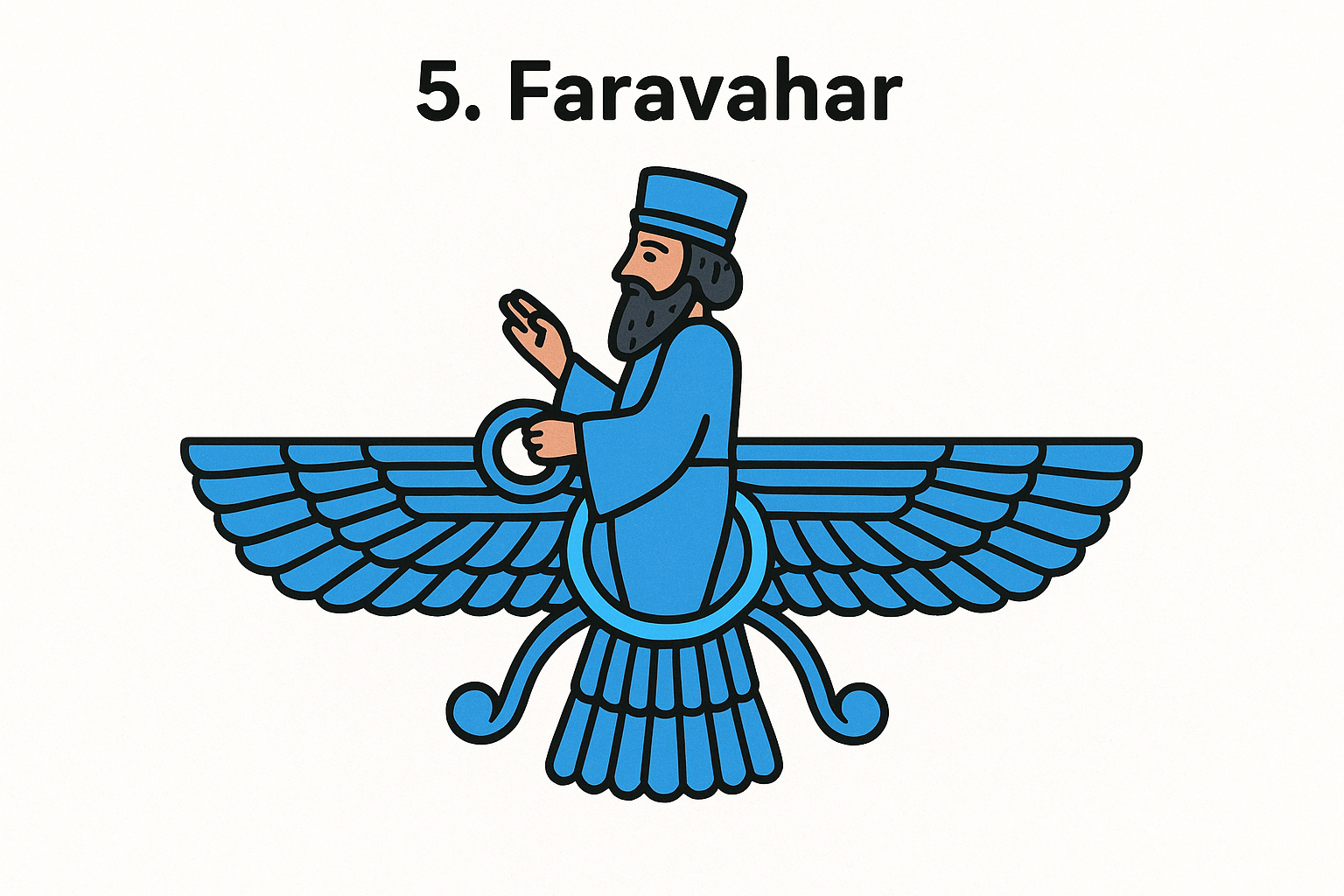
The Faravahar stands out among ancient religious symbols and meanings for how precisely its visual design encodes a complete theological worldview. Every element carries deliberate spiritual meaning rooted in Zoroastrianism, one of the world's oldest monotheistic traditions.
Zoroastrian roots and historical backdrop
Zoroastrianism emerged in ancient Iran, founded by the prophet Zarathustra, with scholarly estimates placing its origins between 1500 and 1000 BCE.
The Achaemenid Persian Empire became its most prominent state sponsor, and Faravahar imagery filled royal inscriptions and palace carvings at sites like Persepolis.
What the figure and elements symbolize
The Faravahar depicts a bearded male figure rising from a winged disc. The wings represent righteousness, the tail feathers represent rejection of evil, and the central ring symbolizes the eternal nature of the soul. The three feather layers correspond to the core Zoroastrian triad: good thoughts, good words, and good deeds.
Each visual layer in the Faravahar is a lesson, not decoration.
How it functioned as an emblem in Persian culture
Persian rulers placed the Faravahar on palace facades, royal seals, and official inscriptions to project divine authority and moral legitimacy. It served simultaneously as both a religious statement and a political symbol, reinforcing the ruler's claim to divine sanction.
Debates and variation in interpretation
Some scholars argue the figure represents Ahura Mazda, the supreme deity of Zoroastrianism, while others interpret it as the fravashi, the guardian spirit of an individual soul.
That distinction shapes how modern Zoroastrian practitioners understand the symbol's personal versus cosmic significance in contemporary worship.
How to use the symbol thoughtfully today
If you display the Faravahar, acknowledge its living religious context rather than treating it as a historical artifact.
The symbol remains actively sacred to Zoroastrian communities worldwide, particularly among Iranian diaspora populations who carry it as a marker of both faith and cultural identity.
6. Ichthys
The Ichthys is among the most quietly powerful ancient religious symbols and meanings in early Christian history. This simple fish outline served as a covert signal among believers living under Roman persecution, making it both a spiritual emblem and a practical survival tool.
Early Christian context and why it spread
Early Christians adopted the fish symbol during active Roman persecution, roughly spanning the first through third centuries CE. Because public worship carried real risk, believers needed a way to identify one another without attracting official attention.
The meaning of the fish and the Greek acronym
The Greek word for fish, "ichthys," doubled as an acronym spelling out "Iesous Christos Theou Yios Soter," translating to Jesus Christ, Son of God, Savior. That compression turned a simple drawing into a complete doctrinal statement.
The fish was not randomly chosen. It embedded an entire confession of faith into a single image that looked harmless to outside observers.
Where it appeared: catacombs, seals, carvings
Believers scratched the Ichthys into catacomb walls, funerary markers, and personal seals throughout the Roman Empire. Its compact shape made it easy to mark quickly in stone or draw in sand during covert gatherings.
How it differs from other early Christian marks
Unlike the cross, which gained public prominence after Constantine legalized Christianity in 313 CE, the Ichthys operated as a pre-legalization identifier designed specifically for concealment. The cross projected authority openly; the fish worked precisely because it did not.
Modern use and common misunderstandings
Today the Ichthys appears on car emblems and jewelry worldwide, often without any awareness of the Greek acronym behind it. Most people display it as a general faith marker, disconnected from the dangerous historical context that originally gave the symbol its urgency.
7. Dharmachakra
The Dharmachakra, or Wheel of Dharma, stands among the most doctrinally precise ancient religious symbols and meanings in Buddhist tradition. Its circular form carries a teaching so complete that scholars consider it a visual summary of the entire Buddhist path.
Buddhist origins and early Indian context
The Dharmachakra traces back to Sarnath, India, where the Buddha delivered his first teaching after achieving enlightenment, an event called the "first turning of the wheel." Early Buddhist art at sites like Sanchi depicted the wheel long before human figures of the Buddha appeared in sculpture.
What the wheel represents in Buddhist teaching
The wheel represents the ongoing spread of dharma, the Buddha's teachings moving outward through time and culture. Rotation symbolizes that the teaching never stops and continues reaching new people across generations.
The wheel does not depict a moment. It depicts a process that has no fixed endpoint.
Key parts: spokes, hub, rim, and what each implies
Each structural element carries specific doctrinal weight. The spokes typically number eight, representing the Noble Eightfold Path. The hub stands for moral discipline, and the rim holds the structure together, symbolizing mindfulness that sustains practice.
Where it appears: art, architecture, national symbols
You find the Dharmachakra carved into Ashoka's pillars across India and woven into the national flag of India as its central emblem. Buddhist temples across Southeast and East Asia display it at entrances and above shrine rooms.
Misuse, appropriation, and respectful display
When you use this symbol outside a Buddhist context, treat it as a living religious emblem rather than a design choice. The Dharmachakra remains central to active Buddhist worship globally, and casual commercial use strips away doctrinal meaning that practitioners consider sacred.
Where to go next
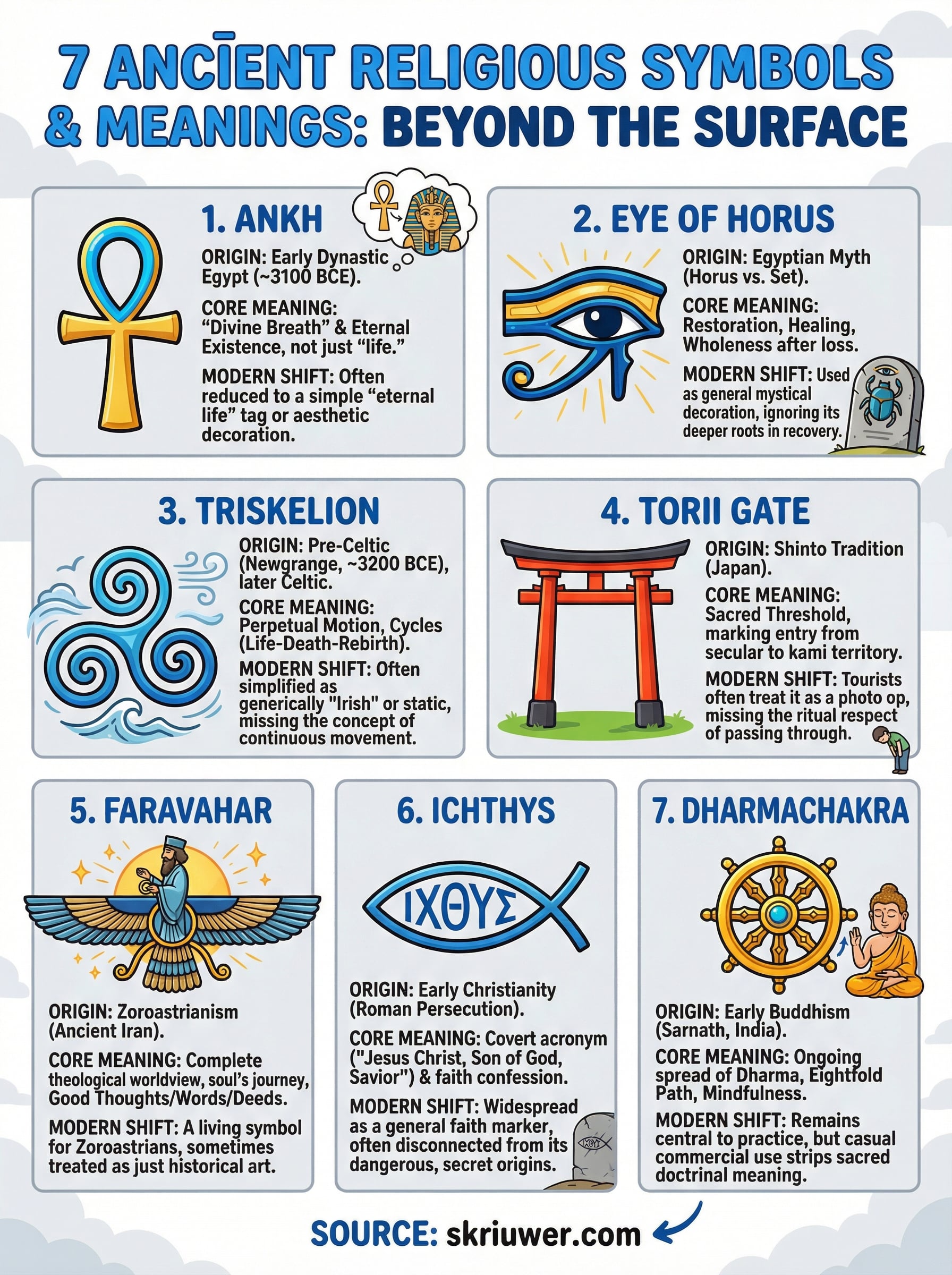
These seven symbols represent only a fraction of what ancient religious symbols and meanings reveal about how human cultures have understood the sacred. Each one started in a specific community, with a specific theological purpose, and traveled through time collecting layers of reinterpretation along the way. Understanding that journey matters more than simply recognizing a shape.
If this kind of historical depth interests you, you are exactly the reader we publish for at Skriuwer. Our catalog covers overlooked history, cultural studies, and religious traditions that mainstream publishers tend to simplify or skip. Every title we carry is chosen because it adds something that surface-level sources leave out.
Browse our full collection and find books that treat history and culture with the seriousness they deserve at Skriuwer's independent bookstore. Whether you are deepening your knowledge of ancient traditions or starting fresh, there is something in the catalog worth your time.
Recommended Reading
Interested in the spiritual and cultural foundations of ancient civilizations? These books are for you:
- The History of Christianity: Birth to Medieval Influence – Trace the origins and evolution of one of the world's major religions.
- Greek Mythology Book For Adults – Discover the myths that shaped ancient Greek religion and culture.
- Norse Mythology Book For Adults – Explore the rich spiritual traditions of the Norse world.